
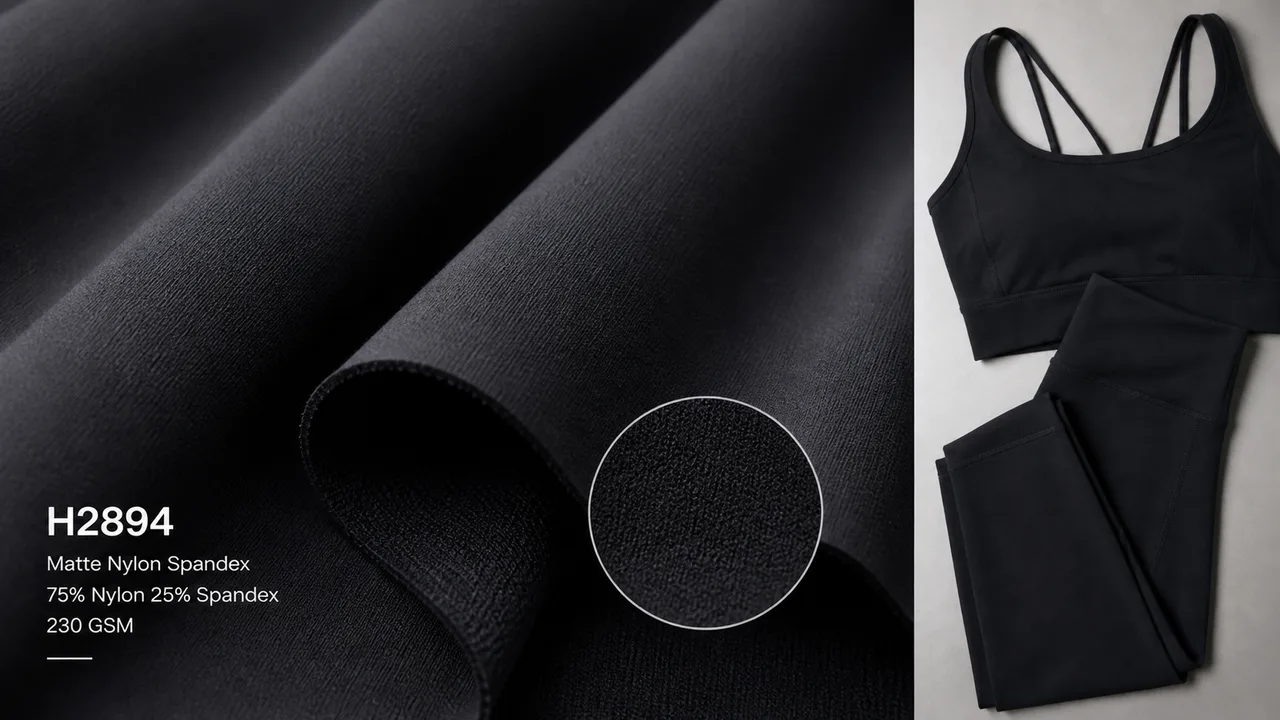
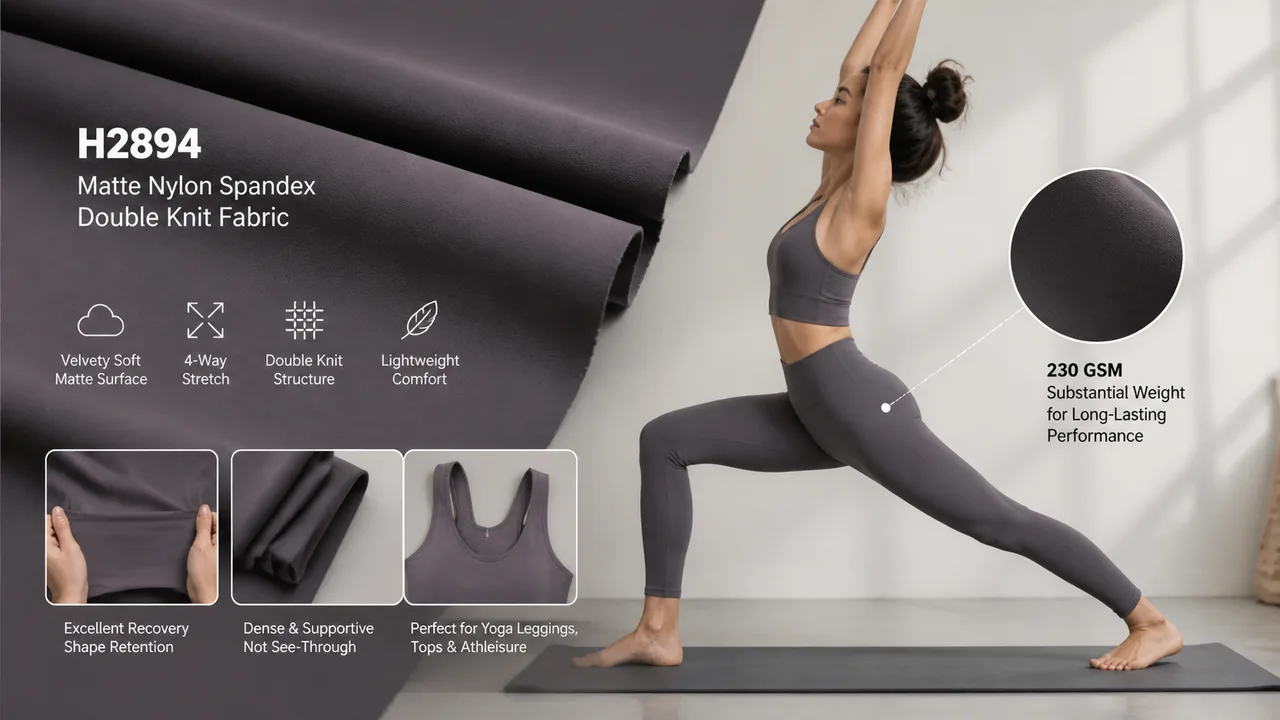
H2894 is a candidate for matte, close-fitting activewear, not a substitute for garment testing. ClothFactory’s catalogue lists a double-knit construction at 75% nylon, 25% spandex, 230 g/m² and 165 cm width. These are nominal catalogue specifications; a purchase order needs an agreed technical sheet, tolerances and an approved sample revision. The buying decision is whether the fabric delivers the required coverage, support and appearance in the intended pattern.
Start with the garment, not the spandex percentage
A fitted yoga legging and a relaxed athleisure top place different demands on the same fabric. A legging stretches across the seat and knee, where loop opening can expose underwear contrast. A top may remain relatively unstretched but show seam ridges, cling or excessive weight. Approving H2894 for one style does not approve it for the whole collection.
Spandex content describes composition, not compression pressure or recovery after repeated wear. Two fabrics with the same percentage can require different forces to reach the same extension because yarn specification, stitch geometry and finishing differ. Ask for lengthwise and widthwise force-extension data, residual extension after recovery, and the test conditions. ISO 20932-1 provides strip-test methods for fabric elasticity; the buyer must still define the garment-relevant acceptance criteria.
Separate a matte appearance from squat coverage
A low-lustre surface can support a restrained visual finish, but it does not establish opacity. Evaluate each production colour at the extension created by the actual garment, with agreed lighting, backing contrast and viewing positions. Include the lightest colourway and the most highly strained fit in the size range rather than approving every colour from a black swatch.
For an illustrative fit calculation, a fabric panel measuring 80 cm around a body circumference of 100 cm has 20% negative ease relative to the body, but must extend 25% relative to its own relaxed length: (100 − 80) ÷ 80 × 100. That distinction matters when specifying a stretched coverage assessment. A finished garment distributes strain unevenly, so the calculation is a starting point, not a replacement for a squat and movement trial.
Approve the surface and the assembly together
Compare face and reverse against a retained standard before and after the intended care sequence. Brushing, friction from a bag strap and repeated contact at the inner thigh can change appearance without causing a hole. Specify an appropriate pilling or abrasion assessment and inspect shade, surface fuzz and seam visibility on the finished sample.
Run a sewing trial with the intended seam type, thread and machine settings. Record the needle system and size, stitch density, feed settings and any heat-transfer conditions that produced an acceptable result. A universal needle number or fixed stitch length is not a reliable production instruction. Check skipped stitches, needle damage, seam extension and seam recovery after laundering; a fabric that stretches well can still fail as an assembled garment.
Translate the quoted price into usable garment cost
At the nominal 230 g/m² and 1.65 m full width, theoretical mass is 230 × 1.65 ÷ 1,000 = 0.3795 kg per linear metre, or approximately 2.64 m/kg. This is a conversion at the stated dimensions, not guaranteed cutting yield. Confirm whether the quote uses full or usable width and whether edges, defects and relaxation reduce the marker area.
A lower price per kilogram may lose its advantage if the fabric needs lining, produces fewer panels per marker or requires additional seam correction. Compare qualified alternatives using actual marker consumption and the cost of the approved construction. Do not count the same cutting loss both in marker consumption and in a second waste allowance.
Set a release gate before committing to bulk
The approval record should identify the fabric revision, colour, finished weight, minimum usable width, care procedure, elasticity conditions and garment coverage standard. Attach the approved garment and a retained fabric cutting to that record. Agree how a shade, construction or finish change triggers reapproval.
H2894 belongs on the shortlist when a matte double-knit appearance and close-fitting silhouette match the brief. Hold the order if coverage depends on an untested colour, recovery is described only as “four-way stretch,” or the bulk finish differs from the sample. A premium collection needs repeatable production evidence, not a stronger adjective on the specification sheet.