
Buyers should interpret an opacity result only when the test method, fabric color, backing, conditioning, measurement geometry, and stretch state are stated. A high relaxed opacity value does not prove that leggings, sports bras, or shapewear will remain covered when the fabric is stretched, wet, or assembled into a garment.
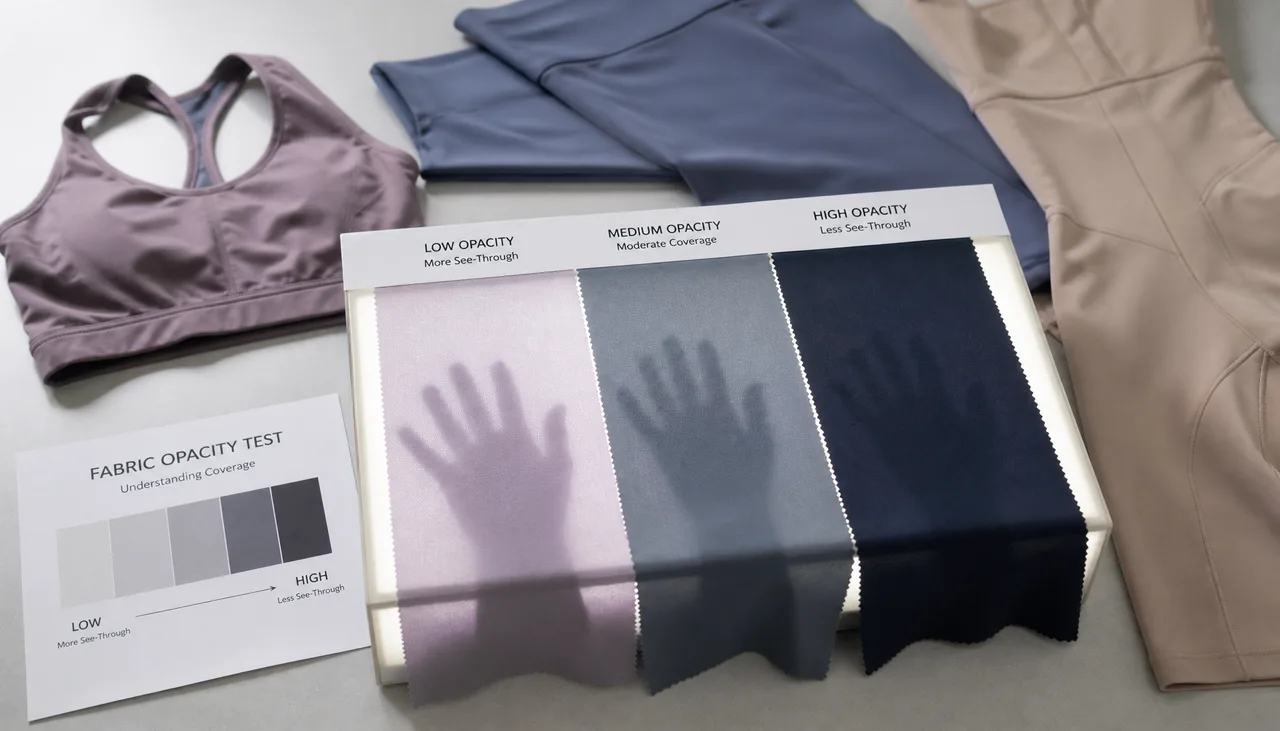
Confirm what the reported number represents
“Opacity,” “light transmission,” and “coverage” are related but not interchangeable terms. An opacity value generally increases as less light is visible through the specimen, while a transmission value moves in the opposite direction. The report must define the measured property and calculation; buyers should not assume that opacity is simply 100% − transmission unless the stated method uses that relationship.
Before comparing two reports, confirm:
- the test method and instrument;
- illumination and detector geometry;
- backing color or reference standard;
- specimen color and dye lot;
- aperture size and number of readings;
- conditioning and wet or dry state;
- whether the fabric was relaxed or extended;
- extension direction and percentage.
Results produced under different conditions may describe different optical behavior even when both documents use the word “opacity.”
Evaluate opacity at the garment's working extension
Activewear fabrics open between loops and become thinner when stretched. This can expose the wearer or a contrasting underlayer even when the relaxed swatch appears opaque. The buyer should therefore define the extension expected at the seat, thigh, knee, bra cup, or shapewear panel and request measurements or visual assessments at that condition.
Illustrative calculation — not a ClothFactory test result: assume a 100 mm fabric section is extended to 150 mm in one direction while the other dimension remains unchanged. Its area increases by 50%:
150 mm ÷ 100 mm = 1.50
The same fabric mass is then distributed across approximately 1.5 times the original area, so the mass per projected area becomes about:
1 ÷ 1.50 = 0.667, or 66.7% of the relaxed value.
This simplified geometry explains why coverage can fall under extension, but it does not predict the final opacity value. Loop deformation, yarn shape, fabric thickness, color, and finishing change the optical response and must be measured on the actual sample.
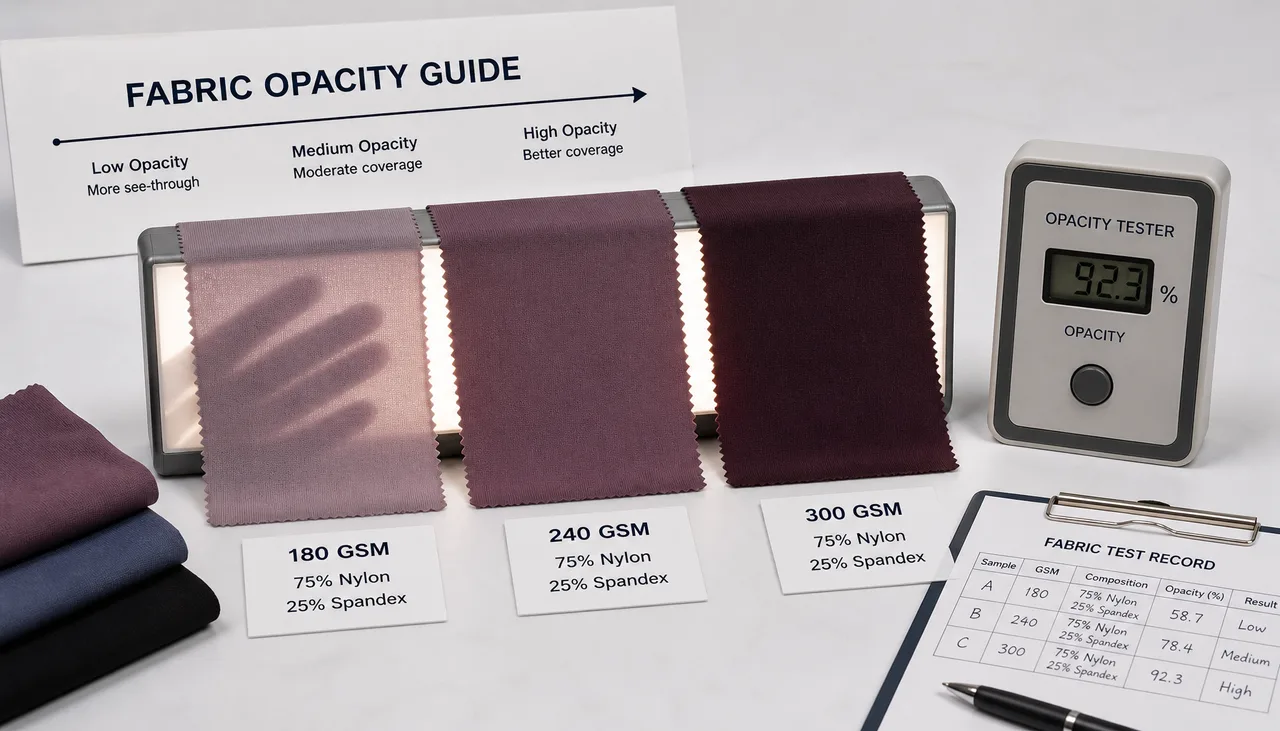
Compare color, construction, and finish separately
The same knit construction can produce different opacity results across colors. Dark shades often mask contrast differently from pale or bright shades, but no color should be accepted by assumption. Test the commercially important shades or define a risk-based color plan that includes the shades most likely to show contrast.
GSM, thickness, yarn size, knit density, and surface finish all influence coverage, but none is a standalone guarantee. A higher-GSM fabric can still become visibly open under stretch, while a lower-GSM construction may maintain coverage through tighter loop geometry or different yarn selection. Compare the finished fabric, not just nominal composition or greige specifications.
If moisture-management, brushing, heat setting, or another finish is applied, repeat the relevant opacity assessment after the production finish and agreed wash cycle. An optional finish should not be described as a default property of every color or order.
Match the test to the activewear application
| Application | Critical viewing condition | Additional approval check |
|---|---|---|
| Yoga leggings | Seat and thigh at the intended garment extension | Squat and bend assessment on the correct size, color, and underlayer |
| Compression shorts | Sustained extension across seat and upper leg | Recovery, seam distortion, and coverage after laundering |
| Sports bras | Cup and side panel over the intended lining or skin-tone contrast | Coverage at extension, moisture exposure, and seam placement |
| Shapewear | High-extension control zones | Local thinning, panel transitions, comfort, and residual growth |
| Lightweight training tops | Back and shoulder during movement | Wet-state appearance, air permeability, and body-side contrast |
Laboratory readings help control material consistency. A garment trial confirms whether pattern dimensions, seam placement, panel orientation, lining, and wearer movement create an acceptable result. Neither step should replace the other.
Define acceptance against a reference, not a universal number
There is no single opacity percentage that is correct for every activewear product. Buyers should establish an approved reference fabric or garment and record the conditions under which it passes. The bulk requirement can then specify the same method, shade group, extension, backing, conditioning, and tolerance.
A practical approval record should include:
- fabric code, composition, knit construction, finished GSM, and usable width;
- color and dye-lot identity;
- relaxed and extended test conditions;
- numerical results with individual readings, not only an average;
- an approved visual reference where appearance matters;
- wash or wet-state checks required by the product brief;
- the action required when a lot falls outside tolerance.
Individual readings matter because an average can hide local variation caused by barre, uneven density, finishing variation, or specimen selection.
Avoid common interpretation errors
- Comparing percentages from different methods. Matching units do not make the results equivalent.
- Approving only the relaxed fabric. Coverage can change materially at the garment's working extension.
- Using GSM as an opacity guarantee. Weight does not describe loop opening, thickness, or color contrast.
- Testing one shade for the complete range. Color and dyeing conditions can change perceived and measured coverage.
- Ignoring the backing. A white, black, or skin-tone backing can produce a different visual conclusion.
- Relying only on a squat photo. Camera exposure, lighting, underwear color, pose, and image processing make uncontrolled photos difficult to compare.
- Treating fabric data as a garment result. Pattern strain, seams, panels, and sizing affect final show-through.
Information to request from the supplier
Ask for the full opacity report, not a single percentage copied into a product sheet. The report should identify the sample, method, instrument conditions, color, backing, specimen state, extension, number of readings, and result range. Send the supplier the garment application, target fit, expected extension, shade plan, lining or underlayer, care cycle, and approved reference.
ClothFactory can use those conditions to compare nylon-spandex or polyester-spandex candidates and prepare matched samples. Bulk approval should remain tied to the agreed test setup and garment verification rather than to an isolated opacity claim.