
Buyers should test stretch and recovery with the fabric direction, load or extension, cycles, hold time, recovery time, conditioning, and wash history fixed in advance. Maximum stretch alone is not enough: activewear fit also depends on force at garment extension and residual growth after release.
Define the measurements separately
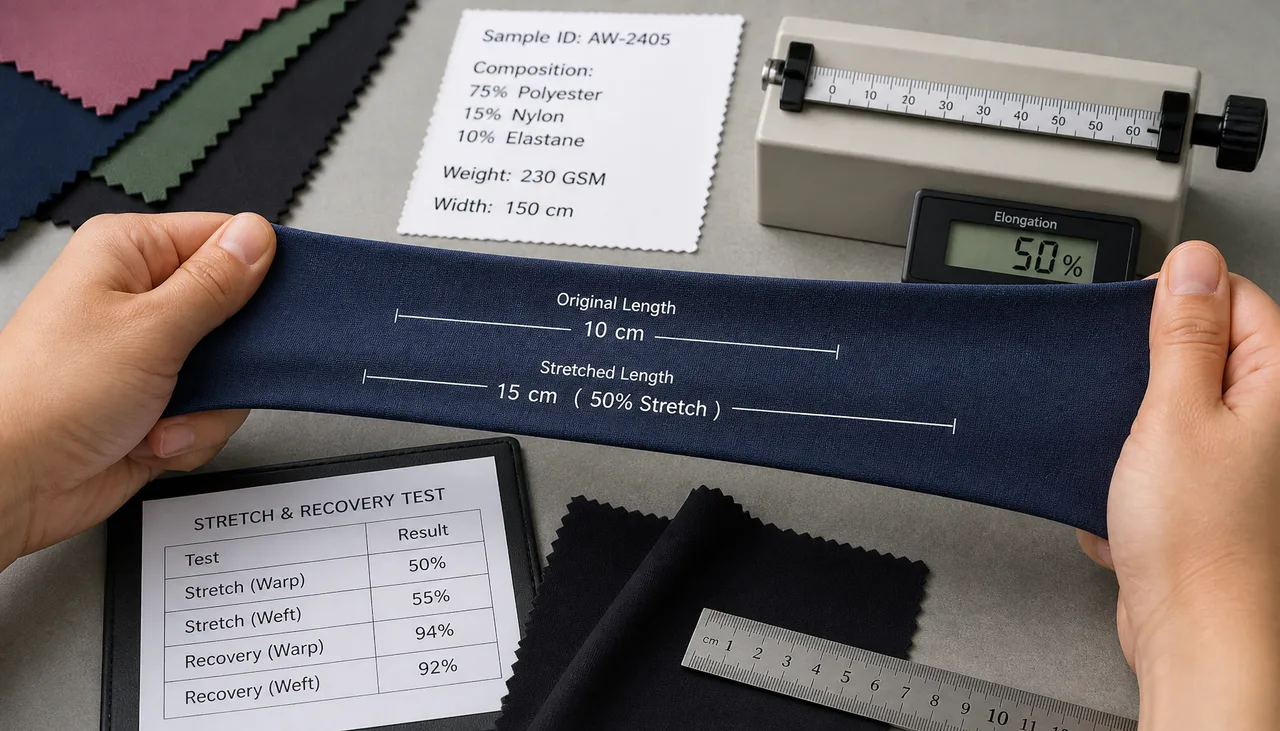
Stretch describes how far a specimen elongates under a stated condition. Recovery describes how closely it returns after the load is removed. Residual growth is the extension that remains after a stated recovery period. A fabric can reach a high extension and still recover poorly.
For an extension-based calculation:
Stretch (%) = (extended length − initial length) ÷ initial length × 100
The report must state the initial gauge length and how the extended length was produced. Results from different loads, specimen sizes, or hold times cannot be compared directly.
Test the directions used by the garment
Knitted fabrics may behave differently along the course and wale directions. Test both when pattern pieces use both, and record panel orientation. For leggings, sports bras, and fitted tops, define the extension expected at critical body zones so the laboratory result can be connected to the pattern.
A material may stretch easily but provide too little support, or require excessive force at normal wear extension. If support matters, compare force at a specified extension in addition to maximum stretch and recovery.
Use one procedure for every candidate
Keep these variables consistent:
- specimen direction, size, and gauge length;
- conditioning temperature and humidity where specified;
- applied load or target extension;
- loading cycles and speed;
- hold and recovery times;
- wash and drying procedure;
- calculation and reporting units.
Hand stretching can identify obvious differences but cannot establish a purchase tolerance. Use matched specimens and documented conditions for supplier comparisons.
Include washing and garment validation
Washing can relax the knit, change dimensions, or alter a finish. Measure dimensional change separately, then repeat stretch and recovery after the defined care cycle. Do not mix shrinkage with extension by reusing an uncontrolled marked length.
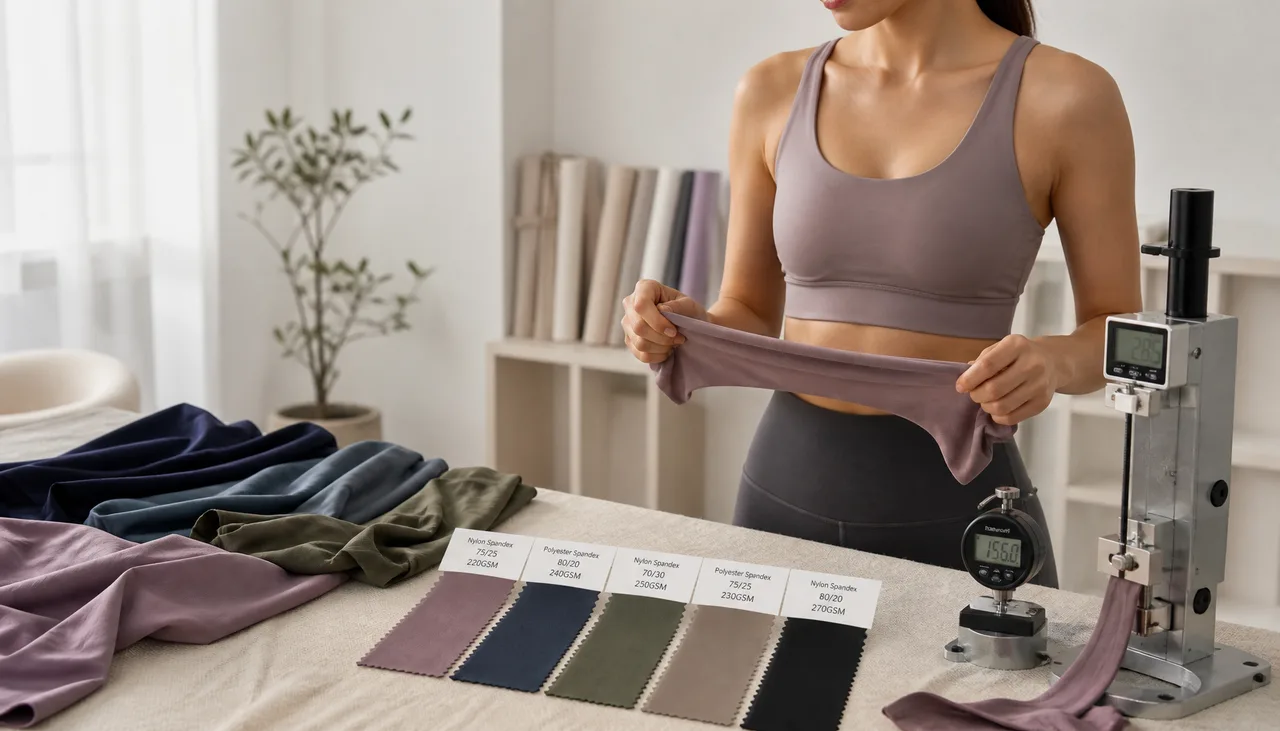
The final garment sample should confirm waistband hold, knee and elbow recovery, seam appearance, dressing effort, and comfort. Pattern reduction, elastics, lining, and seams can change fit even when the fabric passes its laboratory limit.
Interpret common result patterns
| Result | Likely procurement concern |
|---|---|
| High stretch, high residual growth | Bagging or loss of shape after movement |
| Low stretch at the required load | Restrictive fit or excessive seam stress |
| Acceptable recovery before wash but poor after wash | Care-cycle instability |
| Large difference by direction | Panel-orientation and fit imbalance risk |
| Wide specimen variation | Lot, conditioning, construction or method inconsistency |
There is no universal pass value for every activewear garment. Set limits from the fit, support level, construction, care route, and approved garment sample.
Procurement next step
Give the supplier the garment type, critical body-zone extension, panel direction, target force or support, care cycle, and reporting method. Request identified swatches and matched pre- and post-wash data, then validate the selected fabric in a fitted garment before bulk approval.