
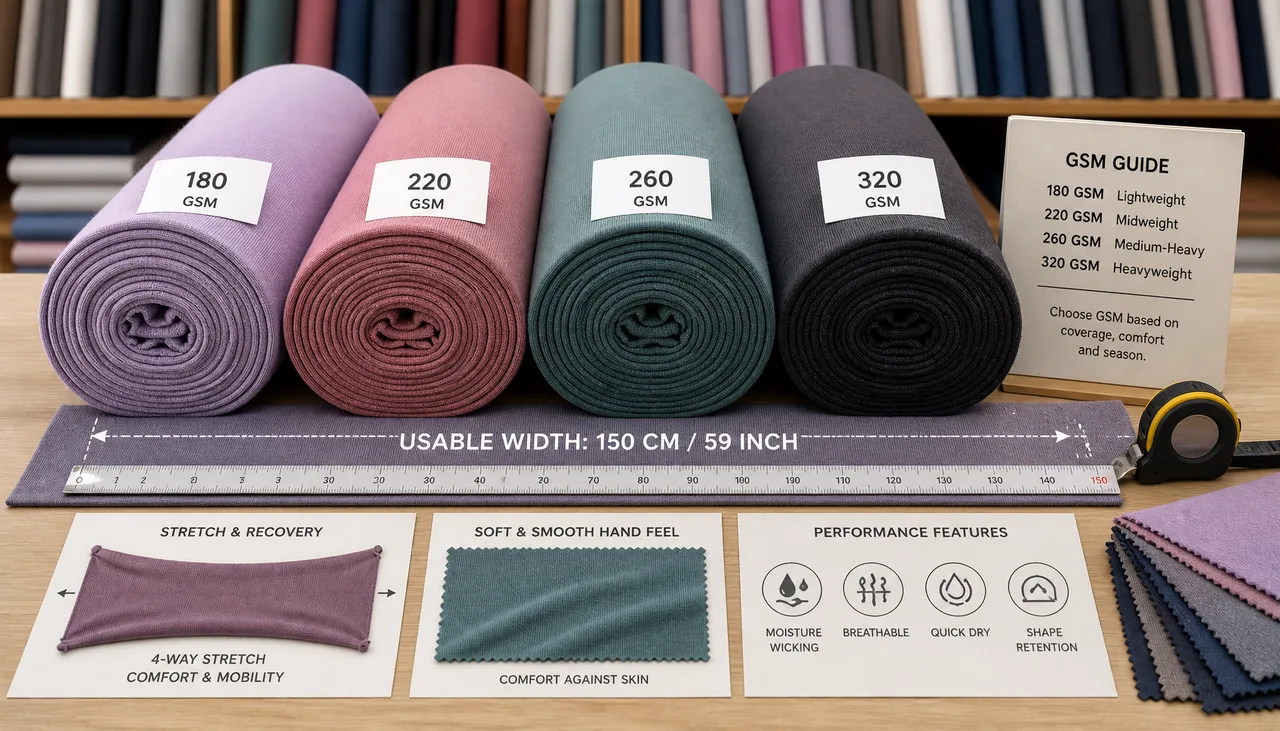
Brands should choose GSM from the dress's target weight, coverage, drape, stretch, and layering requirements, then choose usable width from an actual marker rather than the supplier's nominal full width. The two specifications must be evaluated together because GSM affects garment mass while usable width affects linear-meter consumption, cutting yield, and panel placement.
Define the dress construction before selecting fabric
An athleisure dress may be a fitted single-layer style, a loose travel dress, or a performance design with an inner bra, shorts, mesh panels, or lining. Each construction places different demands on the main fabric.
Before requesting samples, record:
- dress silhouette and finished length;
- fitted and relaxed garment zones;
- whether shorts, cups, lining, or pockets are built in;
- target drape, compression, coverage, and hand feel;
- climate and intended activity;
- pattern orientation and required stretch direction;
- target garment weight and care cycle.
A fitted dress may need stronger recovery and coverage at the seat and bust. A loose silhouette may prioritize drape and low bulk. These decisions should come before a GSM range is placed on the specification.
Use GSM to control mass, not to predict every performance property
GSM measures fabric mass per square meter. It helps buyers estimate garment weight and compare constructions, but it does not independently determine thickness, opacity, breathability, recovery, or durability. Yarn size, loop geometry, knit density, fiber blend, color, and finishing can make two fabrics with the same GSM behave differently.
| Design requirement | How GSM contributes | What still needs verification |
|---|---|---|
| Lightweight movement | Lower mass may reduce garment weight and bulk | Coverage, cling, recovery, and seam stability |
| Fitted coverage | Additional mass may support cover in some constructions | Appearance at working extension and in pale colors |
| Structured drape | GSM affects weight and hang | Knit structure, thickness, finishing, and pattern shape |
| Repeated wear | GSM forms part of the construction | Pilling, abrasion, recovery, and dimensional stability |
| Warmth or cooling | Mass can influence the wear experience | Air permeability, moisture behavior, layering, and garment design |
Approve the finished, dyed fabric rather than transferring a GSM conclusion from a different construction or greige sample.
Estimate garment mass from the pattern area
The net fabric mass in a garment can be estimated as:
Net fabric mass (g) = pattern area (m²) × GSM (g/m²)
Illustrative calculation — not ClothFactory order data: assume the net pattern area for the main dress fabric is 1.25 m². At 200 gsm:
1.25 m² × 200 g/m² = 250 g
At 240 gsm, the same pattern area contributes approximately 300 g, an increase of 50 g before thread, trims, cups, lining, and accessories. This calculation helps the buyer compare garment mass; it does not prove that the heavier option has better coverage or durability.
Specify usable width, not only nominal width
Nominal or full width may include selvedges, unstable edges, pin marks, coating variation, or other areas that cannot be placed inside the marker. Usable width is the consistently cuttable width of the finished, relaxed fabric.
Ask the supplier to state:
- nominal full width and guaranteed usable width;
- measurement condition and relaxation time;
- whether width is open, tubular, or measured after slitting;
- width tolerance within and between rolls;
- usable width after the agreed wash or relaxation procedure;
- stretch direction and any edge-to-center performance variation.
The usable-width guarantee should refer to the same finished construction, color, and process used for bulk production.
Calculate consumption with marker efficiency
A simplified area-based estimate is:
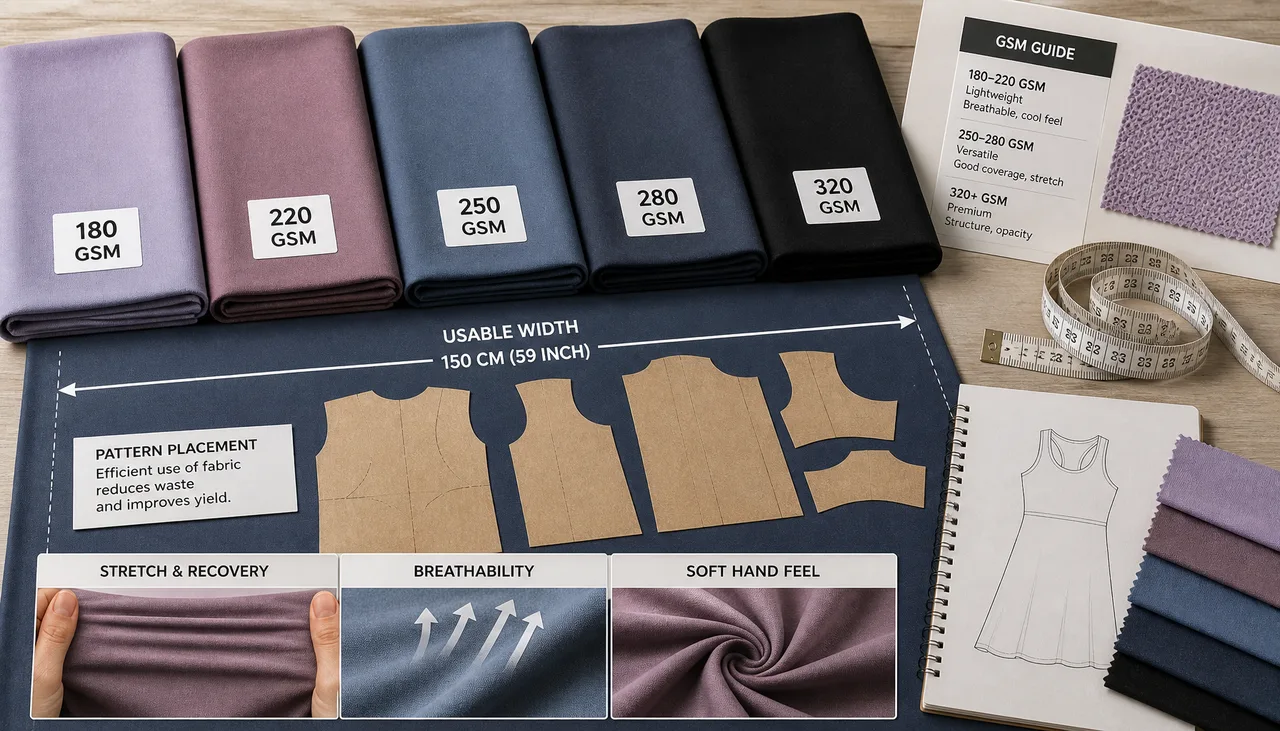
Linear consumption (m) = net pattern area (m²) ÷ [usable width (m) × marker efficiency]
Illustrative calculation — not a production marker: assume a 1.25 m² net pattern area and 82% marker efficiency.
At 1.45 m usable width:
1.25 ÷ (1.45 × 0.82) = 1.05 m per dress
At 1.55 m usable width:
1.25 ÷ (1.55 × 0.82) = 0.98 m per dress
The simplified difference is approximately 0.067 m per dress, or about 337 m across 5,000 dresses. Actual consumption may differ because pattern shapes, sizes, stripe direction, nap, one-way placement, stretch orientation, defects, and order ratios affect the marker. Use CAD markers for commercial approval.
Check whether the wider fabric really improves yield
A wider roll does not automatically reduce cost. The extra width may be unusable if major panels cannot be nested across it, if stretch direction conflicts with pattern orientation, or if the edges fail coverage or recovery requirements. Wider fabric can also increase kilograms per linear meter, which affects quotations expressed by weight.
Compare each candidate using the same size ratio and marker rules. Record usable width, marker efficiency, meters per garment, fabric price basis, and expected cutting loss. This provides a more reliable comparison than price per kilogram or price per meter alone.
Approve GSM and width under matched conditions
For each candidate fabric:
- identify composition, knit construction, finish, color, and fabric face;
- condition and relax the sample under the agreed procedure;
- measure GSM at distributed positions rather than from one specimen;
- measure usable width at several positions along the sample or roll;
- check stretch and recovery in the pattern directions;
- create the intended marker using the guaranteed usable width;
- make a garment sample and assess weight, drape, coverage, fit, and seams;
- repeat the relevant checks after the agreed care cycle;
- place GSM, usable width, tolerances, and inspection rules in the bulk specification.
Avoid common sourcing errors
- Choosing GSM from a generic product category. Dress construction and fit determine the requirement.
- Treating GSM as thickness or opacity. These properties must be checked separately.
- Using full width in the marker. Selvedges and unstable edges may not be cuttable.
- Assuming wider always means lower consumption. Pattern geometry and stretch direction control the real yield.
- Comparing price per kilogram without converting yield. GSM and width change meters per kilogram and garments per roll.
- Approving only one color. Dyeing and finishing may change GSM, width, hand, and coverage.
- Leaving tolerances undefined. Nominal values do not establish roll- or lot-level acceptance.
Information to send with the sample request
Provide the supplier with the dress sketch, pattern or preliminary marker, size ratio, net pattern area, target garment weight, fit, stretch direction, color, finish, care cycle, and required performance tests. Request the finished GSM, guaranteed usable width, tolerances, and matched sample identification.
ClothFactory can use that brief to compare nylon-spandex or polyester-spandex candidates and determine whether an existing base fabric or a development option better supports the dress. Final approval should use a production-representative fabric sample, an actual marker, and a garment fitting rather than GSM or width alone.