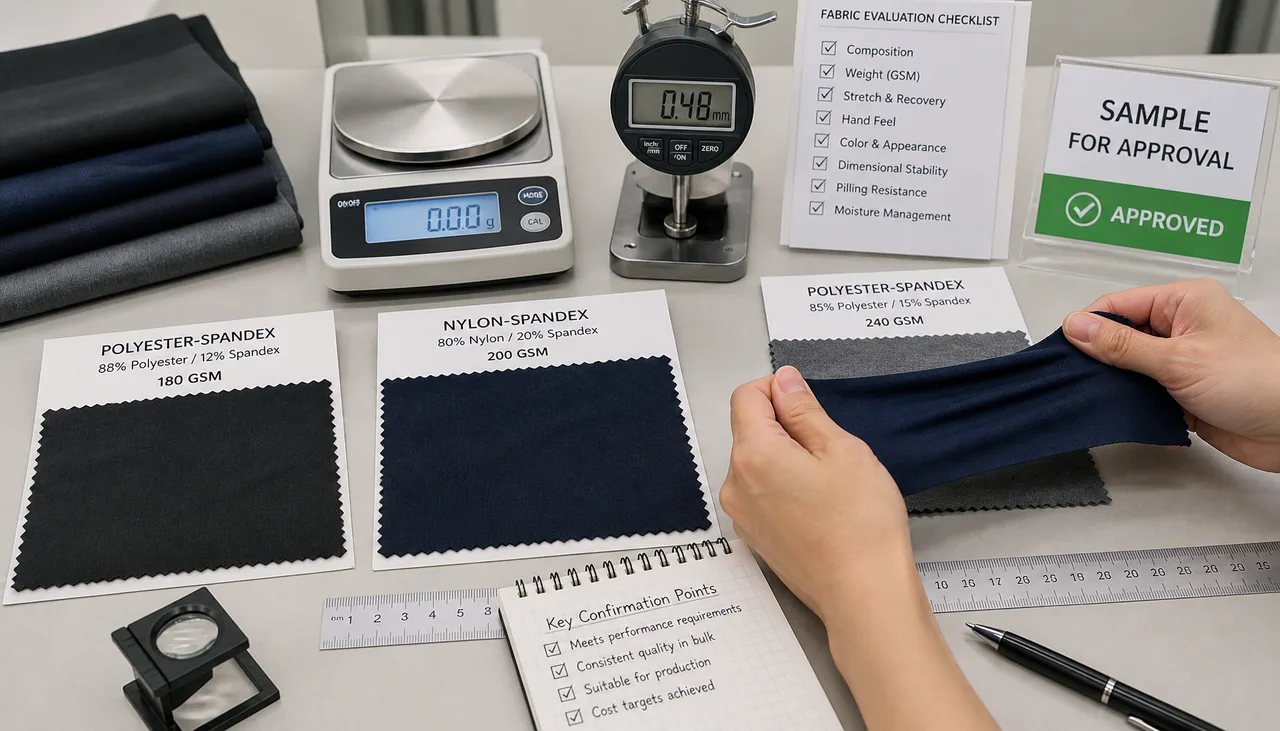
Before approving base-layer fabric for bulk production, confirm the exact construction, finished dimensions, skin-contact comfort, stretch recovery, moisture and thermal requirements, color performance, durability, and lot-control plan. Approval must be based on identified production-relevant material and agreed methods—not composition, GSM, or a hand swatch alone. The final decision should also reflect the complete garment after sewing, decoration, laundering, and its intended layering conditions.
Confirm the use case and layering conditions
Define whether the product is for cold-weather skiing, high-output running, everyday thermal wear, or another application. State whether the garment is next to skin, its intended fit and compression level, the expected temperature and activity range if the brand has validated one, and the layers worn above it. These inputs determine the acceptable trade-off among insulation, air exchange, drying, moisture transfer, softness, seam comfort, and garment mass. A single fabric cannot be assumed to optimize every condition.
Freeze the finished fabric specification
- Fiber composition and knit structure, with the approved face and reverse identified.
- Finished GSM and usable width, including measurement conditions and tolerances.
- Stretch direction, extension and recovery requirements under named conditions.
- Color, finish, hand, luster, surface appearance, bow, skew and edge requirements.
- Dimensional stability after the brand’s specified care or production exposure.
Polyester-spandex and nylon-spandex describe broad material families, not guaranteed performance. Yarn selection, stitch density, knit geometry, dyeing, heat setting, brushing, and chemical finishing can change the behavior of fabrics with similar labels. Keep a sealed physical reference for subjective characteristics and numerical limits for measurable ones. Identify the approved version and ensure that the supplier, garment factory, buying team, and laboratory are working from the same specification.
Review test evidence under controlled conditions
The buyer should select tests from the actual product risk: stretch and recovery, dimensional stability, colorfastness, pilling, abrasion, bursting strength, air permeability, drying or moisture behavior, and any regulated chemical requirements relevant to the destination market. State the method edition, specimen condition, direction, wash cycle, units, and acceptance limit. Results from a different construction, color, finish, or test condition should not be used as evidence for the proposed bulk quality.
Check the garment after production-relevant processing
Cut and sew enough trial garments to assess the full size range or the sizes most likely to expose fit risk. Apply the intended print, transfer, bonding, or brushing process, then perform the agreed care cycles. Review seam grin, edge curl, spirality, opacity at extension, recovery at knees or elbows, skin-contact irritation, dimensional change, and layered comfort. Laboratory fabric results support control, but they do not predict every interaction created by garment design and processing.
Convert tolerances into a bulk-release rule
Hypothetical calculation: if a base-layer marker consumes 0.90 m² and the approved fabric is 180 GSM, theoretical fabric mass is 0.90 × 180 = 162 g before cutting loss and trims. A bulk shift to 195 GSM raises theoretical mass to 175.5 g, an increase of 13.5 g per garment. Whether that change is acceptable depends on the agreed tolerance and garment validation; the example shows why average GSM cannot be treated as a minor purchasing detail.
| Approval item | Buyer evidence | Bulk control |
|---|---|---|
| Construction | Identified production-relevant sample | Traceable yarn, greige and finish route |
| Appearance and color | Signed physical standard | Roll and lot shade assessment |
| Performance | Reports tied to the approved sample | Agreed verification frequency |
| Garment suitability | Processed and washed prototype | No unapproved process change |
| Dimensions | GSM, width and stability results | Individual roll limits plus lot rules |
Release the order only after responsibilities are clear
Record who supplies and selects bulk samples, who pays for testing, who releases lots, and what happens when a result falls outside tolerance. Confirm production lead time, color sequence, minimum dye-lot constraints, packing, retained samples, claim period, and re-order controls. Send ClothFactory or any supplier the signed specification and approval pack before the purchase order becomes final. This makes bulk approval a controlled production decision rather than acceptance of an attractive development sample.