
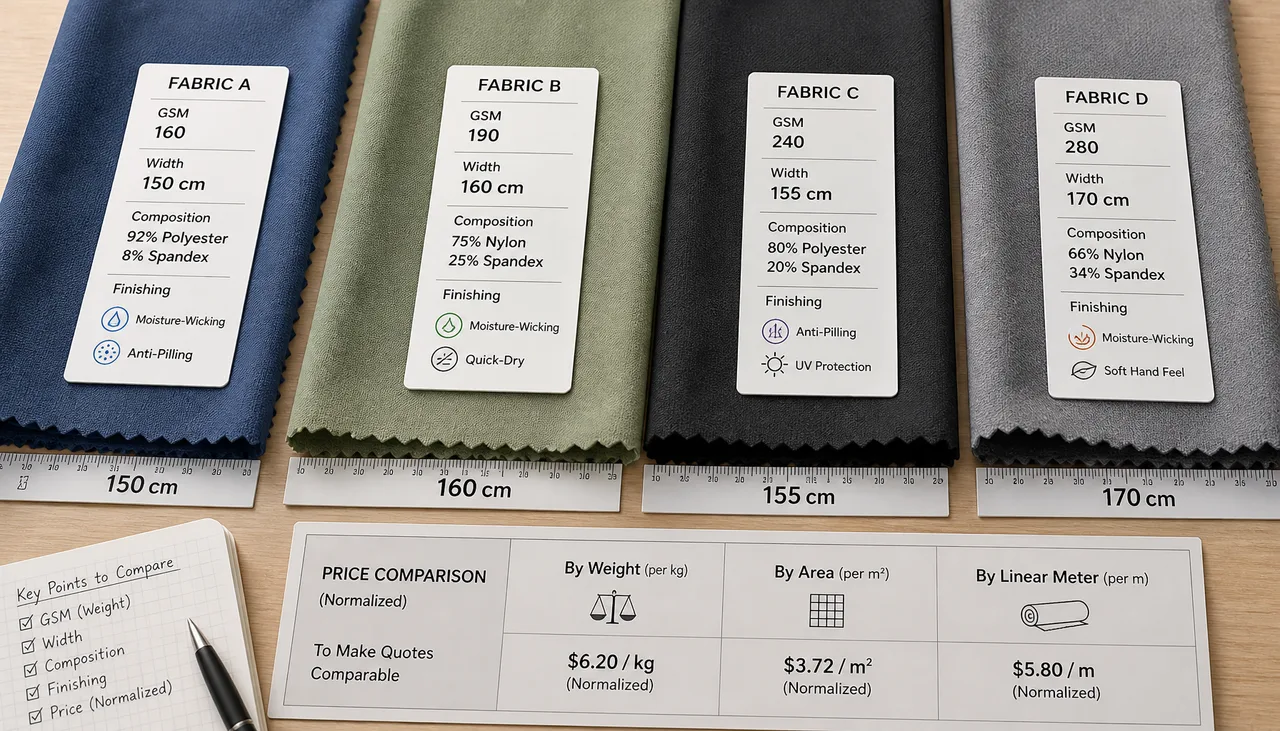
Compare fabric quotes only after separating technical suitability from price conversion. A kilogram price, a linear-metre price and a price for a different usable width are not directly comparable. First establish which candidates meet the garment brief. Then convert the quotations to a common basis and calculate the cost of producing acceptable garments.
Confirm what each price actually buys
Record currency, price unit, delivery term and named place, tax treatment, quotation validity, minimum order by colour and any surcharges. Confirm whether weight excludes packaging and whether width means full width or usable cutting width. For tubular fabric, establish whether the stated width is laid-flat or opened width before applying any area conversion.
Ask whether the quoted article includes the approved dyeing and finishing route. A price for unfinished or differently finished material does not cover the same product as a finished fabric ready for cutting. Keep the technical-sheet revision beside the quote so a commercial comparison does not silently compare different constructions.
Convert kilogram prices using the billed fabric dimensions
For open-width fabric with consistent mass per area, theoretical kilograms per linear metre = GSM × full width in metres ÷ 1,000. A kilogram quote multiplied by that result gives a theoretical linear-metre price. If invoiced mass includes unusable edges, using only usable width in this conversion understates the cost.
Usable-area cost is then linear-metre price ÷ usable width in metres. This is a screening calculation, not garment yield. It assumes the quoted weight and width are representative; actual invoiced mass, measured length and agreed usable width should reconcile the production costing.
| Input or result | Fabric A | Fabric B |
|---|---|---|
| Quotation | $10.00/kg | $3.50/linear m |
| Finished weight | 220 g/m² | As specified in B’s approved technical sheet |
| Full / usable width | 1.65 m / 1.60 m | 1.55 m / 1.50 m |
| Calculated mass per metre | 0.363 kg/m | Not needed to convert a metre quote |
| Linear-metre price | $3.63 | $3.50 |
| Price per usable square metre | Approximately $2.27 | Approximately $2.33 |
B has the lower metre price, while A has the lower usable-area price. Neither result decides the order: both materials still need technical approval, and the cutting marker determines how much each garment consumes.
Run the marker before ranking the fabrics
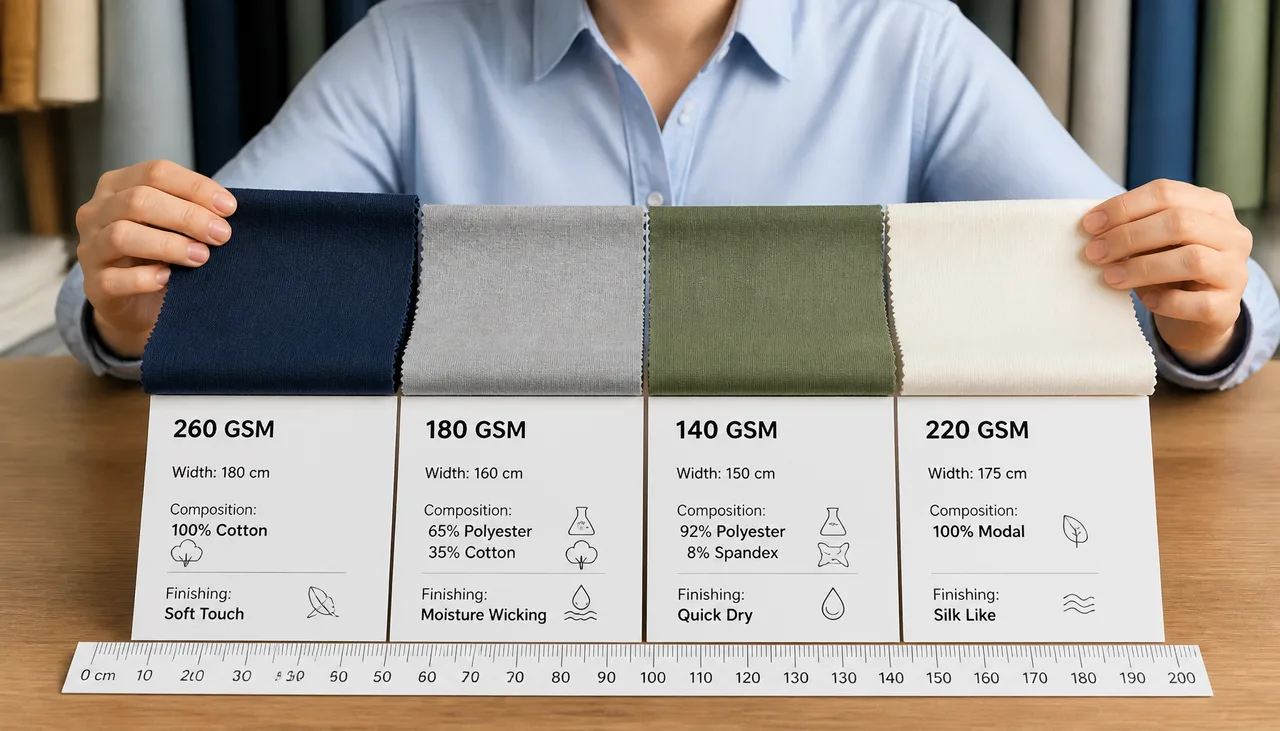
Use the actual pattern, size ratio, minimum usable width and any nap or one-way restrictions. A few centimetres of usable width can determine whether another panel fits across the marker. Area cost alone cannot capture that step change.
Continuing the hypothetical example, suppose approved markers consume 0.90 m per garment for A and 1.00 m for B. Material cost is $3.63 × 0.90 = $3.267 for A and $3.50 × 1.00 = $3.50 for B. A would save about $0.23 per garment under those assumptions. The consumption values must come from actual markers, not from assuming that wider fabric always produces a fixed percentage saving.
Price the performance gap and process changes
Different composition, weight and finishing can change support feel, surface durability, decoration compatibility and care behaviour. Remove any candidate that cannot meet a mandatory requirement. If an alternative needs lining, a different seam or an extra finishing operation, cost the revised garment rather than pretending the fabrics are interchangeable.
Ask whether a claimed moisture-management finish or surface treatment is included in the quote and represented in the sample. Request appropriate evidence for any required durability after care. A soft initial hand feel does not establish equivalent long-term performance.
Allocate order-level costs without hiding waste
Sampling, laboratory work, small-lot dyeing charges and freight may be fixed or partly fixed. As an illustration, a $300 order-level charge adds $0.10 per garment to 3,000 accepted garments, but $0.50 to 600. Use the realistic order quantity and distinguish development costs from recurring production costs.
Define what the consumption figure already includes. If marker consumption includes cutting waste, do not add the same allowance again. Additional roll defects, end losses or rejected garments need separate, justified assumptions. Under an illustrative 98% accepted-garment yield, a production cost of $3.30 per piece started becomes $3.30 ÷ 0.98, or about $3.37 per accepted piece, before any recovery value.
Make the comparison auditable
The final comparison should link each price to the approved specification, sample, marker and delivery basis. Show assumptions and unresolved deviations beside the total, not in a separate email chain. Confirm the commercial terms again when quantities, colours or specifications change.
Select the lowest defensible cost for an acceptable garment, not the lowest isolated price unit. A quote is decision-ready when another buyer can reproduce the conversion and understand exactly which technical and commercial risks remain.