
Compare fabric quotations by matching the technical specification, billing unit, order quantity, included services, and delivery scope before ranking prices. Then calculate material cost against the actual garment marker, including unusable edges and agreed production allowances.
Establish what each supplier is pricing
For a nylon-spandex leggings program, two offers with the same composition can cover different knit constructions, finished weights, widths, and finishing routes. Ask suppliers to identify the quoted sample and specification revision. A quotation for an unfinished base cannot be compared directly with a dyed, finished fabric whose recovery and appearance have already been approved.
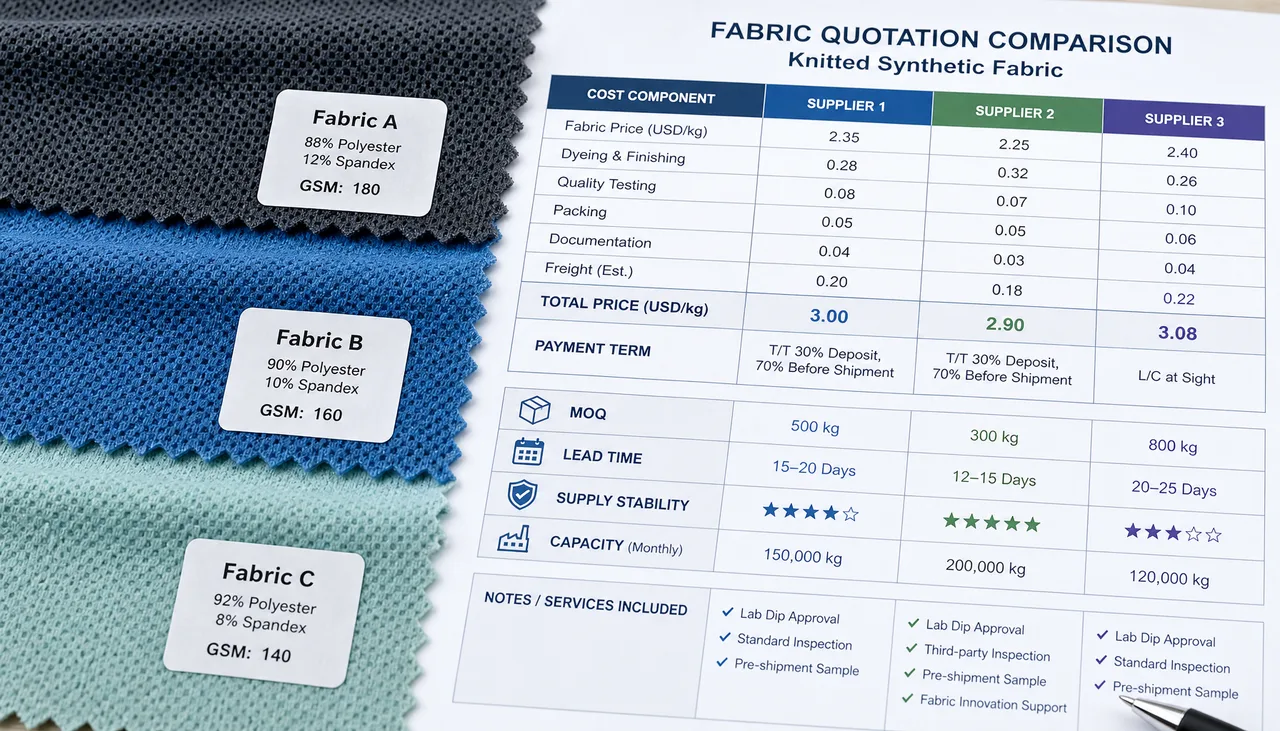
Convert the price without hiding edge waste
Illustrative calculation: assume USD 8/kg, 200 g/m², and a total billed width of 1.60 m. One linear metre weighs approximately 0.200 × 1.60 = 0.320 kg and costs USD 2.56. If only 1.50 m is usable, the edge loss is still included in the paid weight; multiplying price by usable width alone would understate the cost.
If the production marker consumes 0.90 linear metres per garment at that usable width, baseline fabric cost is USD 2.304 per garment. Add documented spreading, defects, and other allowances without counting losses already included in the marker twice. These hypothetical figures assume uniform GSM and net fabric billing; verify whether cores and packaging are excluded.
Separate recurring cost from development cost
| Quotation component | Question to resolve |
|---|---|
| Finished fabric | Which color, finish, width, tolerance and quantity does the price cover? |
| Development and samples | Is the charge per construction, color, trial or revision? |
| Testing and inspection | Which tests and lots are included, and who pays for retesting? |
| Packing and transport | Which costs are included up to the named delivery location? |
| Repeat orders | Does the quoted price depend on the first-order volume or yarn commitment? |
Check minimums at color level
A program requiring several small colors can cost more than one large color even at the same total weight. Request the minimum per construction and per dye lot, small-lot charges, permitted quantity variation, and quote validity. No fixed kilogram-to-metre conversion applies across different weights and widths.
Close the gaps before awarding the order
Send shortlisted suppliers the same comparison sheet and ask them to mark exclusions explicitly. Keep technical acceptance separate from commercial ranking: a cheaper fabric that fails coverage, recovery, or the production marker is not an equivalent offer. Approve the sample reference, cost basis, inspection responsibilities, and treatment of nonconforming rolls together.