
Buyers can compare moisture-management reports only when the suppliers tested the same property with the same method, specimen orientation, conditioning, liquid volume, and wash state. A wicking result, drying-time result, vapor-transmission result, and composite moisture-management index answer different questions and should not be ranked as if they were one metric.
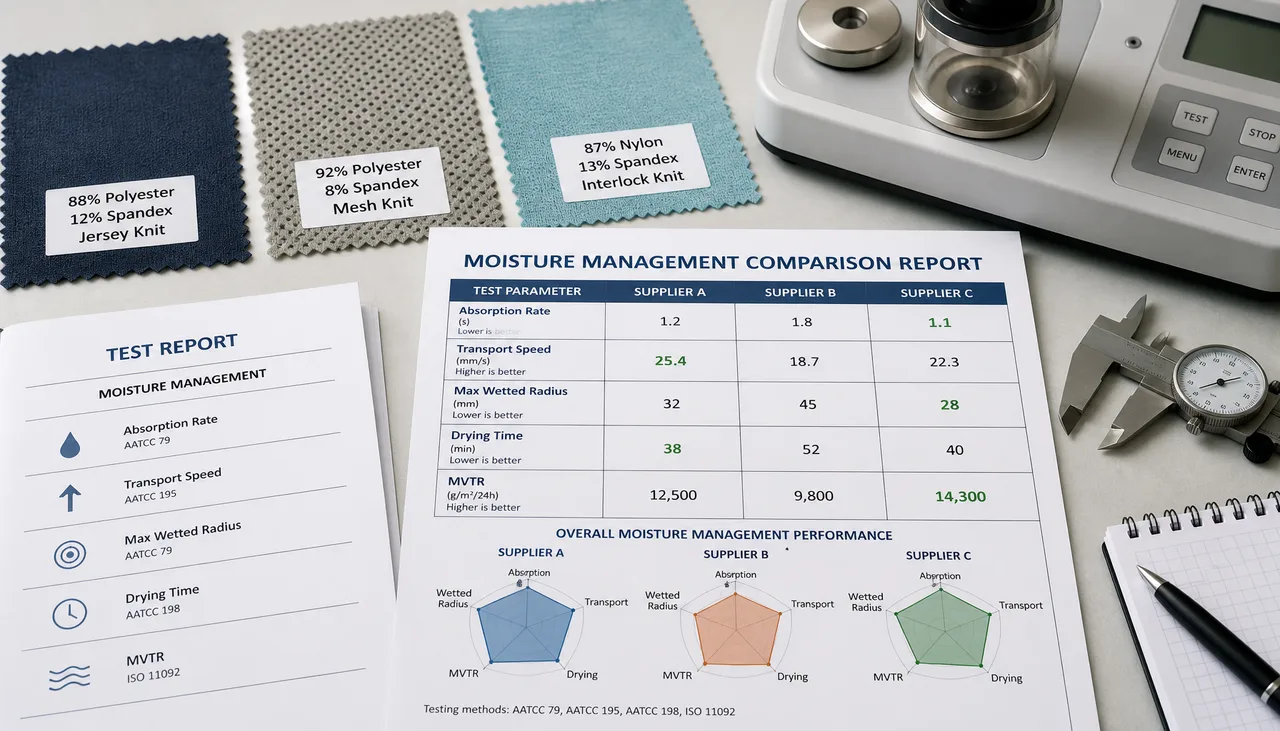
Start with the moisture problem in the garment
Define where moisture originates and what the fabric must do before requesting reports. A next-to-skin training top may need liquid sweat to leave the skin-side surface and spread across the outer surface for evaporation. A sports-bra cup, yoga-legging waistband, or shapewear control panel may hold more fabric layers against the body, so drying, local saturation, and comfort can differ from a single-layer swatch.
The supplier brief should state:
- garment type and fabric location;
- skin-side and outer-side orientation;
- expected sweat exposure and climate;
- single-layer or laminated construction;
- target fit and working extension;
- care cycle and number of washes to be evaluated;
- which performance claim, if any, the final product must support.
Without this context, a report can be technically complete but irrelevant to the buyer's product.
Separate the moisture-management metrics
| Reported property | What it can indicate | What it does not prove by itself |
|---|---|---|
| Wetting time | How quickly the test liquid first wets a defined surface | Drying speed, directional transport, or comfort during wear |
| Absorption rate or capacity | How quickly or how much liquid enters the specimen under the stated method | Whether moisture moves away from the skin-side surface |
| Spreading radius or speed | How far and how quickly liquid spreads across a surface | Evaporation rate or vapor transfer through the garment |
| One-way transport | Movement of liquid from one fabric face toward the other under the test setup | Performance when the fabric is reversed, stretched, layered, or heavily saturated |
| Drying rate or drying time | Water loss under stated temperature, humidity, airflow, and starting moisture | Initial wetting or directional liquid transport |
| Moisture-vapor transmission | Passage of water vapor through the specimen under stated conditions | Liquid sweat wicking or drying after saturation |
| Composite index | A calculation combining selected measurements within one test method | Direct equivalence to another method, instrument, or wearer-comfort claim |
Check how the report defines every term. Two suppliers may use the same label while reporting different units, endpoints, or calculations.
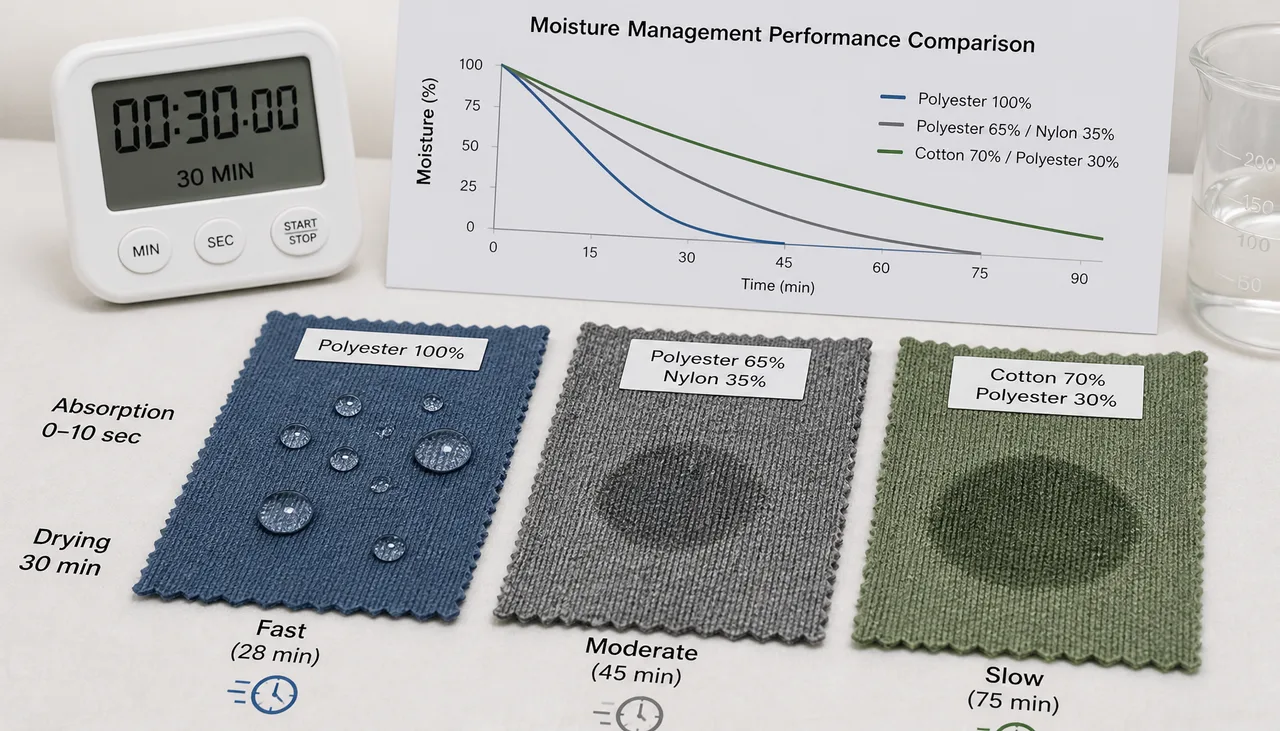
Confirm that the reports are actually comparable
Before placing results side by side, verify the following fields:
- test method, revision, and instrument;
- specimen identity, composition, knit construction, finished GSM, and color;
- fabric face placed against the test liquid or sensor;
- specimen dimensions and orientation;
- liquid type, volume, temperature, and application procedure;
- conditioning temperature and relative humidity;
- drying airflow and endpoint, where applicable;
- relaxed or extended specimen state;
- unwashed, prewashed, or post-wash condition;
- number of specimens, individual readings, average, and variation.
If any of these conditions differ, record the reports as separate evidence rather than declaring one fabric better.
Review individual readings, not only the average
A single average can hide unstable performance across the fabric width or between specimens. Ask for the individual results, minimum, maximum, and any excluded reading together with the reason for exclusion.
Illustrative example — not ClothFactory test data: suppose five drying-time readings are 18, 19, 20, 21, and 32 minutes. The average is:
(18 + 19 + 20 + 21 + 32) ÷ 5 = 22 minutes
The 14-minute range between the fastest and slowest readings is commercially important. A report showing only “22 minutes” would hide the 32-minute result and could overstate consistency. The buyer should investigate specimen location, test execution, or fabric variation before setting a bulk tolerance.
Check whether the result survives laundering
Moisture behavior may come from fiber properties, yarn geometry, knit structure, a topical finish, or a combination of these factors. The report should identify any finish and state whether the result was measured before or after the buyer's intended care cycle.
If a finish is optional, do not treat the reported property as standard for every order. Request matched pre-wash and post-wash samples under the same method. A result from one construction, color, or finish should not be transferred to another fabric without verification.
Compare the finished fabric, not composition alone
Polyester-spandex and nylon-spandex can both be engineered for activewear moisture requirements. Fiber content does not determine wetting, transport, or drying performance on its own. Yarn cross-section, filament count, knit density, fabric thickness, GSM, heat setting, dyeing, and finishing can change the result.
Color can also affect heat absorption and finishing conditions, while working extension changes loop openings and thickness. When the garment is close fitting, include the intended stretch state or confirm performance through a garment trial.
Connect laboratory data to garment verification
Laboratory reports control material comparison; wearer trials and garment tests confirm product behavior. Use both stages:
- compare candidate fabrics under one laboratory method and one conditioning plan;
- make garment samples in the intended size, pattern, seams, lining, and color;
- evaluate the correct fabric face against the body;
- check high-sweat zones, layered areas, waistbands, and cups separately;
- repeat the agreed assessment after laundering;
- retain the approved fabric and garment references for bulk comparison.
Do not use an uncontrolled spray, water-drop video, or touch test as the only evidence for a moisture-management claim. These checks can screen samples but do not create comparable supplier data.
Avoid common report-comparison errors
- Comparing different properties. Fast wetting is not the same as fast drying or one-way transport.
- Ignoring fabric orientation. Skin-side and outer-side results can differ.
- Mixing test methods or units. Identical-looking numbers may come from different calculations.
- Comparing washed and unwashed samples. Finishing durability changes the commercial conclusion.
- Using a single reading. One specimen does not show variation across width, rolls, or dye lots.
- Assuming composition guarantees performance. Construction and finishing remain material variables.
- Treating laboratory data as a comfort guarantee. Garment fit, layering, climate, and wearer activity affect the final experience.
Build a report request suppliers can answer consistently
Send every supplier the same document listing the end use, fabric face, finished GSM and width, target color, test property, method, conditioning, wash cycle, specimen count, required raw readings, and acceptance rule. Request the fabric code and dye-lot identity on both the report and physical sample.
ClothFactory can use that brief to compare nylon-spandex or polyester-spandex candidates under matched conditions. Bulk approval should remain tied to the agreed method, post-wash requirement, production finish, and garment verification rather than to a standalone “moisture-wicking” label.