
Before requesting a fabric quote, buyers should define what the sample yardage must prove, how much material each evaluation step requires, and whether the sample will come from existing stock or a new development run. The quote should separate sample costs from bulk terms and identify the fabric specification, color, finish, testing allocation, lead time, freight, and approval status.
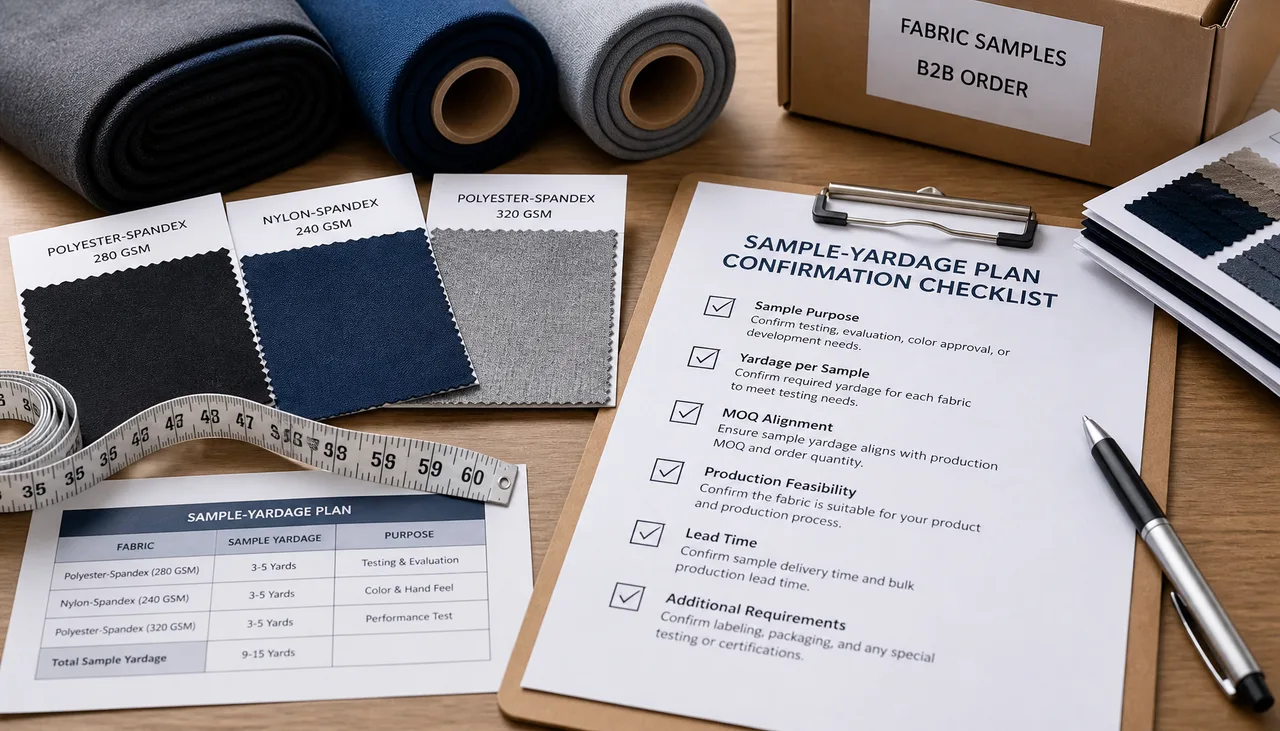
Identify the sample type and decision
“Sample” can refer to several different materials. Each answers a different question:
| Sample type | Main purpose | What it does not automatically prove |
|---|---|---|
| Swatch or hanger | Screen color, hand, surface, and broad construction suitability | Garment yield, complete testing, or bulk consistency |
| Existing sample yardage | Produce prototypes and conduct limited evaluation from available material | Exact custom color, finish, or future bulk lot |
| Development yardage | Evaluate a requested construction, finish, or color at a limited scale | Full-scale production repeatability unless specifically validated |
| Lab dip | Approve a solid-color direction under agreed viewing conditions | Finished hand, GSM, width, or complete performance |
| Print strike-off | Approve print color, scale, repeat, registration, and appearance | All physical properties or bulk print consistency |
| Pre-production or bulk-lot sample | Confirm defined characteristics from a production-representative lot | Automatic acceptance of the remaining shipment without an agreed plan |
The quote should name the sample type. A stock sample that is useful for pattern development should not be described as an exact bulk-production reference unless its construction, color, and finish are traceable and confirmed.
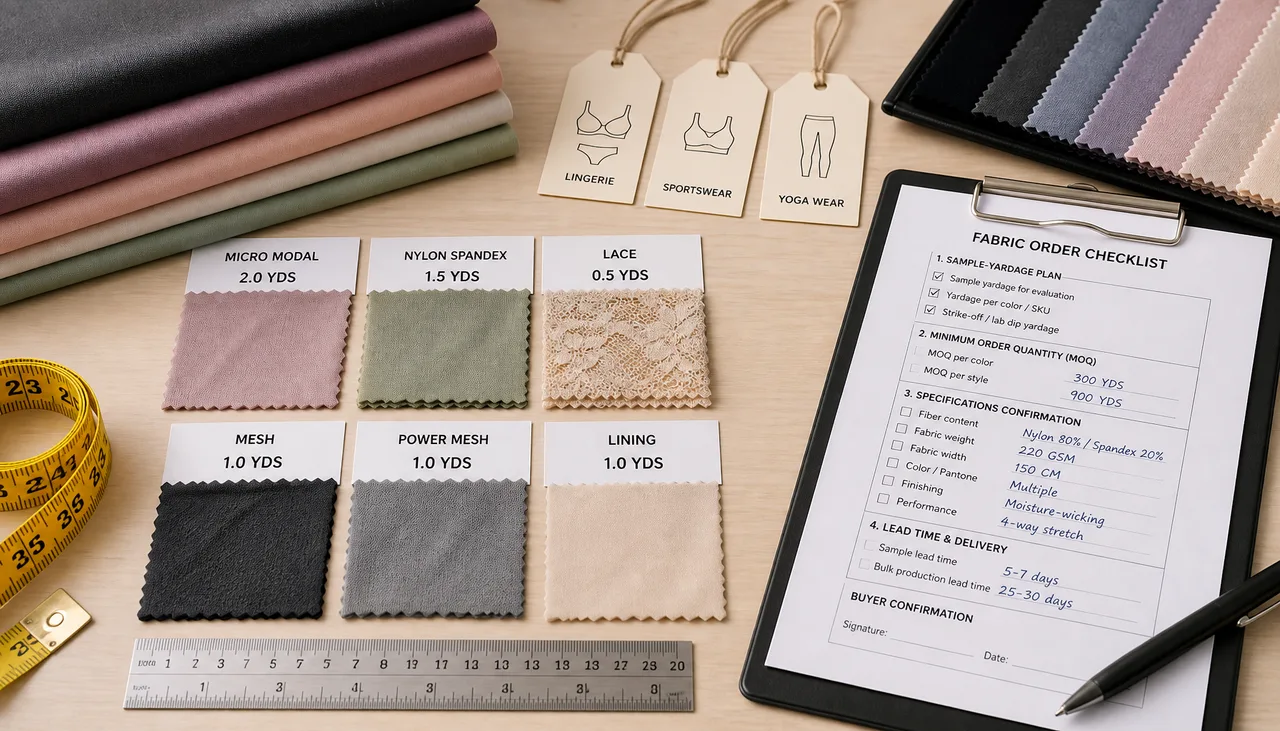
Calculate yardage from the evaluation plan
Start with the garments, tests, retained references, and contingency required. Ask the garment factory for marker consumption at the confirmed usable width rather than estimating solely from garment category.
A sample-yardage plan may include:
- fit samples in required sizes;
- color, print, finish, or construction variants;
- duplicate garments for wash or wear evaluation;
- laboratory specimens and conditioning allowance;
- seam, bonding, raw-edge, or component trials;
- buyer, supplier, and factory retained references;
- cutting loss, end allowance, and replacement contingency.
Illustrative calculation
The following is a hypothetical planning example, not a ClothFactory requirement. Assume a buyer needs two garments in each of three sizes, the sample marker uses 0.85 m per garment, and a 20% cutting and contingency allowance is applied:
2 garments × 3 sizes × 0.85 m = 5.10 m
5.10 m × 1.20 = 6.12 m
Round-up rules and extra material for laboratory testing, retained references, or failed cutting attempts should be added separately. A percentage allowance is not a substitute for an actual sample marker.
Provide a quotable fabric specification
The supplier cannot price sample yardage accurately from an application name such as “yoga fabric” or “underwear fabric.” Provide the known requirements and label unknown items as open for recommendation.
Include:
- intended garment and exact fabric location;
- nylon-spandex, polyester-spandex, or permitted composition alternatives;
- knit construction or approved reference sample;
- target finished GSM and tolerance;
- minimum usable width and measurement condition;
- stretch direction, expected garment extension, recovery, or force requirement;
- hand-feel reference and fabric face;
- color reference, number of colors, and viewing conditions;
- required finish and whether it is optional or mandatory;
- planned care cycle and required tests;
- expected sample quantity and potential bulk quantity stated separately.
Do not describe optional moisture-management, cooling, antibacterial, brushing, or other finishing as a default fabric property. Each requested treatment can affect price, sample lead time, hand, color, and minimum production requirements.
Confirm whether the sample represents bulk production
Ask the supplier to state the sample's source:
- existing stock and lot identity;
- an earlier production lot;
- laboratory or pilot development;
- newly produced sample yardage;
- first production lot.
Record which characteristics are expected to match bulk and which may change. Small-scale dyeing, printing, heat setting, brushing, coating, or bonding trials may not reproduce full-scale results exactly. The approval workflow should therefore identify whether a later pre-production or bulk-lot confirmation is required.
The sample should carry a fabric code, composition, construction, finished GSM, usable width, color or lot reference, finish, and issue date. Without this traceability, an approved garment sample may not provide a reliable bulk reference.
Allocate material before cutting begins
Divide the sample yardage in writing so garment sampling does not consume material reserved for testing. A practical allocation record can identify:
| Allocation | Information to record |
|---|---|
| Garment development | Sizes, quantities, marker width, and factory destination |
| Laboratory testing | Test list, specimen condition, and laboratory destination |
| Wash or wear evaluation | Garment or fabric quantity and care cycle |
| Process trials | Bonding, printing, seam, edge, elastic, or other trial quantity |
| Retained reference | Buyer, supplier, and garment-factory retention quantity |
| Contingency | Reason for reserve and who may authorize its use |
If the available quantity is limited, prioritize the decisions that must be made before bulk commitment. Do not cut every available meter into garments and then discover that no identified material remains for verification or comparison.
Separate every quoted cost and condition
The sample quotation should state:
- sample-yardage unit price and quantity basis;
- development, dyeing, printing, finishing, or setup charges;
- testing, inspection, courier, tax, and freight responsibility;
- sample lead time and the event that starts it;
- stock reservation period, if any;
- payment terms and cancellation conditions;
- whether any charge is refundable or creditable to bulk production;
- applicable bulk MOQ and whether it is per color, construction, finish, or order;
- expected bulk pricing basis and validity period, if offered;
- whether sample and bulk may differ in shade, width, GSM, hand, or finish.
Sample pricing is not necessarily a scaled version of bulk pricing. Limited quantities may use stock fabric, special handling, separate dyeing, or development work that changes the cost basis.
Define the approval path before ordering samples
Use a written sequence such as:
- Buyer confirms the application brief and open technical questions.
- Supplier identifies suitable existing material or defines a development route.
- Both parties confirm sample type, quantity, cost, source, and lead time.
- Supplier issues traceable sample yardage and a specification sheet.
- Buyer allocates material to garments, tests, process trials, and retained references.
- Buyer records approval, conditional approval, or rejection against the identified sample.
- Supplier confirms what must be re-approved on pre-production or bulk material.
- Bulk production begins only after the agreed written authorization and payment event.
Avoid common sample-yardage mistakes
- Requesting an arbitrary number of meters. Calculate from marker consumption, tests, variants, and retained references.
- Assuming stock yardage equals future bulk. Confirm construction, lot, color, and finish traceability.
- Using sample yardage for every decision. Lab dips, strike-offs, performance tests, and garment prototypes serve different purposes.
- Leaving usable width open. Marker consumption becomes unreliable when the quoted width differs from the cutting width.
- Testing after all fabric has been cut. Reserve identified material before sample-room use.
- Treating sample price as bulk price. Ask for separate commercial bases and validity.
- Approving an unrecorded finish. Optional treatments must appear in the sample specification and bulk order.
Procurement next step
Prepare a sample-yardage worksheet listing garment quantities, marker consumption, tests, process trials, retained references, contingency, and delivery destinations. Send it with the target composition, construction, GSM, usable width, stretch requirements, color, finish, and care cycle. ClothFactory can then identify whether an existing nylon-spandex or polyester-spandex sample is suitable or whether a development step is required, while keeping sample-yardage terms separate from the eventual bulk commitment.