Demanding identical physical and mechanical properties across different colorways is technically unfeasible in knitted synthetic apparel programs. Variations in dyestuff saturation, bath pH, dwell duration, and thermal heat setting alter fabric mass, finished width, and recovery between pale tints and deep shades. Sourcing partners should be given defined commercial tolerance bands—such as directional weight targets within plus or minus 10 to 15 GSM, fixed minimum cuttable widths, and documented dimensional stability limits—enforced through pre-bulk laboratory reports and shade band approvals.
Why Fabric Variables Shift Between Colorways
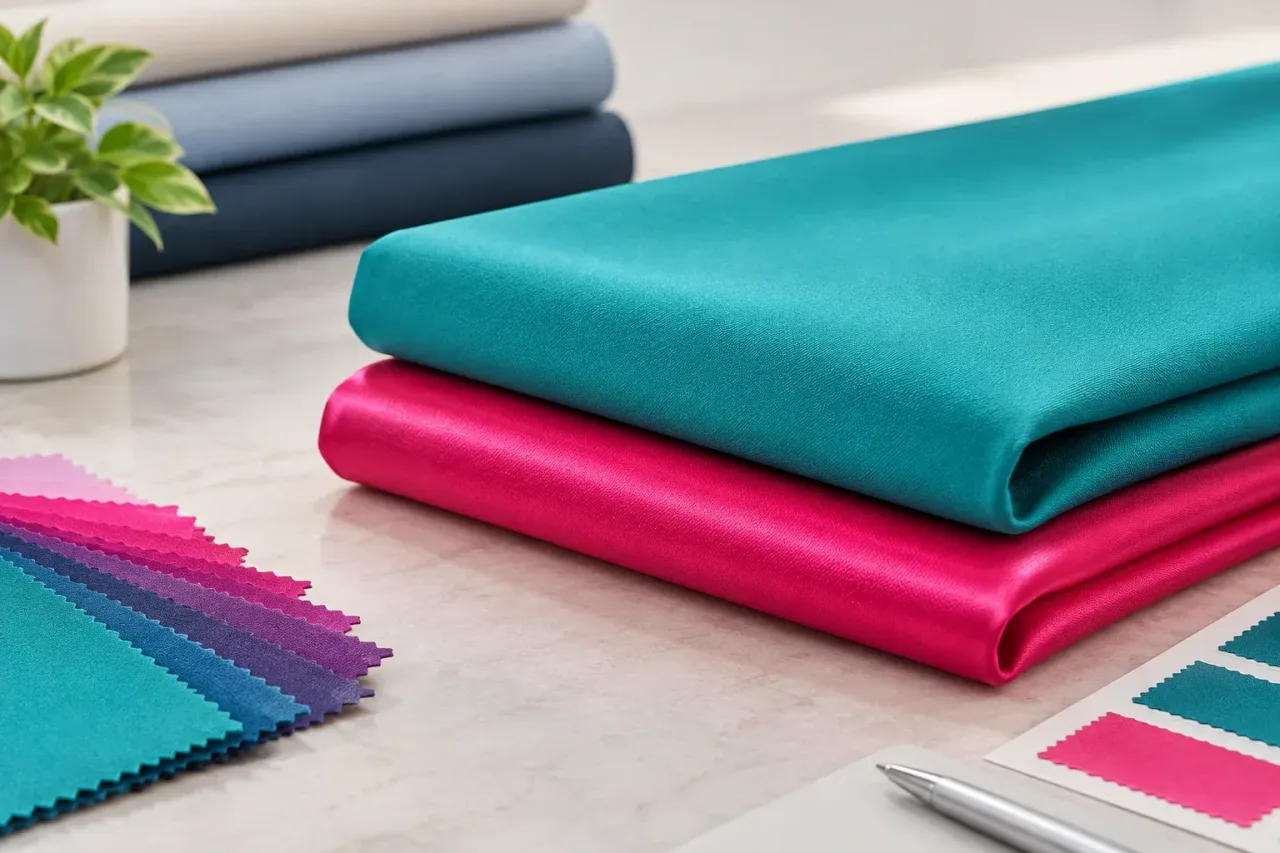
Dyeing is a thermo-chemical conversion that alters both the physical structure and the mass of synthetic knit fabrics. Deep shades like jet black, navy, or saturated jewel tones require heavy dyestuff concentrations and extended liquor dwell times at elevated temperatures to achieve target fixation. In contrast, optic whites or pastel shades undergo minimal chemical loading, lighter scouring, and shorter bath exposure.
These processing differences trigger measurable physical shifts:
- Mass and weight shifts: High dye molecule saturation and auxiliary leveling chemicals add minor direct weight, but the prolonged wet agitation causes knit loops to relax and compact. A darker shade frequently registers a higher finished mass per unit area than a light pastel knitted from the identical greige roll.
- Thermal relaxation and stenter exposure: To dry, fix, and stabilize elastane blends, fabrics pass through stenter frames under high heat. Dye recipe wash-off requirements dictate how long and how hot a lot must run. Slight differences in thermal exposure affect spandex modulus, altering the residual stretch and post-wash shrinkage behavior between dye lots.
- Surface friction and hand feel: Intensive washing, acid reduction baths, or cationic softening agents used to stabilize heavy dyestuffs change the yarn's surface lubricity. Two colorways running the same nominal yarn construction will often display distinct tactile softness or drape.
Measurable Tolerance Bands to Specify in Tech Packs
Rather than requesting absolute uniformity across color palettes, professional buyers establish contract-ready tolerance windows in their technical packages. This separates non-negotiable physical constraints (such as minimum usable width for marker planning) from natural, dye-dependent mechanical metrics.
|
Specification Parameter |
Commercial Tolerance Band |
Reference Test Standard |
Sourcing and Production Consequence |
|---|---|---|---|
|
Mass Per Unit Area |
±10 to 15 GSM from directional target |
ISO 3801 or ASTM D3776 |
Prevents unacceptable opacity differences and excessive yield loss per kilogram across colors. |
|
Cuttable Usable Width |
Minimum absolute threshold (e.g., ≥160 cm) |
Visual inspection / 4-Point System |
Protects marker efficiency; width above minimum is acceptable, but sub-width rolls stall garment cutting. |
|
Fibre Composition |
±2% to 3% elastane tolerance |
ISO 1833 |
Controls fundamental modulus and ensures compliance with declared garment labeling regulations. |
|
Dimensional Stability |
Within ±5% change after standard home laundering |
AATCC 135 |
Avoids differential garment shrinkage across colorways within the same retail size grade. |
|
Stretch and Recovery |
60% to 120% elongation, growth under 5% after 30 min |
ASTM D4964 |
Maintains consistent fit, compression, and shape retention across light and dark legging panels. |
Enforcing a minimum cuttable width rather than a symmetric plus-or-minus width window prevents production bottlenecks. If a navy lot finishes at 162 cm and a white lot finishes at 165 cm, both safely clear a 160 cm minimum cuttable specification, allowing cutting rooms to execute standardized pattern markers without re-grading.
Verification Workflows: Shade Bands and Pre-Bulk Release
Managing multi-color consistency requires an auditable approval sequence before fabric rolls leave the finishing mill. Sourcing agents should execute formal checkpoints rather than relying on subjective visual claims.
Implement these verification steps before cutting authorization:
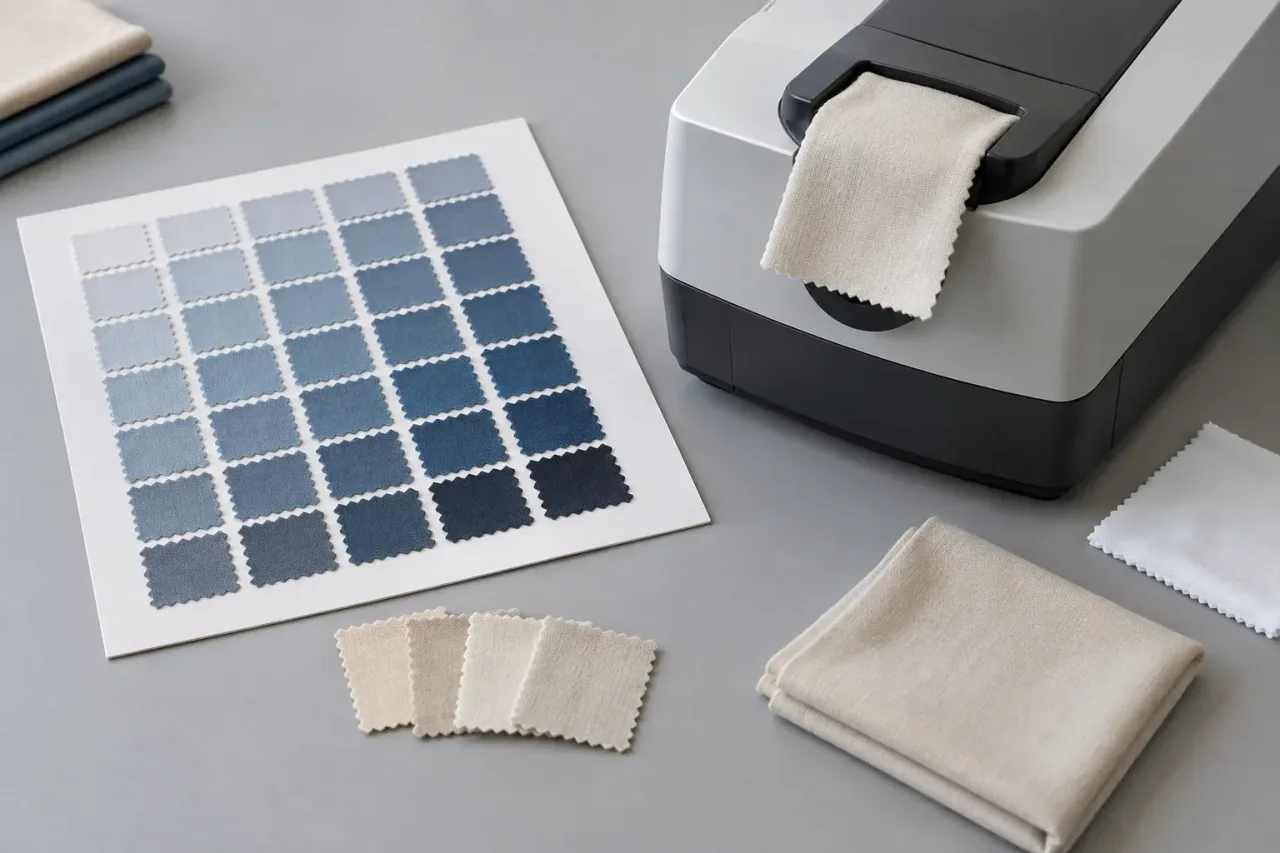
- Spectrophotometric Delta E verification: Require instrumental color measurement targeting a deviation threshold of Delta E below 1 (using CMC or CIE DE2000 under specified illuminants) against approved lab dips. This establishes an objective baseline for color accuracy.
- Shade band continuity swatches: Mandate shade band approval cards using swatches collected from the start, middle, and end of each production lot. This confirms lot-to-lot continuity and visual tolerance range across production rolls.
- Pre-bulk physical test reports: Require documented third-party or mill laboratory test reports verifying GSM, cuttable width, dimensional change, and colorfastness to rubbing, perspiration, and laundering. Inspect reports to catch out-of-spec physical drift before authorising roll release.
Documenting these tolerance windows in purchase orders provides sourcing agents with clear, enforceable parameters while accommodating the genuine chemical constraints of commercial dyeing.