
Buyers should define golf-shirt fabric by garment use, knit construction, finished GSM and usable width, stretch and recovery, moisture and air behavior, color durability, and compatibility with the collar, placket, and decoration. Fiber composition alone is not a specification; every claimed function and critical production property needs an agreed sample or test condition.
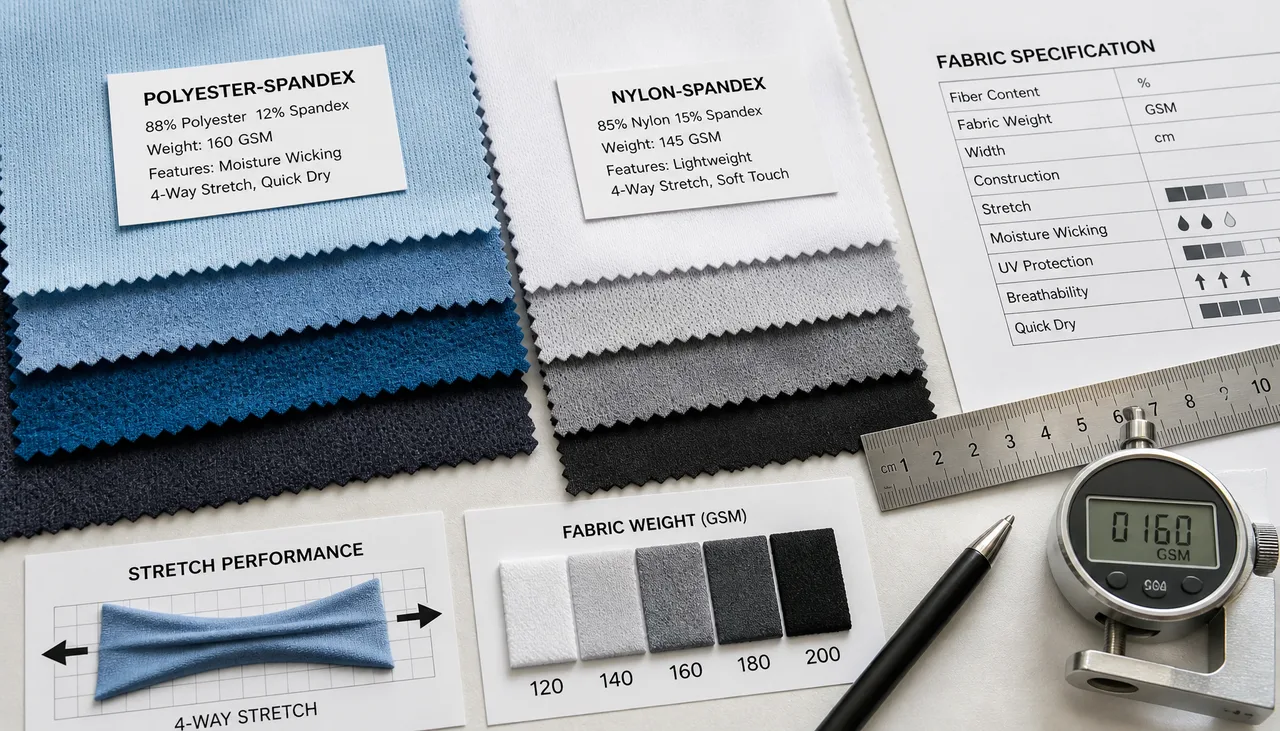
Start with the golf-shirt use case
A golf shirt for hot-weather walking, a club uniform, and a premium leisure polo may use different fabrics even when all are described as polyester-spandex or nylon-spandex. Define the wearing environment and commercial position before asking for swatches.
The initial brief should state:
- climate, season, and expected activity level;
- men's, women's, or unisex fit and size range;
- relaxed, regular, or close fit;
- short or long sleeve;
- target drape, texture, and hand feel;
- collar and cuff construction;
- embroidery, heat transfer, print, or other decoration;
- care label and intended product claims.
This information tells the supplier which properties require development and which existing fabrics are relevant.
Select knit structure before fine-tuning GSM
Knit structure affects appearance, airflow, stability, stretch, snagging, and compatibility with a collar and placket. Buyers should request the exact construction rather than use “polo fabric” as the complete description.
| Knit option | Why a buyer may consider it | What requires confirmation |
|---|---|---|
| Piqué or another textured knit | Recognizable polo appearance and surface texture | Snagging, pilling, drape, print quality, and edge stability |
| Interlock | Smooth surface, coverage, and dimensional stability in some constructions | Weight, heat retention, stretch recovery, and placket bulk |
| Single jersey | Lower bulk and fluid drape in some constructions | Curling, spirality, coverage, and seam stability |
| Engineered mesh or jacquard | Zoned appearance or airflow without a separate panel | Pattern repeat, usable width, snagging, placement, and bulk consistency |
These are development directions, not guaranteed outcomes. Yarn selection, density, dyeing, heat setting, and finishing can change the behavior of the same structural category.
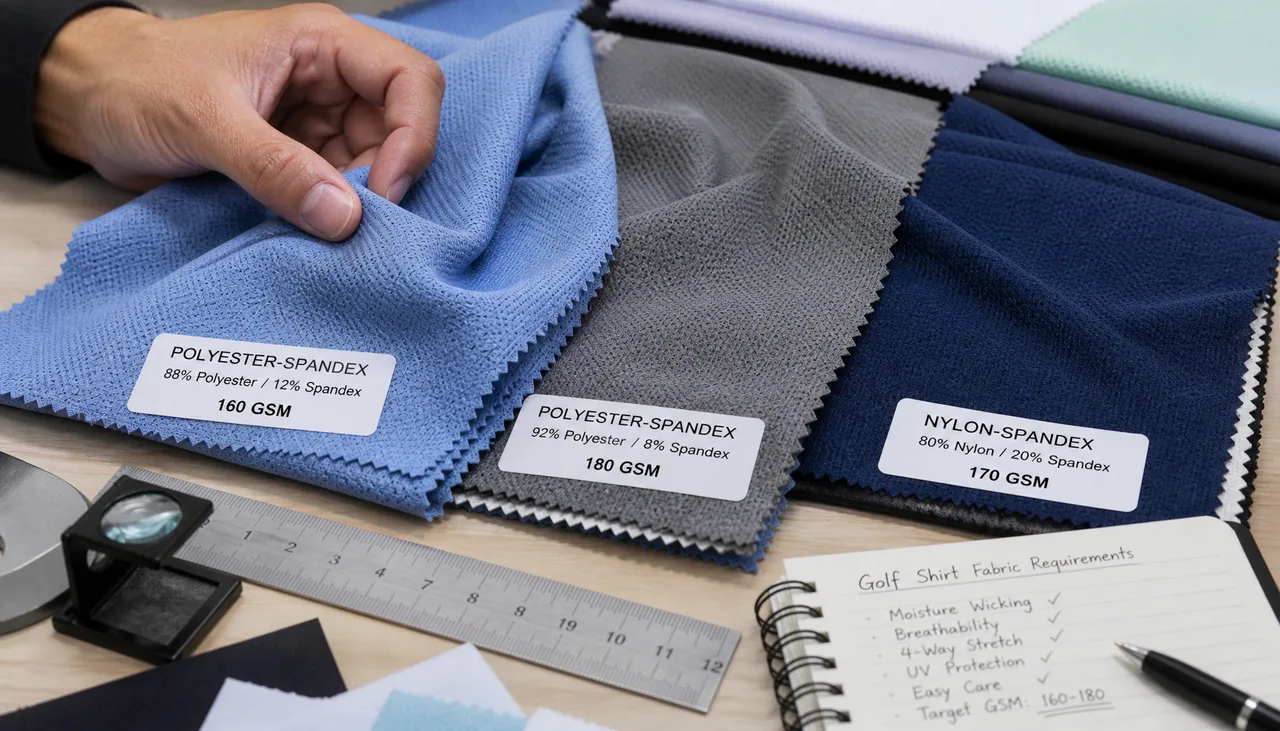
Use GSM to manage garment weight and drape
GSM measures fabric mass per square meter. It helps estimate garment weight, but it does not independently establish thickness, breathability, durability, or moisture performance.
Illustrative calculation — not ClothFactory product data: assume the net main-fabric pattern area for one golf shirt is 1.10 m². At 160 gsm:
1.10 m² × 160 g/m² = 176 g
At 200 gsm, the same area contributes approximately 220 g, an increase of 44 g before the collar, cuffs, thread, buttons, labels, and cutting waste. The brand should decide whether the extra mass improves the intended drape and coverage enough to justify the change.
Specify finished GSM with an agreed tolerance and test state. A greige value or one specimen does not define the dyed bulk fabric.
Define stretch around the golf swing
Stretch should support movement at the shoulder, upper back, sleeve, and torso without leaving permanent growth. State the required direction, extension, hold time, recovery time, and post-wash condition. Four-way stretch should not be used as a substitute for numerical or reference-based requirements.
The collar, placket, embroidery, and shoulder seams can restrict a stretch body fabric. Make a garment sample using the intended trims and construction, then check:
- reach and rotation during the swing;
- placket distortion or gaping;
- sleeve and armhole mobility;
- shoulder-seam recovery;
- hem growth and garment twist;
- appearance after laundering and relaxation.
Separate moisture, drying, airflow, and UV claims
Moisture wicking, drying rate, air permeability, and UV protection are different properties. Select only the tests relevant to the product brief and use the applicable method and target-market claim rules.
For a hot-weather golf shirt, a buyer may compare:
- liquid spreading or directional transport on the correct fabric face;
- drying under defined temperature, humidity, airflow, and starting moisture;
- air permeability of the finished construction;
- wet and dry hand feel through garment trials;
- UPF under the required color, stretch, wet, and care conditions if a sun-protection claim is planned.
An optional topical finish should be identified separately and checked after the agreed wash sequence. Do not assume every color or order includes the same finish.
Protect the collar, placket, and decorated areas
The golf-shirt body fabric must work with the collar, cuff, placket reinforcement, buttons, and decoration. A lightweight or highly elastic body can distort when paired with a rigid placket or dense embroidery.
Request sewing and decoration trials using production-representative materials. Review puckering, needle damage, seam growth, print or transfer appearance, embroidery support, and shade compatibility between body fabric and rib or collar components.
If the collar uses a separate knit, specify its composition, GSM, dimensions, stretch, recovery, shrinkage, and color standard independently. Matching color before laundering does not prove that the body and collar will age at the same rate.
Define durability and color requirements from use
Select tests according to the actual garment risks:
- dimensional stability and spirality after the care procedure;
- pilling, snagging, and abrasion for the chosen surface;
- fabric-appropriate strength and seam performance;
- colorfastness to laundering, perspiration, rubbing, water, and light where relevant;
- shade continuity within and between rolls;
- appearance and recovery after repeated care cycles.
The specification should identify the method, condition, tolerance, and failure action. “Good colorfastness” or “anti-pilling” is not an acceptance criterion.
Build a supplier-ready requirement sheet
| Specification area | Information to provide or confirm |
|---|---|
| End use | Climate, activity, fit, season, price position, and target customer |
| Construction | Knit type, fabric face, composition, finished GSM, usable width, and finish |
| Movement | Stretch and recovery by direction, garment zones, and post-wash requirement |
| Comfort | Hand reference, airflow, moisture behavior, drying, and garment weight |
| Appearance | Texture, drape, coverage, color, and shade tolerance |
| Assembly | Collar, cuff, placket, seams, buttons, embroidery, print, or transfer |
| Durability | Shrinkage, spirality, pilling, snagging, abrasion, strength, and colorfastness |
| Supply control | Sample identity, tolerances, roll inspection, lot testing, and change approval |
Attach a sketch, preliminary pattern or garment reference, color standard, care label, and any test requirements. Ask the supplier to mark which items are confirmed, which require sampling, and which are not available for the proposed construction.
Avoid common sourcing mistakes
- Specifying only composition and GSM. These values do not define structure, recovery, hand, or durability.
- Choosing the body fabric without the collar and placket. Component mismatch can distort the garment.
- Using “breathable” or “quick dry” without a method. Different tests answer different questions.
- Approving stretch by hand. Record direction, extension, recovery, and wash state.
- Testing one color for the full range. Dyeing and shade depth can change hand and performance.
- Ignoring decoration trials. Embroidery and transfers may alter stretch, drape, or appearance.
- Leaving usable width open. Marker yield and consumption depend on the cuttable width.
Procurement next step
Send the supplier a one-page brief covering the golf-shirt use case, fit, knit structure, composition, finished GSM, usable width, hand, stretch, color, collar and placket, decoration, care cycle, and required tests. Request identified swatches and a garment trial before approving bulk production.
ClothFactory can use that brief to compare an existing nylon-spandex or polyester-spandex construction with a development option. Final approval should remain tied to the finished fabric specification, production-representative garment sample, and agreed test conditions.