
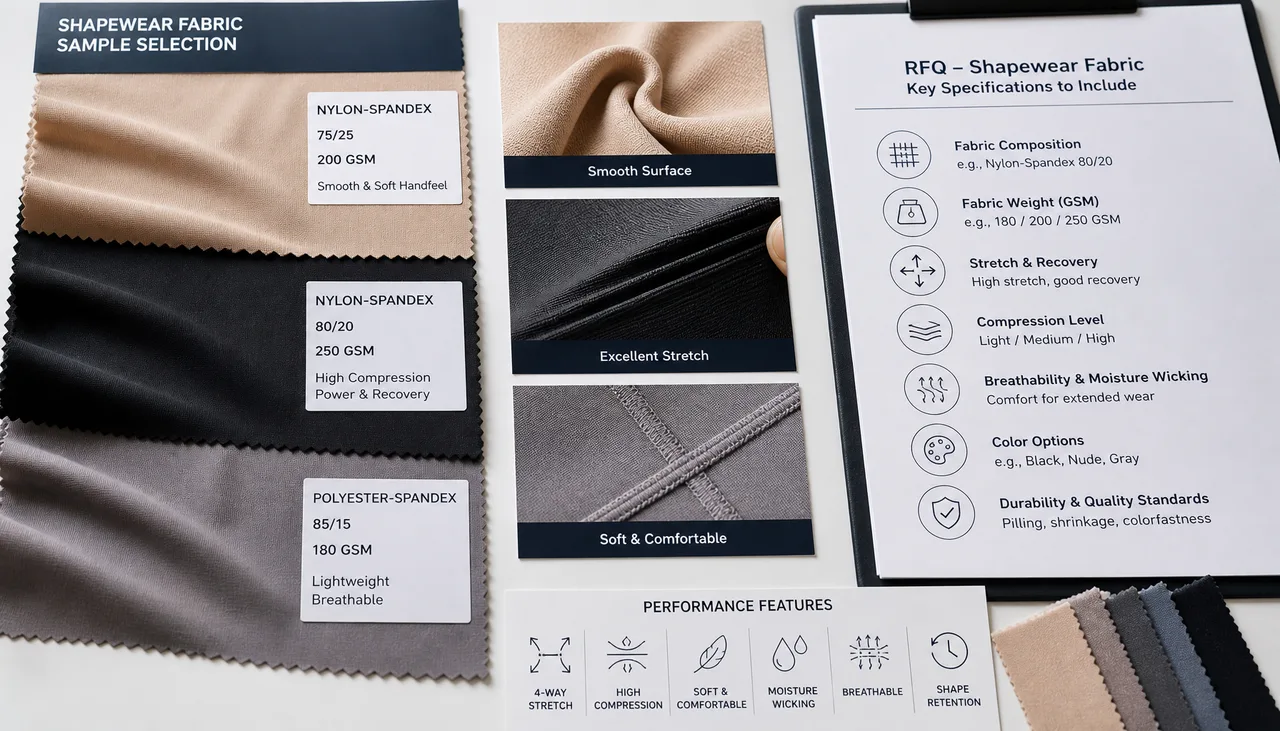
A shapewear fabric RFQ should define the garment zone, target fit, expected material extension, force and recovery requirements, construction, finished GSM, usable width, color, finish, testing conditions, quantity, and approval process. Composition or spandex percentage alone does not tell a supplier how much support the material must provide.
Start with the product and body zone
State what the fabric will do in the garment. A main body panel, abdominal reinforcement, back-smoothing panel, leg opening, gusset, lining, and waistband can require different force, recovery, thickness, and skin-contact characteristics.
Include:
- garment type and target consumer;
- body zone and whether the fabric is main, reinforcement, lining, or trim;
- intended support level described as a measurable development target;
- expected garment extension at that zone;
- pattern orientation relative to fabric direction;
- wear duration, climate, and intended care cycle;
- whether the product is fashion shapewear or subject to a medical or therapeutic claim.
Medical or therapeutic compression requires its own applicable product, regulatory, pressure-validation, and labeling framework. It should not be inferred from a general shapewear-fabric quotation.
Specify fabric force rather than “high compression”
Terms such as light, medium, firm, or high compression are not reproducible unless the buyer defines the test condition. Ask for force at a specified extension in both principal fabric directions, together with stretch recovery and residual growth.
The RFQ should state or request agreement on:
- specimen dimensions and gauge length;
- target extension and extension rate;
- force-reporting point and units;
- loading cycles and hold time;
- recovery interval and acceptable residual growth;
- pre-wash or post-wash condition;
- garment orientation of each tested direction.
Maximum elongation and spandex percentage do not replace these measurements. Two fabrics can extend to the same length while applying different force and recovering differently.
Provide a finished-fabric specification
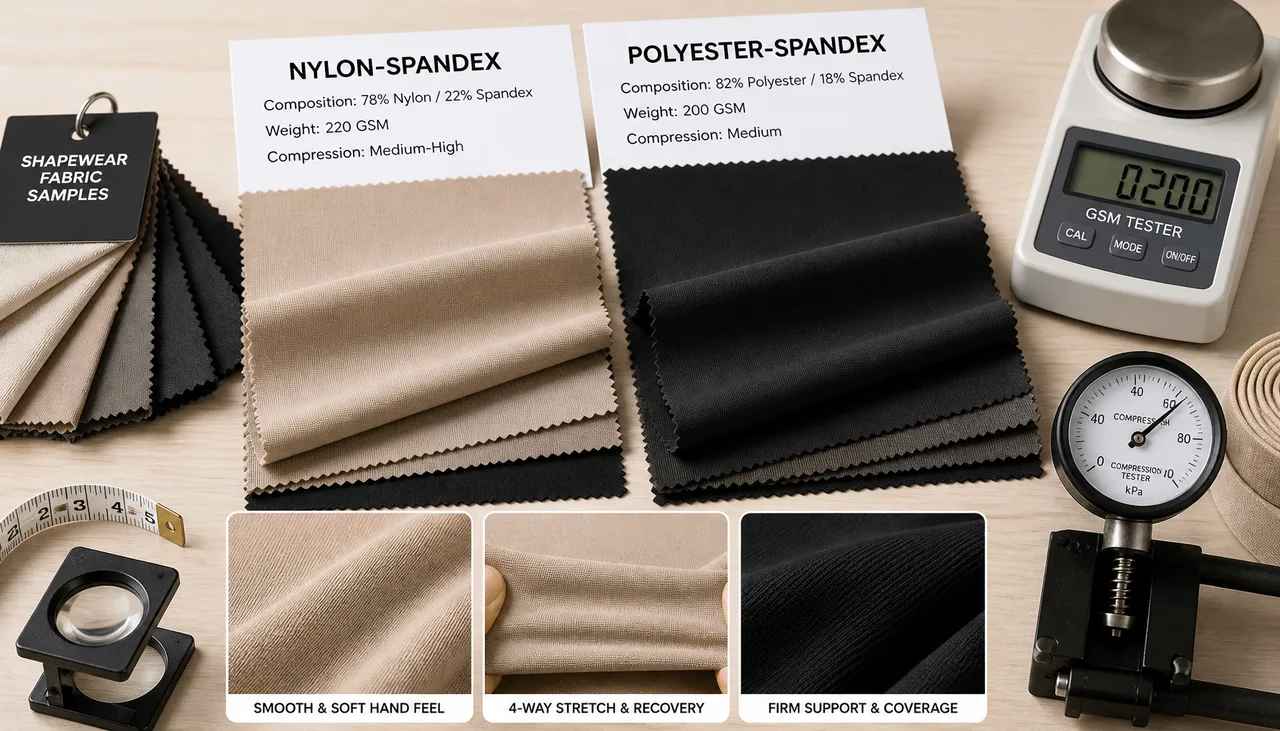
Mark each field as required, preferred, or open to supplier recommendation. This lets the supplier suggest an existing base fabric without silently changing a mandatory requirement.
| RFQ field | Information to provide or request |
|---|---|
| Composition | Nylon-spandex, polyester-spandex, permitted alternatives, and tolerance if required |
| Construction | Knit type or approved reference sample; face and back identification |
| Finished GSM | Target and tolerance measured after the agreed finishing and relaxation condition |
| Usable width | Minimum cuttable width, measurement condition, and excluded edge zones |
| Thickness | Target or limit where seam, bond, or garment bulk matters |
| Stretch response | Direction-specific extension, force, recovery, and growth conditions |
| Hand feel | Approved physical reference and required fabric side |
| Color | Standard, number of colors, viewing conditions, and shade tolerance process |
| Finish | Required treatment, performance claim, wash durability, and whether optional |
| Care | Washing, drying, heat, and number of evaluation cycles |
GSM is a mass-control value, not a compression rating. Higher GSM may add weight or cover without producing the required force or recovery.
Describe the garment construction and process
Shapewear performance depends on how the fabric interacts with the pattern and assembly system. Include any known requirements for:
- cut-and-sew, bonded, free-cut, seamless-look, or circular-knitted construction;
- seam type, needle, thread, and seam-extension needs;
- bonding film or adhesive, temperature, pressure, and dwell time;
- elastic, gripper, lining, gusset, hook-and-eye, zipper, or molded component;
- raw-edge curl, laddering, or fraying limits;
- print, lamination, brushing, coating, or heat-transfer processing.
If bonding or free-cut construction is planned, request a process trial on the intended finished fabric. A swatch-level fabric approval does not prove bond durability, edge comfort, or wash resistance.
Define the testing and acceptance matrix
Select tests from the actual garment risks. A shapewear RFQ may require:
- composition, finished GSM, usable width, and thickness verification;
- force at specified extension, maximum stretch where relevant, recovery, and residual growth;
- dimensional stability and spirality after the intended care cycle;
- bursting strength or another construction-appropriate strength check;
- pilling, abrasion, and snagging resistance;
- colorfastness to laundering, perspiration, and wet/dry rubbing;
- seam, bond, edge, elastic, or component compatibility;
- moisture or drying performance only where a defined claim is planned;
- restricted-substance and destination-market requirements supplied by the buyer.
For each item, state the method, specimen condition, units, tolerance, wash history, and action after failure. A list of test names without acceptance conditions is not a complete specification.
State quantities in comparable units
Provide development quantity, initial bulk forecast, number of colors, and expected repeat-order pattern separately. Identify whether the quote should use kilograms, linear meters, rolls, or another unit.
When converting meters to approximate kilograms:
Approximate kg = linear meters × usable width (m) × finished GSM ÷ 1,000
Illustrative calculation — not a ClothFactory MOQ or quotation:
1,000 m × 1.50 m × 220 g/m² ÷ 1,000 = 330 kg
The invoiced quantity may differ because actual GSM, finished width, roll lengths, and commercial tolerance affect delivered weight. Ask the supplier to state the invoicing basis and permitted overproduction or under-delivery.
Separate sampling from bulk commitment
The RFQ should distinguish:
- available swatches or hangers;
- stock sample yardage for garment development;
- custom color, finish, or construction development;
- laboratory testing material;
- bonding, seam, and component trials;
- retained buyer, supplier, and factory references;
- production-representative or bulk-lot confirmation.
Ask which sample characteristics are expected to match bulk and which require reconfirmation. Stock fabric in a different color or finish may support early fitting but should not automatically become the bulk-performance reference.
Request complete commercial terms
Ask the supplier to quote or confirm:
- unit price and pricing basis;
- applicable MOQ by construction, color, finish, or order;
- sample, development, dyeing, finishing, testing, and setup charges;
- whether any charge is refundable or creditable to bulk production;
- sample and bulk lead times and what starts each period;
- payment schedule and approval gates;
- quotation validity and raw-material availability;
- freight terms, packaging, roll-length policy, and inspection documents;
- overproduction or under-delivery tolerance;
- procedure for rejected, narrow, short, or out-of-tolerance rolls;
- repeat-order conditions and lot-to-lot controls.
Do not insert an assumed MOQ into the RFQ. Ask the supplier to confirm the applicable minimum after the construction, color, finish, width, GSM, and quantity basis are defined.
Use a clear approval sequence
- Buyer issues the garment-zone brief and identifies mandatory versus flexible requirements.
- Supplier proposes traceable existing fabrics or a defined development route.
- Both parties confirm sample type, quantity, cost, source, and lead time.
- Buyer evaluates fabric force, recovery, hand, cover, color, and required tests.
- Garment factory completes seam, bond, component, fit, and care trials.
- Buyer records approval against the identified fabric and garment sample.
- Supplier confirms which properties must be checked again on pre-production or bulk material.
- Bulk production starts after the agreed written authorization and payment event.
Copyable RFQ checklist
- Garment and body zone:
- Fashion or regulated compression claim:
- Required/preferred composition:
- Knit construction or reference:
- Finished GSM and tolerance:
- Minimum usable width:
- Thickness requirement:
- Pattern orientation and expected extension:
- Required force, recovery, and growth conditions:
- Hand-feel reference:
- Color standard and number of colors:
- Finish and durability requirement:
- Seam, bonding, edge, and component details:
- Care cycle and tests:
- Sample and development quantities:
- Initial bulk forecast and pricing unit:
- Destination and commercial terms:
- Approval responsibilities and bulk-release point:
Procurement next step
Issue the RFQ with a zone-specific performance brief rather than requesting “high-compression shapewear fabric.” ClothFactory can compare nylon-spandex or polyester-spandex constructions against the required force, recovery, GSM, usable width, hand, color, and finish, while the garment factory validates pattern reduction, seams, bonding, components, fit, and finished-garment pressure.