
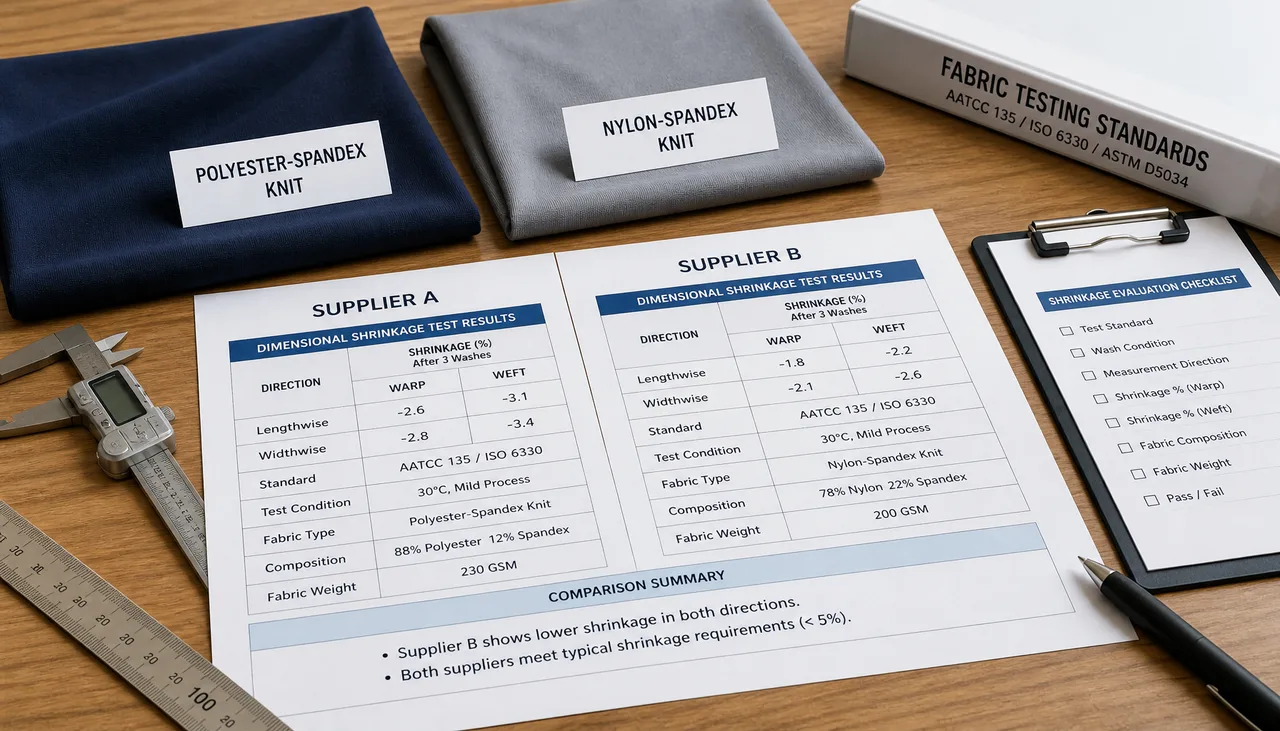
Compare supplier shrinkage reports only after aligning the specimen identity, washing and drying procedure, cycle count and measurement conditions. Keep lengthwise and widthwise results separate, then translate dimensional change into the finished garment’s measurement requirements. A smaller percentage under a gentler care procedure does not establish a more stable fabric.
1. Establish whether the reports are comparable
For nylon-spandex and polyester-spandex knits, request the fabric code, construction, finished GSM, colour, finish revision and production-lot reference. Different compositions can compete for the same garment brief; they do not have to be identical. What matters is testing each candidate against the same intended use and clearly identifying any material differences.
A report stating only “ISO tested” is incomplete. Three standards address different parts of a dimensional-change assessment:
- ISO 3759 addresses specimen preparation, marking and measurement.
- ISO 6330 specifies domestic washing and drying procedures for textile testing.
- ISO 5077 addresses determination of dimensional change after washing and drying.
Ask for the applicable edition and exact procedure, including machine type, detergent, load or ballast, drying route, number of complete cycles, conditioning and any deviations. A wash-temperature label alone does not define an equivalent test.
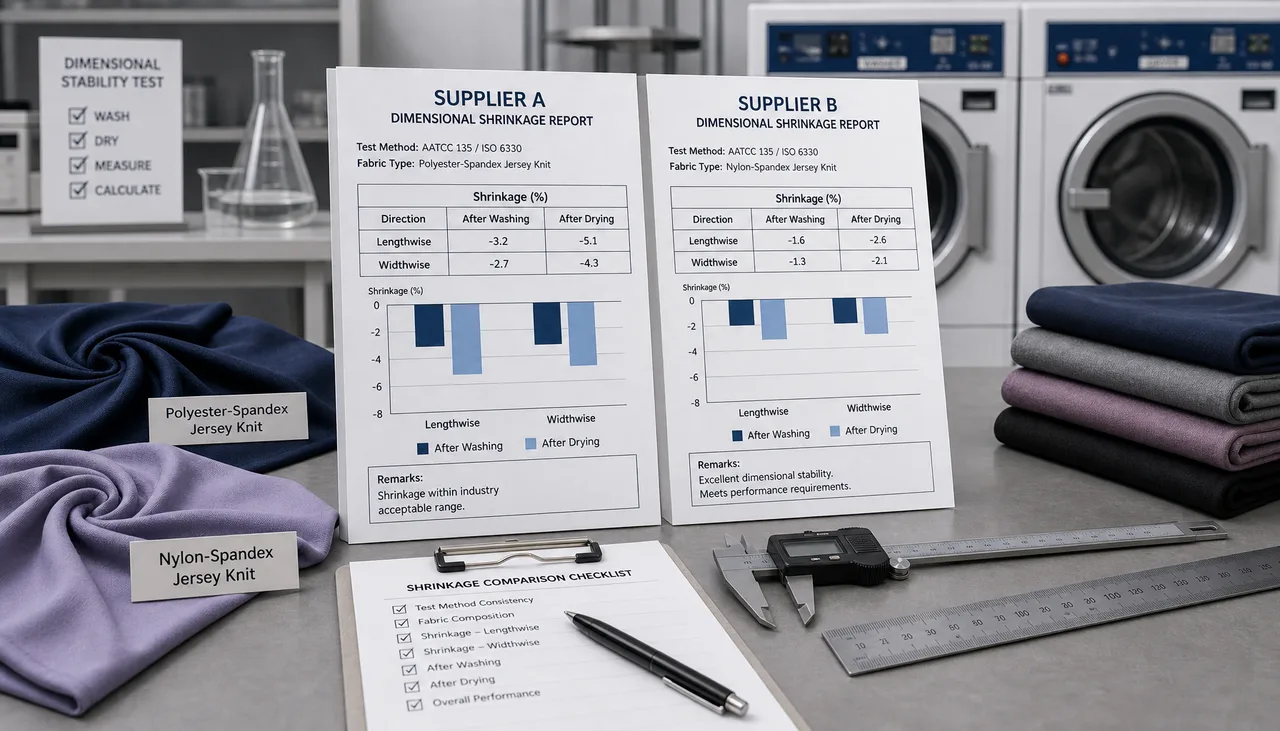
Comparison trap: a hypothetical result of −1% after one wash followed by flat drying cannot be ranked against −3% after five wash-and-tumble-dry cycles. First retest under the agreed garment care procedure. Neither number establishes which supplier is better.
2. Read signed dimensional change, not a single “shrinkage” score
Use a stated calculation convention:
Dimensional change (%) = (length after treatment − original length) ÷ original length × 100.
For example, a 500 mm marked distance measuring 480 mm after the specified washing, drying and conditioning sequence changes by −4%. A widthwise distance changing from 500 mm to 505 mm changes by +1%. Negative values indicate contraction and positive values indicate growth under this convention. If a supplier reports shrinkage as a positive number, reconcile the sign convention before comparing results.
These are calculation examples, not ClothFactory test results. Do not average the two directions: length loss and width growth create different fit and cutting risks. Also distinguish dimensional change from elastic recovery and seam spirality; a passing result for one does not establish the others.
3. Translate the result into a garment and cost decision
Consider a hypothetical yoga-legging brief requiring an 80 cm inseam after the agreed care sequence, with an allowed range of 79–81 cm. If a trial garment measures 80 cm before care and that measurement contracts by 4%, its post-care inseam becomes 76.8 cm. It fails the garment requirement even if a supplier describes 4% fabric shrinkage as acceptable.
A simple compensation calculation gives 80 ÷ (1 − 0.04) = approximately 83.33 cm before care. That is 4.17% additional length at this measurement, not a proven 4.17% increase in total marker consumption. Fabric-strip behaviour may not transfer directly to a sewn garment, and the waistband, seams, pocketing and other panels can respond differently.
Use the calculation to frame a trial, not to authorise an automatic pattern enlargement. First establish whether the change is repeatable across relevant samples and production lots. Then compare the cost of a qualified pattern adjustment with a more stable construction or a revised finishing route. Include actual marker yield, additional sampling and rejection exposure; the lower price per kilogram may not produce the lower cost per accepted legging.
4. Write a bulk-acceptance rule that cannot hide failing material
Agree directional limits from the approved garment and demonstrated process capability. There is no single commercial shrinkage limit suitable for every stretch knit, garment or care instruction. A test-method reference does not replace the buyer’s acceptance specification.
- Test scope: define the material state, care procedure, cycle count and reporting directions.
- Sampling: distinguish the laboratory method’s specimen requirements from the order plan covering selected lots, rolls and locations. MOQ does not determine either count.
- Decision rule: state whether limits apply to individual results, a specified mean or another agreed statistic. Require traceable readings rather than only a pass stamp.
- Disposition: define how nonconforming rolls are held, investigated, retested or submitted for an authorised concession.
For illustration, three lengthwise results of −1%, −2% and −6% have a mean of −3%. If the hypothetical contract requires every result to fall between −3% and +1%, the mean does not rescue the −6% result. Do not silently remove an outlier or keep retesting until a pass appears; follow the agreed investigation rule.
5. Investigate discrepancies through the production route
When matched tests disagree, confirm sample identity and laboratory conditions before changing the fabric. Ask the mill to review relevant knitting, dyeing, heat-setting, compaction where used, finishing and relaxation records. Determine whether development yardage and bulk followed the same route and whether reprocessing occurred. These are investigation paths, not proof of a cause.
A finishing adjustment intended to improve dimensional stability may also change width, GSM, hand or force-extension behaviour. Recheck the affected properties and the sewn garment before accepting the revision. Do not gain a better shrinkage number at the expense of usable width, opacity or recovery.
6. Keep the approval package traceable
For a ClothFactory sourcing comparison, submit the garment measurement specification, intended care route, candidate fabric references and complete supplier reports. Record the agreed test conditions, sample and lot IDs, directional limits, retained physical sample and approval owner. Require review when construction or finishing changes. This connects laboratory evidence to a repeatable purchase decision without presenting an unverified report or a hypothetical example as factory performance.