
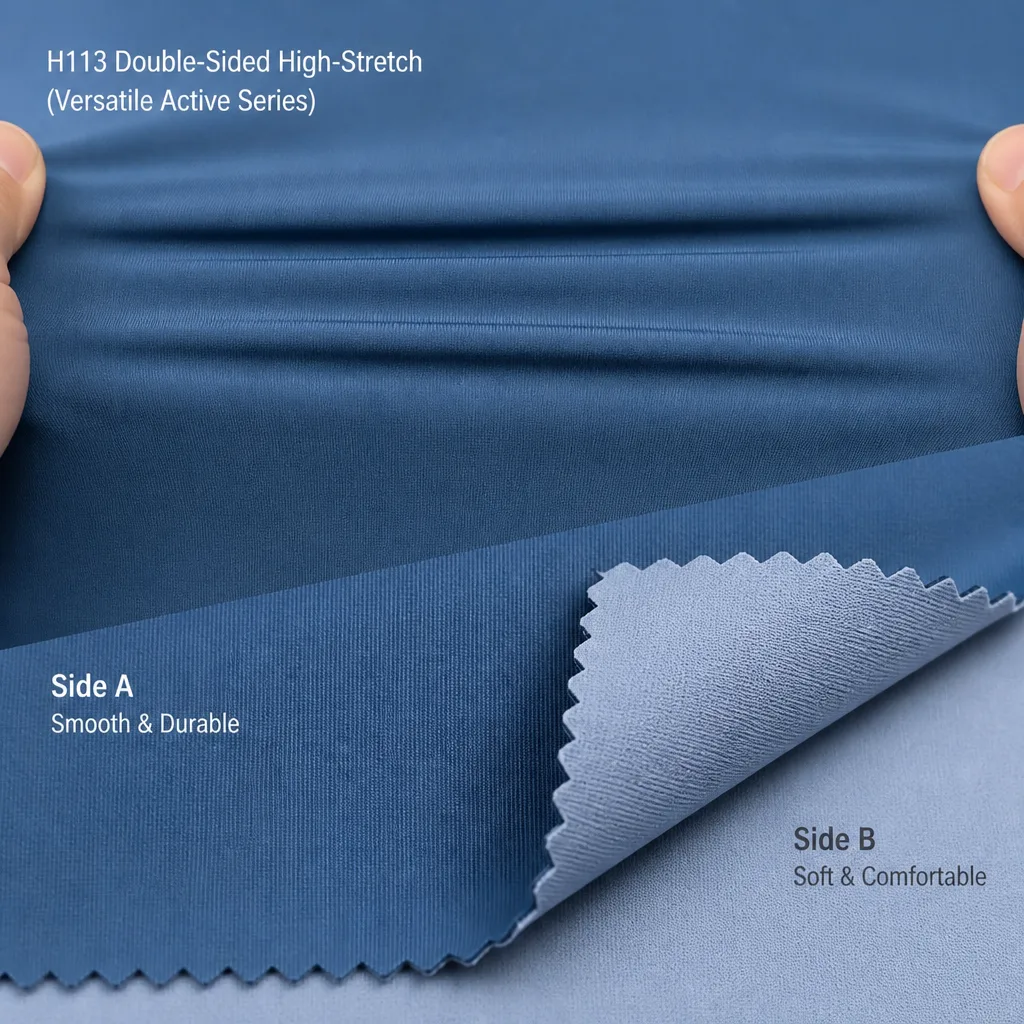
H113 is a 72% nylon, 28% spandex double-sided fabric specified at 220–230 GSM for fitted activewear. Buyers should treat the composition and weight as a starting point: support, stretch recovery, moisture handling, opacity, and wash durability must be approved on the finished fabric and in the intended garment construction.
Read the specification as a system
The supplied product information identifies three relevant variables:
- 72% nylon / 28% spandex: a high elastane proportion, which signals that stretch and recovery require close control during knitting, finishing, cutting, and sewing.
- 220–230 GSM: a medium-to-substantial fabric mass for fitted activewear, subject to the garment pattern and end use.
- Double-sided construction: both faces should be inspected for hand feel, appearance, snagging, and consistency because either side may contact the skin or remain visible in construction details.
These values do not establish compression level, moisture-wicking performance, colorfastness, or long-term shape retention by themselves. Each claim needs a defined test method and an agreed acceptance requirement.
Match H113 to the garment requirement
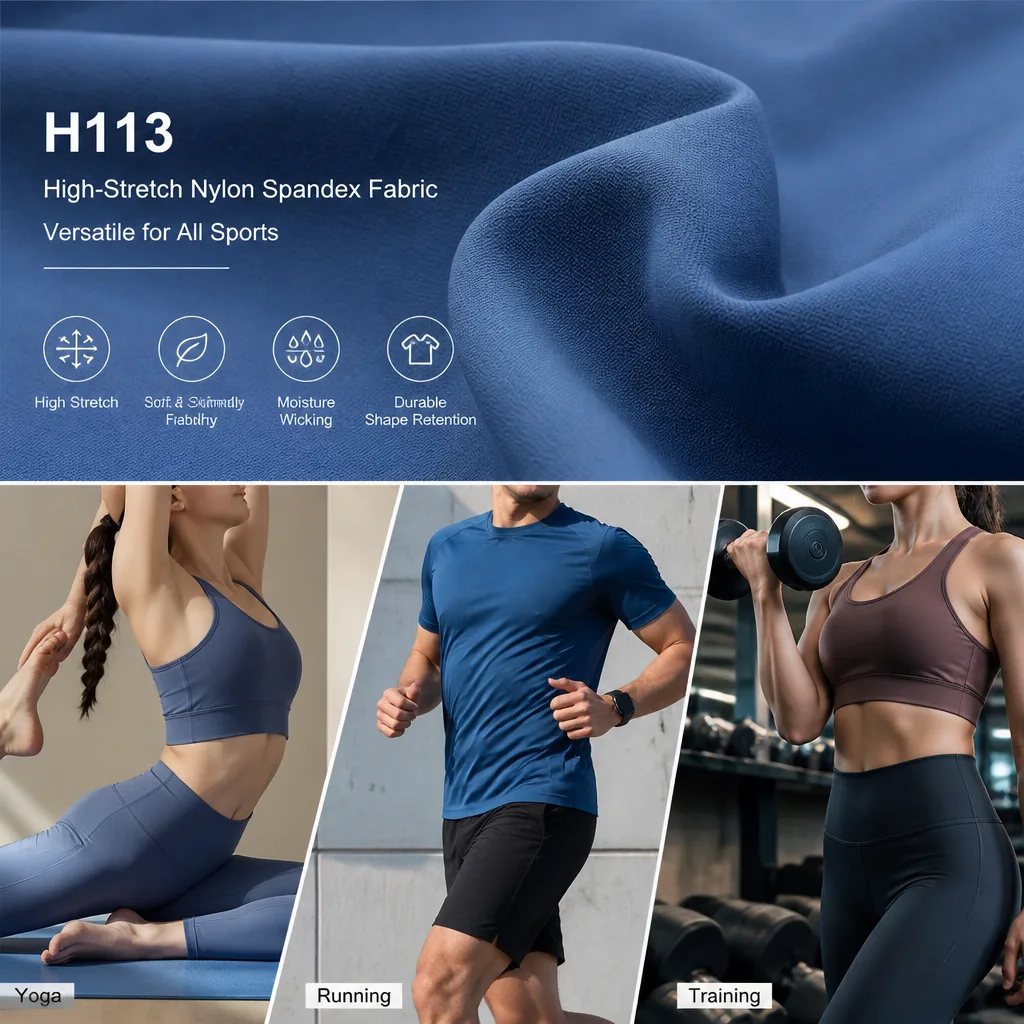
H113 may be considered for yoga leggings, fitted training bottoms, sports tops, and other close-to-body activewear where a smooth two-sided surface and substantial stretch are required. The same fabric can behave differently across these applications because pattern reduction, seam placement, panel orientation, and body-zone extension change the load applied to the material.
For leggings, assess recovery and coverage at the intended hip and seat extension. For tops, check whether the weight, drape, and moisture conditions are appropriate for the design. A fabric suitable for a supportive bottom is not automatically the right choice for a lightweight training shirt.
Illustrative garment-weight calculation
The following is a hypothetical calculation, not ClothFactory production or test data. If a garment consumes 1.20 m² of finished fabric before cutting waste, the fabric mass would be:
- at 220 GSM: 1.20 m² × 220 g/m² = 264 g;
- at 230 GSM: 1.20 m² × 230 g/m² = 276 g.
The 10 GSM difference changes calculated fabric mass by 12 g in this example. It does not indicate which sample will provide better support or comfort; construction, usable width, pattern utilization, and finishing still need to be compared.
Verify the performance claims
Use matched test conditions when comparing H113 with another candidate. At minimum, define:
| Decision area | Required evidence |
|---|---|
| Stretch and recovery | Direction, extension level, hold time, recovery time, and test method |
| Garment support | Prototype fit assessment at the intended pattern reduction; do not infer compression from spandex percentage alone |
| Moisture handling | Test method, fabric side exposed to liquid, conditioning, and wash state |
| Opacity | Selected color tested at representative garment extension |
| Dimensional stability | Agreed wash and drying cycle with length and width change reported separately |
| Surface durability | Pilling, abrasion, and snagging requirements appropriate to the garment |
One color approval should not be used to approve every shade. Dye concentration and finishing conditions can affect hand, appearance, stretch response, and visual coverage.
Cutting and sewing controls
Keep the grain direction consistent across paired and adjacent panels. Before bulk cutting, compare panel dimensions after relaxation because high-stretch fabric can distort when spread under tension.
Run a sewing trial with the intended needle, elastic thread or stretch-compatible thread, stitch density, seam type, and machine settings. Evaluate the seam both relaxed and extended, then repeat the check after the agreed care cycle. The approval criteria should cover skipped stitches, seam grin, tunneling, thread breakage, puckering, and recovery around the seam.
What to include in an H113 sample request
Provide the intended garment, target fit, pattern reduction if known, required finished width, approved GSM tolerance, color, care cycle, and test requirements. Ask the supplier to return exact construction details, usable width, stretch and recovery results by direction, dimensional stability, and any evidence supporting moisture-management or durability claims.
This creates a comparable sourcing record and prevents the 72/28 composition from being treated as proof of finished-garment performance.