
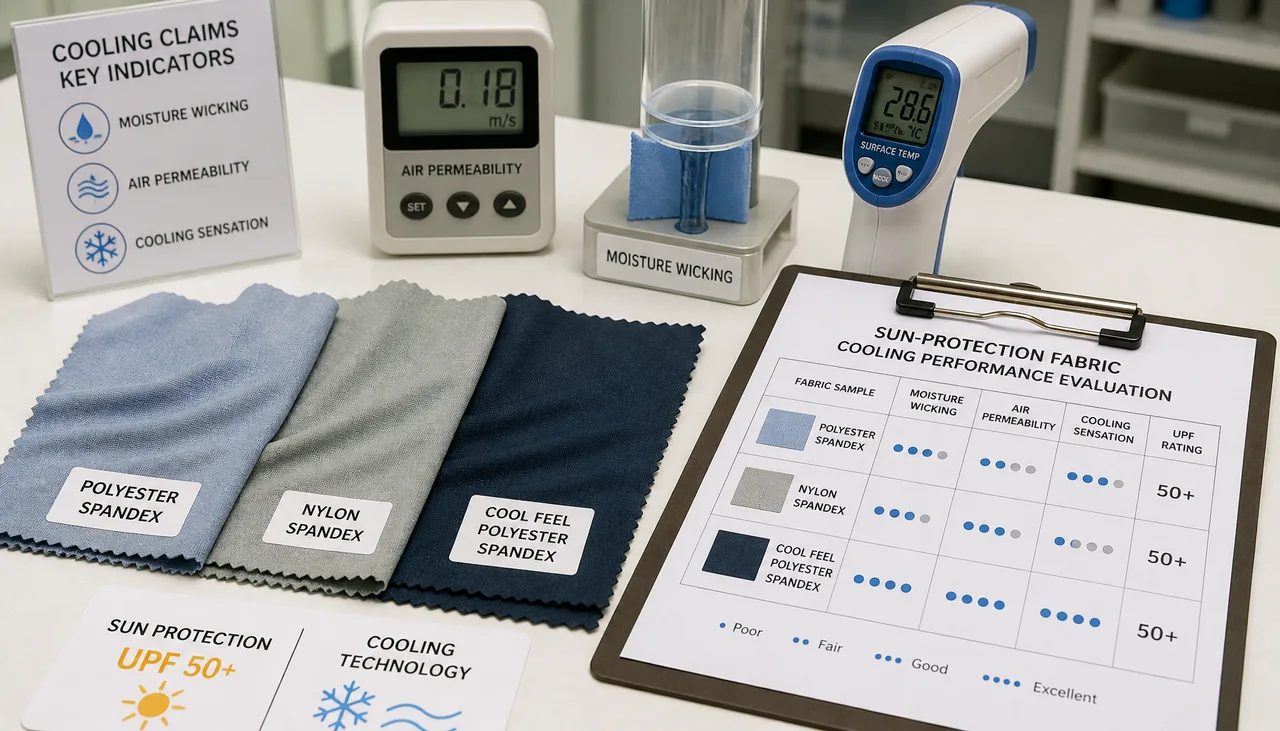
Buyers should evaluate a cooling claim by identifying the physical property being claimed, the test method used, and the conditions under which the result applies. “Cooling,” “ice feel,” and “breathable” are not interchangeable, and none of them confirms UPF performance.
Translate marketing language into a measurable property
A cooling claim may refer to:
- initial cool touch when fabric contacts the skin;
- moisture spreading or wicking;
- drying rate;
- air permeability;
- thermal resistance;
- solar or infrared reflectance.
Each property answers a different question. A cool first touch may fade as temperatures equalize. Strong moisture spreading does not prove rapid drying, and high air permeability does not prove lower temperature in direct sun. Ask the supplier to identify the mechanism before reviewing data.
Check whether the evidence matches the fabric
The report should identify the exact composition, construction, color, finish, and conditioning state. Confirm the laboratory method, units, specimen orientation, comparison material, and whether the result is before or after washing.
Avoid percentage-improvement claims unless the baseline, calculation, and test conditions are shown. A result against an unspecified control fabric cannot support a reliable sourcing comparison.
Resolve the cooling and UPF tradeoff
Sun-protection fabric often needs sufficient coverage to limit UV transmission. Increasing density or thickness may change airflow and fabric mass, while opening the construction for ventilation may affect UPF under stretch. The correct balance depends on garment fit, body coverage, color, climate, and activity.
Evaluate UPF and cooling as separate specifications. A valid UPF report does not prove thermal comfort, and a cooling result does not prove UV protection.
Include color, stretching, and washing
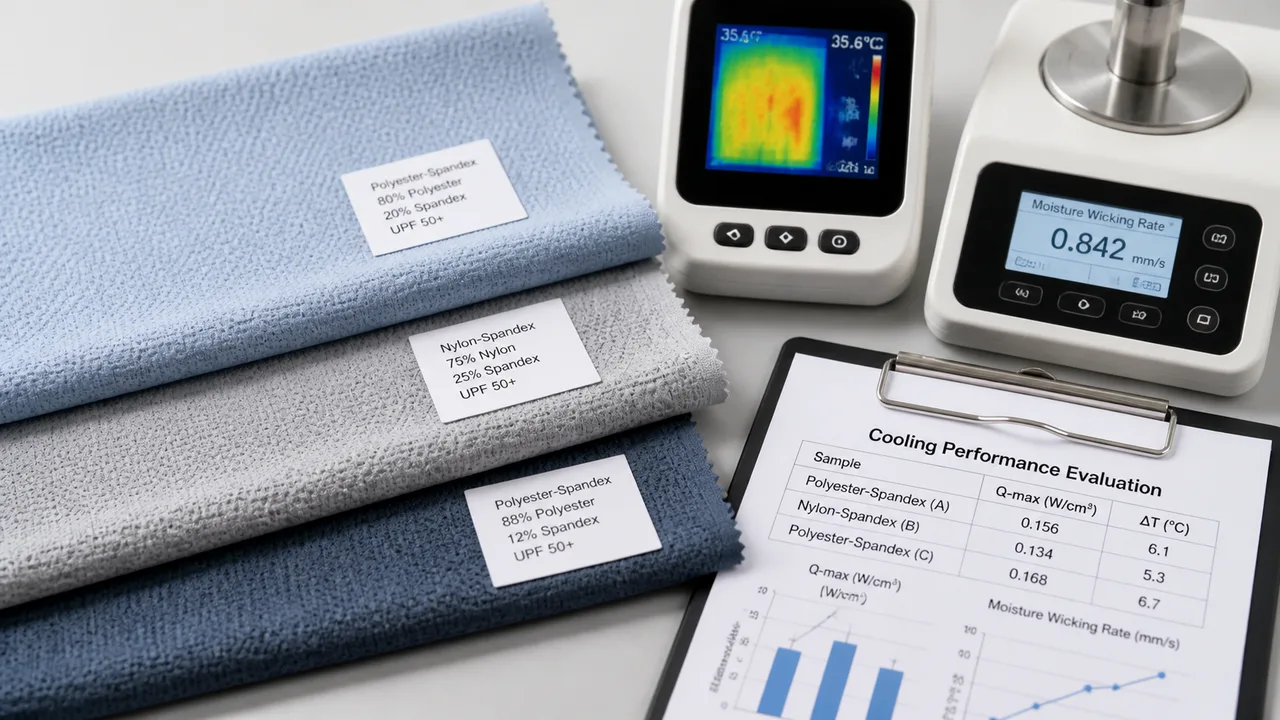
Dark and light colors can absorb and reflect solar energy differently. Dyeing and finishing may also change hand and moisture behavior. Require a color-validation plan rather than extending one shade's result to the entire range.
For fitted garments, check the structure at garment-relevant extension. If cooling or UPF depends on an applied finish, repeat the relevant measurement after the intended care cycle. The wash protocol, number of cycles, and drying method should be stated.
Compare candidates with one evidence table
| Question | Required record |
|---|---|
| What does “cooling” mean? | Defined property and measurement method |
| Compared with what? | Identified control fabric and calculation |
| Under which conditions? | Temperature, humidity, conditioning and specimen state |
| Does it survive care? | Post-wash result under the intended care route |
| Does it maintain sun protection? | Separate UPF evidence for relevant color and extension |
| Does the garment remain usable? | Fit, drape, coverage, seam and wearer trials |
Procurement next step
State the garment, climate, activity, fit, colors, care label, expected extension, and exact cooling and UPF claims. Request complete reports tied to identified finished samples. Compare candidates under the same methods, then verify the selected fabric in a washed garment sample before approving bulk or publishing performance language.