
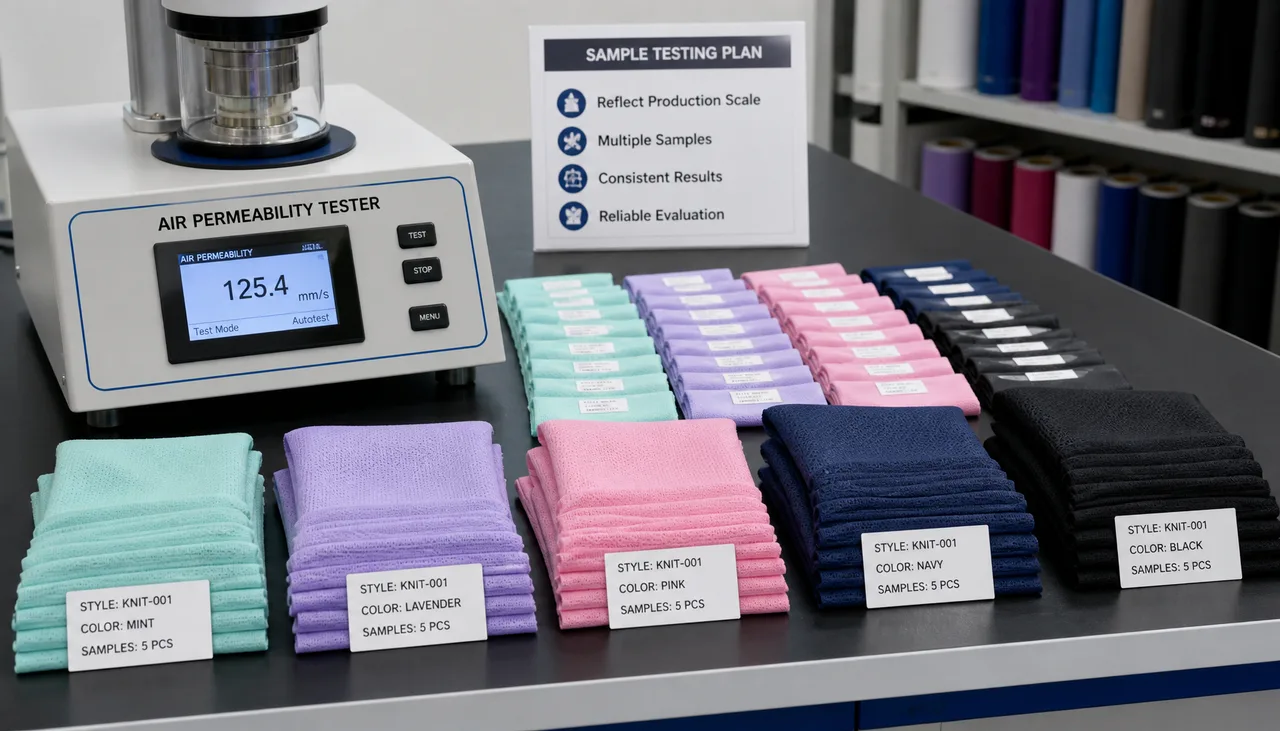
There is no reliable universal sample count for air-permeability testing. The required number depends on the selected test method, fabric variability, lot structure, and the buyer’s acceptance plan. Buyers should ask the laboratory to state the number of test areas required by the method, then distribute those readings across representative fabric positions and production rolls instead of treating repeated readings from one swatch as proof of lot consistency.
Separate test areas, specimens, and production samples
These terms are often confused. A laboratory may take several readings from one conditioned specimen, but those readings describe only the submitted piece. Multiple pieces cut from one roll improve knowledge of within-roll variation, while samples from different rolls are needed to assess a production lot. The test report should therefore identify the submitted roll, dye lot, fabric face, test direction where relevant, conditioning procedure, pressure differential, test-head area, and the location and number of readings.
Build the sampling plan around the decision
| Decision | Sampling emphasis | Limitation |
|---|---|---|
| Screening a new construction | Several separated areas from a clearly identified development sample | Does not establish bulk consistency |
| Approving a pilot lot | Beginning, middle, and end positions where accessible | Represents only the sampled roll or trial |
| Accepting bulk production | Rolls selected across the lot using the agreed inspection plan | Unsampled rolls retain residual risk |
| Investigating a claim | Known conforming and disputed garments or rolls under identical conditions | Results are invalid if methods differ |
Do not average away unstable fabric
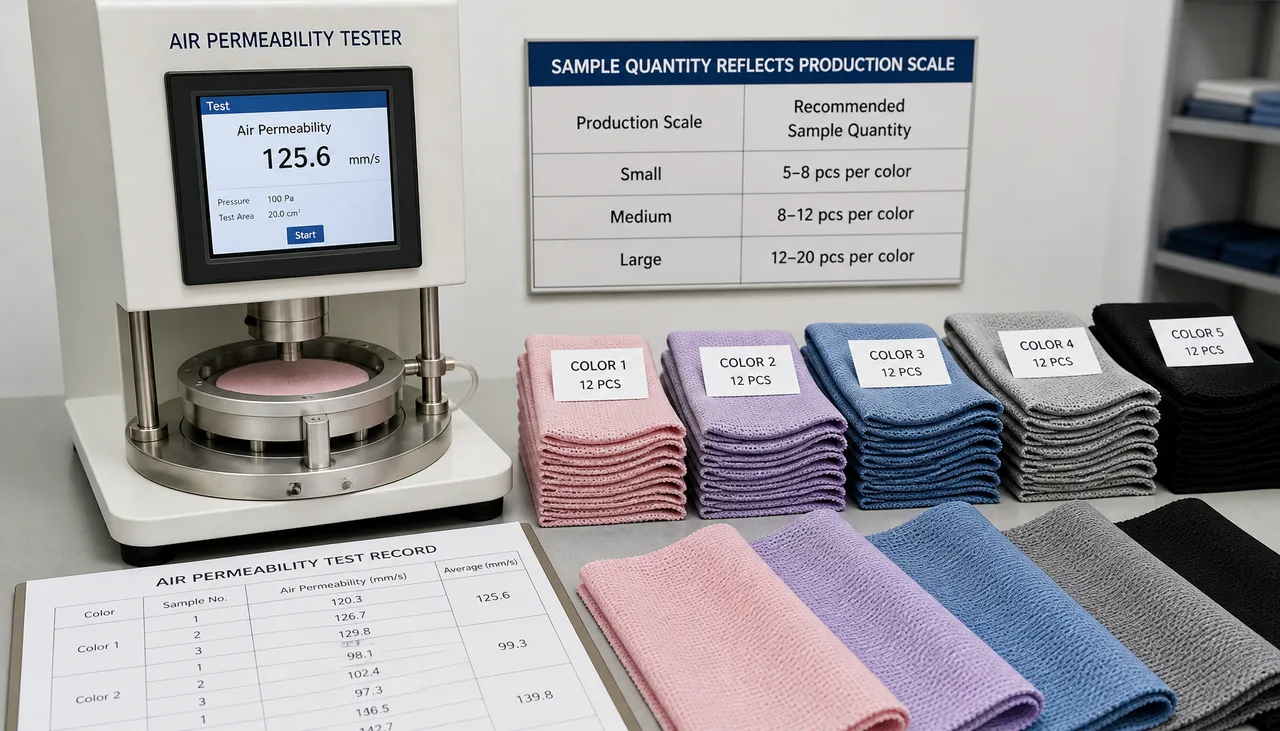
Hypothetical example: suppose five readings from one area are 210, 215, 208, 212, and 211 in the laboratory’s stated units. Their average is 211.2, but it says nothing about another roll. If five readings from a second roll cluster near 150 under identical settings, combining all ten into one average conceals a material difference. Report results by specimen and roll, review dispersion, and investigate process or sampling causes before deciding whether the lot is acceptable.
Control variables before comparing results
Air-permeability values cannot be compared when laboratories use different pressure differentials, test-head areas, conditioning environments, fabric tension, or units. Brushing, calendaring, resin treatment, moisture, relaxation, and laundering can also change the open structure. The purchase specification should name the method edition, test settings, reporting unit, specimen state, face orientation where applicable, number of readings, and pass rule. “Test according to an international standard” leaves too many commercial decisions undefined.
Connect laboratory data to the garment
Higher airflow is not automatically better. A team jersey may need ventilation, while a base layer may require a different balance among air exchange, warmth, moisture movement, and wind exposure. Seams, prints, bonded films, double layers, and garment fit can alter the result experienced by the wearer. Use fabric testing to control material consistency, then validate the shortlisted construction in a finished garment under its intended layering and activity conditions.
What to send the laboratory
- Fabric code, composition, construction, color, finish, lot and roll identifiers.
- The agreed method, pressure differential, test area, units and conditioning state.
- The number and location of submitted pieces and whether edges or defects are excluded.
- Individual readings, average, variation data and the buyer’s acceptance rule.
- Instructions for retaining specimens when confirmation or dispute testing may be required.
Before bulk approval, ask the laboratory to propose a method-compliant specimen plan and ask the supplier for a lot map so the submitted pieces represent production. ClothFactory can provide identified sample yardage for evaluation, but the buyer and laboratory should jointly define the final sampling frequency and acceptance limits. This keeps the result traceable and prevents a small, unusually open or closed swatch from representing an entire order.