Fabric Defect Inspection for Knitted Fabrics
Inspect knitted fabric in two stages: first grade visible defects against an agreed Four-Point limit; then verify GSM, width, stretch recovery, dimensional stability, bursting strength, colorfastness and moisture management with defined tests. Release bulk production only after approving the quality sample, defect limits, inspection scope and test plan.
Define the acceptance agreement before inspection
ASTM D5430 covers the visual inspection and grading of fabrics and allows the method to be used for shipment acceptance when the purchaser and supplier agree on the requirements. ASTM also notes that different point-assignment options can produce materially different results. The purchase order should therefore identify the method, point schedule, inspection scope and acceptance limit rather than state only “Four-Point inspection.”
A workable bulk specification should define:
- the approved quality sample and color standard;
- the percentage or number of rolls to inspect;
- whether rolls are selected randomly or by risk;
- the point-assignment option and score limit;
- critical defects that cause automatic roll rejection;
- permitted shade grouping and roll-to-roll color difference;
- width, GSM and physical-performance tolerances;
- the action required after a failed sample inspection.
There is no single point limit suitable for every order. A buyer may adopt 40 points per 100 square yards, 25 points or another limit, but that number is a commercial acceptance criterion, not proof that the fabric will perform in the garment.
Use the Four-Point System consistently
The common Four-Point schedule assigns points from the longest dimension of each visible defect:
| Defect length | Penalty |
|---|---|
| Up to 3 in (75 mm) | 1 point |
| Over 3 to 6 in (75–150 mm) | 2 points |
| Over 6 to 9 in (150–230 mm) | 3 points |
| Over 9 in (230 mm) | 4 points |
No linear yard or meter should receive more than four points. The Cotton Incorporated Four-Point summary also assigns four points to a full-width defect, a seam, or a section whose usable width is below the agreed minimum. Holes, continuous defects and other critical faults should be handled exactly as stated in the buyer–supplier inspection agreement.
For orders measured in yards and inches, normalize the score as follows:
Points per 100 yd² = total penalty points × 3,600
                       ÷ (inspected yards × fabric width in inches)
Worked shipment example
A buyer inspects 800 yards of 60-inch fabric and records 420 points:
420 × 3,600 ÷ (800 × 60) = 31.5 points per 100 yd²
If the purchase specification allows no more than 25 points per 100 square yards, the inspected lot fails. The correct response is not an immediate argument over the total. First check the defect map: one repeated needle line across several rolls has a different production and cutting impact from many isolated minor marks that produce the same score.
Classify defects by garment risk
The inspection report should record defect type, roll number and position. “Fabric defective” is not enough information for containment or cutting decisions.
| Defect | Likely production signal | Garment risk |
|---|---|---|
| Needle line or drop stitch | Damaged needle, incorrect needle setup or unstable knitting condition | Visible line, hole growth or panel rejection |
| Barre or horizontal banding | Yarn-lot, tension, feed or dye-affinity variation | Repeating shade bands across garment panels |
| Side-to-center or end-to-end shading | Uneven dyeing, heat setting or finishing | Panels from one roll appear mismatched |
| Bow or skew | Knitting and finishing distortion | Twisted seams, displaced stripes or unstable garment shape |
| Crease or heat-set mark | Rope crease, folding pressure or finishing condition | Permanent line that remains after relaxation or washing |
| Oil, contamination or foreign fibre | Machine oil, handling or material contamination | Stains, dye spots or visible foreign matter |
| Snag, pull or surface abrasion | Handling, machine contact or unsuitable surface durability | Broken appearance and reduced consumer durability |
| Hole | Needle damage, excessive tension or handling damage | Automatic panel loss; may propagate under stretch |
For nylon-spandex and polyester-spandex fabrics, inspect the material both relaxed and under a controlled extension agreed during development. A defect that is difficult to see on a relaxed dark fabric may become obvious when a legging panel is stretched. The extension condition must be recorded; uncontrolled hand stretching does not provide comparable results.
Inspect rolls with traceable conditions
The inspection process should make the result repeatable:
- Confirm the purchase order, approved sample, color standard and inspection method.
- Select rolls across dye lots, production dates and machine positions. Increase coverage when earlier lots, new constructions or dark shades present higher risk.
- Condition or relax the fabric as required by the agreed method before measuring width, GSM or distortion.
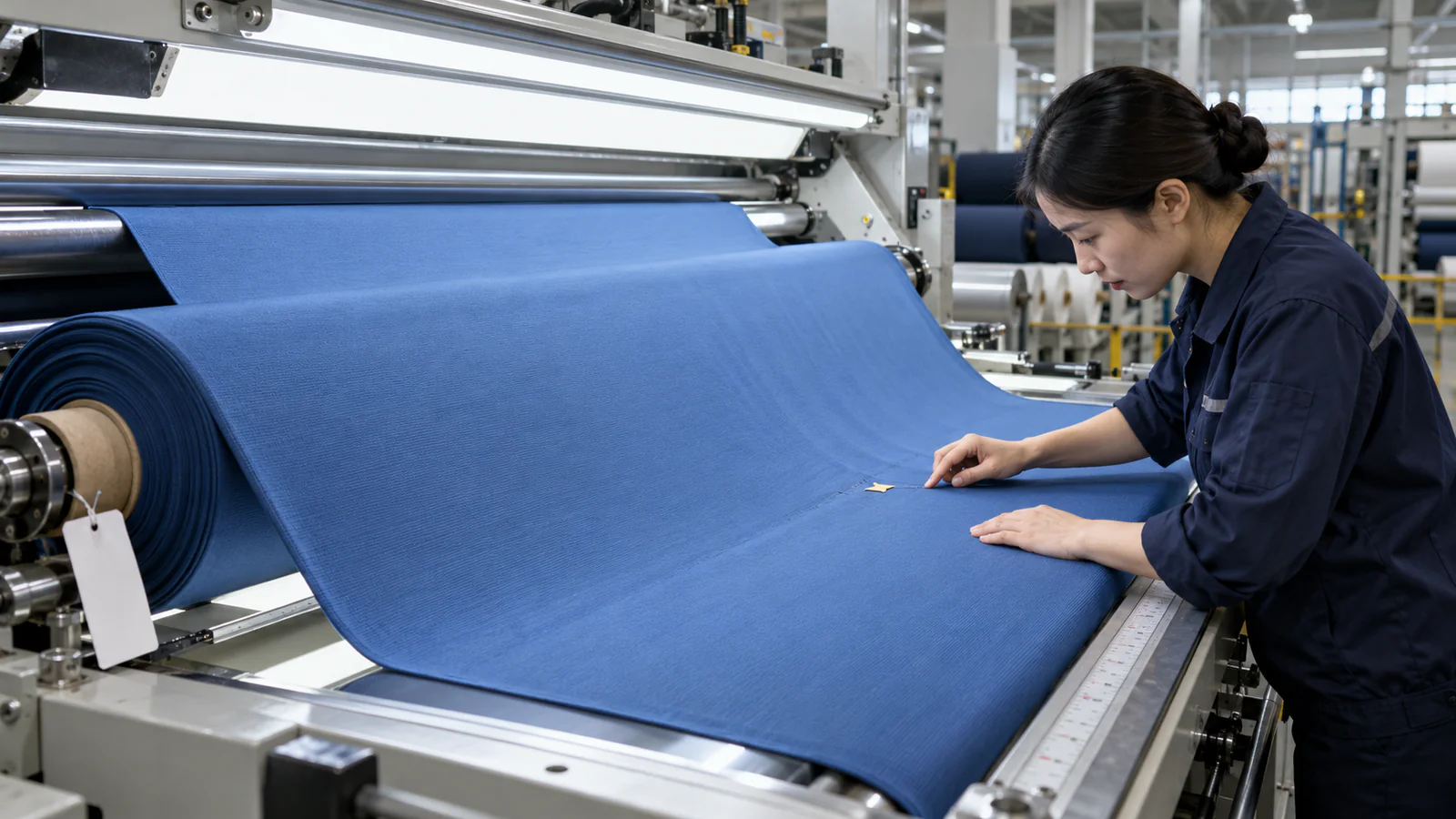
- Inspect on a calibrated machine under consistent lighting. Record the inspection speed instead of relying on an unrecorded “normal speed.”
- Mark every defect and record its roll position, point value and defect code.
- Check usable width and shade at the beginning, middle and end of each inspected roll.
- Calculate the normalized score for each roll and for the inspected lot.
- Quarantine failed or doubtful rolls until disposition is agreed.
The report should retain roll identity. A shipment average can conceal one severely defective roll, while a roll-level record allows cutting teams to segregate material or calculate expected panel loss.
Separate visual grading from performance testing
A visually clean roll can still fail in production. Select laboratory tests according to the garment and claim rather than attaching every available method to every order.
| Procurement risk | Test direction |
|---|---|
| Incorrect fabric weight | Mass per unit area, such as ASTM D3776/D3776M |
| Width shortage | Fabric width, such as ASTM D3774 |
| Twisting or distorted courses | Bow and skew, such as ASTM D3882 |
| Bagging or poor recovery | Stretch and growth under a method suitable for the construction and support level; ASTM D2594/D2594M is one option for low-power knitted fabrics |
| Bursting at knees, elbows or tight seams | Bursting strength, such as ASTM D3786/D3786M or ASTM D6797 |
| Surface fuzzing or pills | Pilling resistance, such as ASTM D4970/D4970M |
| Snagging on textured knits | A snagging method selected for the fabric structure, such as ASTM D3939/D3939M or ASTM D5362 |
| Dye transfer or wash discoloration | Agreed AATCC colorfastness methods for crocking, laundering and perspiration |
| Moisture-management claim | A defined AATCC method such as TM195, TM197, TM198 or TM217, chosen for the claimed behavior |
A pen puncture is not a bursting-strength test, squeezing fabric in a fist is not a recovery test, and timing one water drop is not sufficient evidence for a moisture-wicking claim. These checks may help screen samples, but they should not release bulk fabric or support product claims.
ASTM D2594/D2594M also cautions that its between-laboratory precision is poor for commercial acceptance. If buyer and supplier laboratories report materially different stretch or growth results, test matched specimens and investigate method, conditioning and equipment bias before deciding which lot is acceptable.
Write a release rule that protects garment yield
The release decision should combine four records:
- roll-level visual inspection scores and defect maps;
- shade grouping and roll sequence;
- measured width, GSM and agreed physical-test results;
- the effect of defects on marker placement and usable garment yield.
Return to the 800-yard example. A score of 31.5 fails a contractual limit of 25, but the commercial decision still depends on location. If most points come from a continuous needle line through the marker width, panel loss may make the lot unusable. If isolated defects can be mapped and cut around, the parties may agree to replacement yardage, a credit or controlled cutting. Any concession should identify the affected rolls and must not silently change the standard for future lots.
Information buyers should send with an inspection request
Provide the fabric code and construction, fiber composition, nominal GSM and usable width, color and dye-lot details, end use, approved quality sample, inspection scope, Four-Point limit, critical-defect list, physical test methods and tolerances. For close-fitting activewear, also state the garment zone, expected extension and whether appearance must be assessed under stretch.
This information lets the fabric mill inspect against the intended product rather than a generic checklist. It also creates a traceable basis for corrective action before cutting begins.
References
- ASTM D5430-26: Standard Test Methods for Visually Inspecting and Grading Fabrics
- Cotton Incorporated: Fabric Defects Classification and the Four-Point System
- ASTM D2594/D2594M-21: Stretch Properties of Knitted Fabrics Having Low Power
- ASTM textile test-method directory
- AATCC standard test-method directory