
Brands should retest drying rate when a repeat order changes the fiber, yarn, knit construction, GSM, finish, color process, production route, care condition, or performance claim—or when incoming inspection indicates that the new lot no longer matches the approved reference. If the specification and controlled process remain unchanged, the retest frequency should follow a written risk-based quality plan rather than an unsupported assumption that every repeat order is identical.
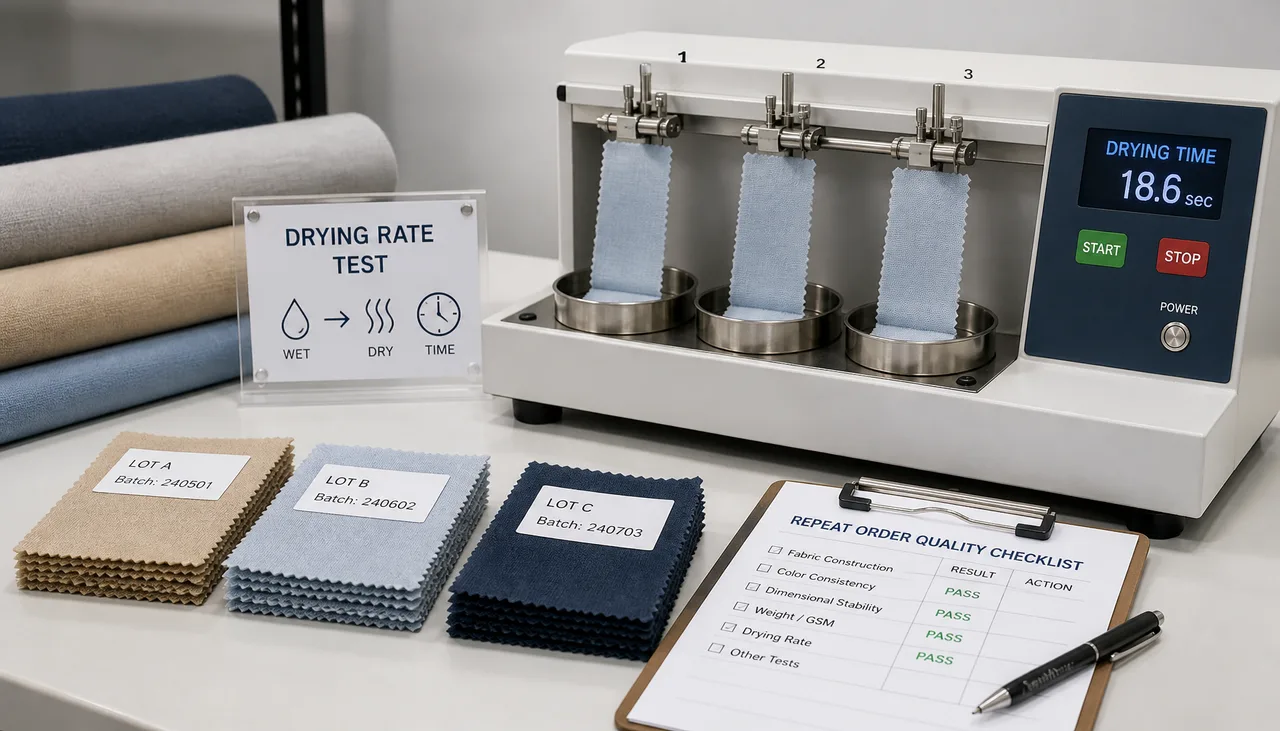
Establish a baseline before setting the retest rule
The first approved production should create a traceable reference. Record the fabric code, composition, knit construction, finished GSM and width, color, finish, care cycle, conditioning, test method, specimen preparation, water application, endpoint, and result. Retesting cannot confirm consistency if the original approval conditions are missing.
Keep drying rate separate from wicking, absorbency, and multidirectional moisture transport. These properties may interact, but one result does not substitute for another. If the product claim is “quick dry,” the purchase specification should identify the exact method and acceptance criterion used to support that claim.
Retest after a material or construction change
Retest when the repeat order changes any variable that can alter water uptake, spreading, evaporation area, or fabric mass. Relevant changes include:
- fiber composition or supplier-declared raw material;
- yarn count, filament structure, texturing, or yarn source;
- knit construction, density, thickness, finished GSM, or width;
- spandex content or fabric stretch that changes the exposed surface under wear;
- brushing, sanding, calendaring, heat setting, or other surface treatment;
- moisture-management, softening, anti-odor, or other chemical finish;
- garment care instruction when testing includes laundering.
A matching composition label is not evidence that two constructions dry at the same rate. Polyester-spandex and nylon-spandex fabrics can each behave differently when yarn, loop geometry, GSM, or finishing changes.
Retest after a production-process change
The supplier should notify the buyer when production moves to a different mill, machine group, dyeing route, finishing line, or subcontracted process. Retesting is also appropriate after a major recipe adjustment, equipment change, prolonged production interruption, or corrective action related to moisture performance.
The purpose is not to distrust every process change. It is to verify that the approved product claim still applies after a variable with technical relevance has changed.
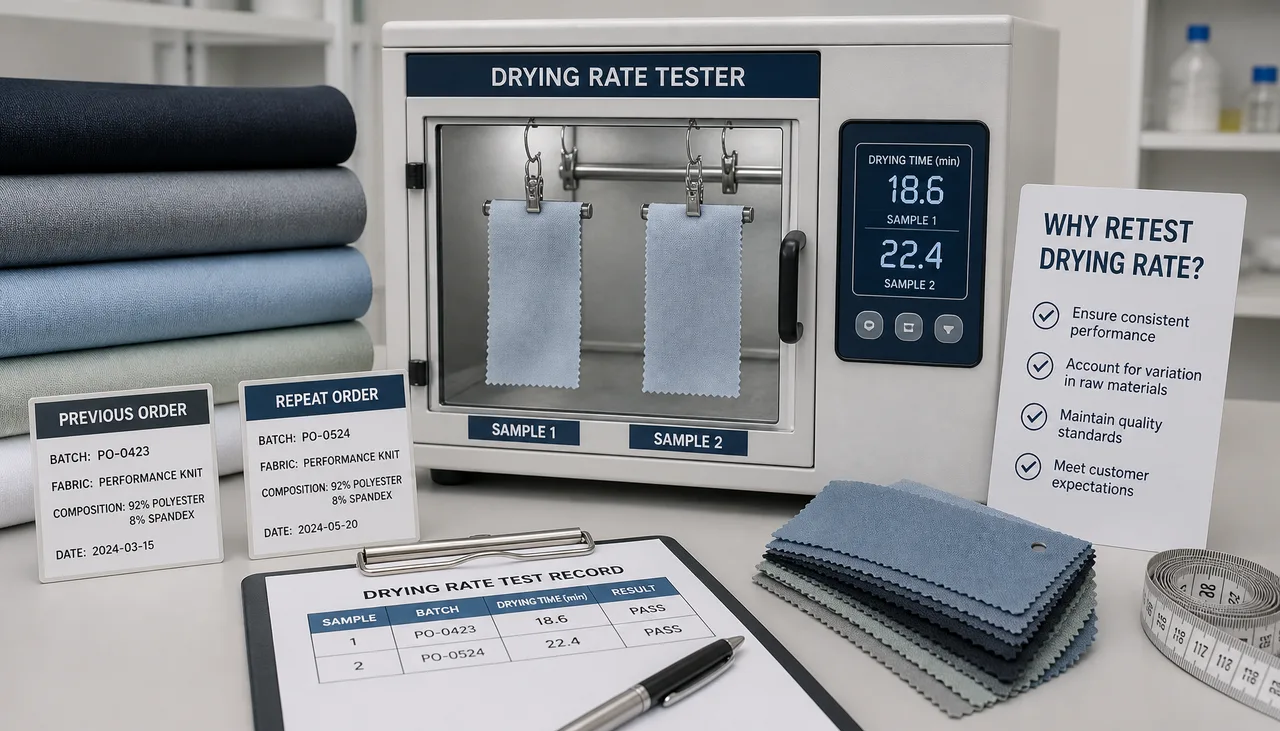
Use a risk-based rule for new colors and dye lots
A new dye lot does not automatically prove that drying performance changed, but color depth, auxiliaries, finishing conditions, and heat history may affect the finished result. The retest rule should reflect how the performance is achieved.
| Repeat-order condition | Recommended action | Reason |
|---|---|---|
| Same construction, finish, color route, and controlled production | Verify according to the agreed periodic or lot-based quality plan | Confirms continued control without treating every reorder as a new development. |
| New color family or materially different shade depth | Retest a representative finished lot | Dyeing and finishing conditions may differ from the approved reference. |
| Finish is responsible for the drying claim | Retest after finish application and after the agreed wash condition | Confirms initial performance and finish durability. |
| Mixed dye lots or production groups in one order | Keep samples traceable and test representative groups | Prevents an average from hiding one nonconforming group. |
| Incoming GSM, width, hand, or appearance has shifted | Hold approval and investigate before relying on the previous result | The shift may indicate a construction or process change. |
| Complaint, failed garment test, or abnormal production result | Retest retained and current samples under the same method | Helps separate fabric variation from garment, laundering, or test variation. |
For claim-critical garments, the purchase agreement may require verification on every lot. For lower-risk products with demonstrated process stability, periodic testing may be appropriate. The buyer and supplier should agree the frequency before production rather than deciding after a disputed result.
Keep retest conditions identical to the baseline
Drying-rate results are sensitive to specimen preparation and environment. Record and control:
- specimen size, orientation, and number;
- conditioning temperature and humidity;
- starting dry mass where the method uses mass;
- amount and application method of test liquid;
- support surface, airflow, temperature, and relative humidity during drying;
- timing interval and endpoint definition;
- whether the fabric is relaxed, extended, new, or laundered;
- method edition, equipment, and any deviation.
Changing the endpoint from “time to a defined residual moisture level” to “mass lost after a fixed time” creates a different measurement. The repeat-order result must use the same definition as the approved baseline.
Illustrative calculation for a mass-loss method
The following is an illustrative calculation, not a ClothFactory test result or a universal test method. Suppose a controlled procedure records a specimen at 12.0 g immediately after wetting and 9.6 g after 20 minutes:
Water mass lost = 12.0 g − 9.6 g = 2.4 g
Average mass-loss rate = 2.4 g ÷ 20 min = 0.12 g/min
This value is comparable only with specimens tested using the same fabric area, water dose, conditioning, airflow, timing, and endpoint. It does not by itself prove that the garment will feel dry during wear.
Investigate the result before rejecting the lot
If the repeat lot differs from the baseline, first confirm that the laboratory conditions, specimen preparation, and calculation are consistent. Then review lot traceability, GSM, construction, finish add-on where applicable, color route, heat-setting history, and wash condition.
Retest matched retained and current specimens when possible. A retained reference tested in the same session helps show whether the difference comes from the fabric or the test environment. Do not discard the original result or repeatedly retest until one specimen passes; retain every result and document the disposition.
Information buyers should include in the repeat-order specification
Provide the supplier or laboratory with:
- approved fabric code and sealed reference;
- composition, knit construction, finished GSM, width, color, and finish;
- intended garment and moisture-related claim;
- drying-rate method, edition, specimen count, and conditioning;
- water dose, timing, endpoint, and acceptance tolerance;
- required prewash or number of wash cycles;
- lot definition and roll-selection rule;
- change-notification requirements;
- retest frequency and action after a failed or borderline result.
Procurement next step
Create a change-control list for every repeat fabric order and compare it with the approved baseline before releasing production. Retest immediately when a relevant material, construction, finish, process, shade route, care condition, or claim changes; otherwise follow the agreed periodic or lot-based verification plan. ClothFactory can provide identified nylon-spandex or polyester-spandex samples for comparison, but the buyer and supplier should agree the method, baseline, frequency, and acceptance rule before treating drying performance as consistent.