
Tennis-dress development is most often delayed when the fabric is approved before the outer dress, inner short, stretch direction, coverage, finish, color, and care requirements are defined separately. The recurring failures are show-through under extension, incorrect stretch force or recovery, unstable dimensions after washing, incompatible seams or bonding, and sample fabric that does not represent the intended bulk construction.
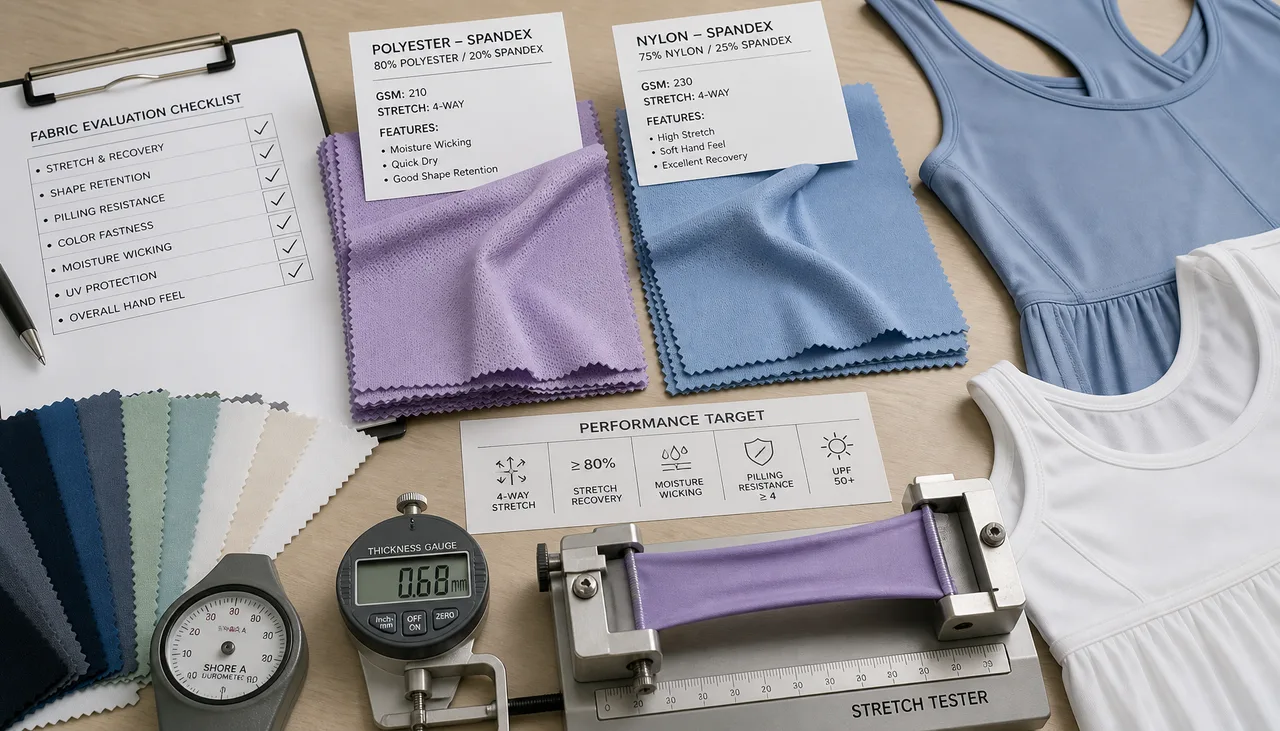
Treat the dress and inner short as separate fabric zones
A performance tennis dress may combine an outer skirt or dress body with an attached inner short, pocket, lining, waistband, or bra component. These zones do not necessarily need the same material response.
- Outer dress or skirt: drape, movement, low bulk, surface appearance, wind response, and color presentation may dominate.
- Inner short: coverage under extension, recovery, support, next-to-skin comfort, pocket stability, and resistance to riding up may dominate.
- Waistband or support panel: force at a specified extension and post-wash recovery may matter more than maximum stretch.
Using one fabric can simplify sourcing, but only if it passes every zone's requirements. Development slows when a single swatch is approved for hand feel and later fails in the liner, waistband, or skirt movement test.
Coverage fails when samples are reviewed only in a relaxed state
Light colors and close-fitting inner shorts can lose cover when the knit opens over the seat and thigh. GSM and fiber composition cannot predict this result by themselves. Yarn size, loop density, color, finish, garment extension, and lighting all affect appearance.
Define the extension expected in the garment zone, then inspect the intended color in relaxed and extended states under consistent lighting. A dark development swatch should not be used to approve a white or pale production color.
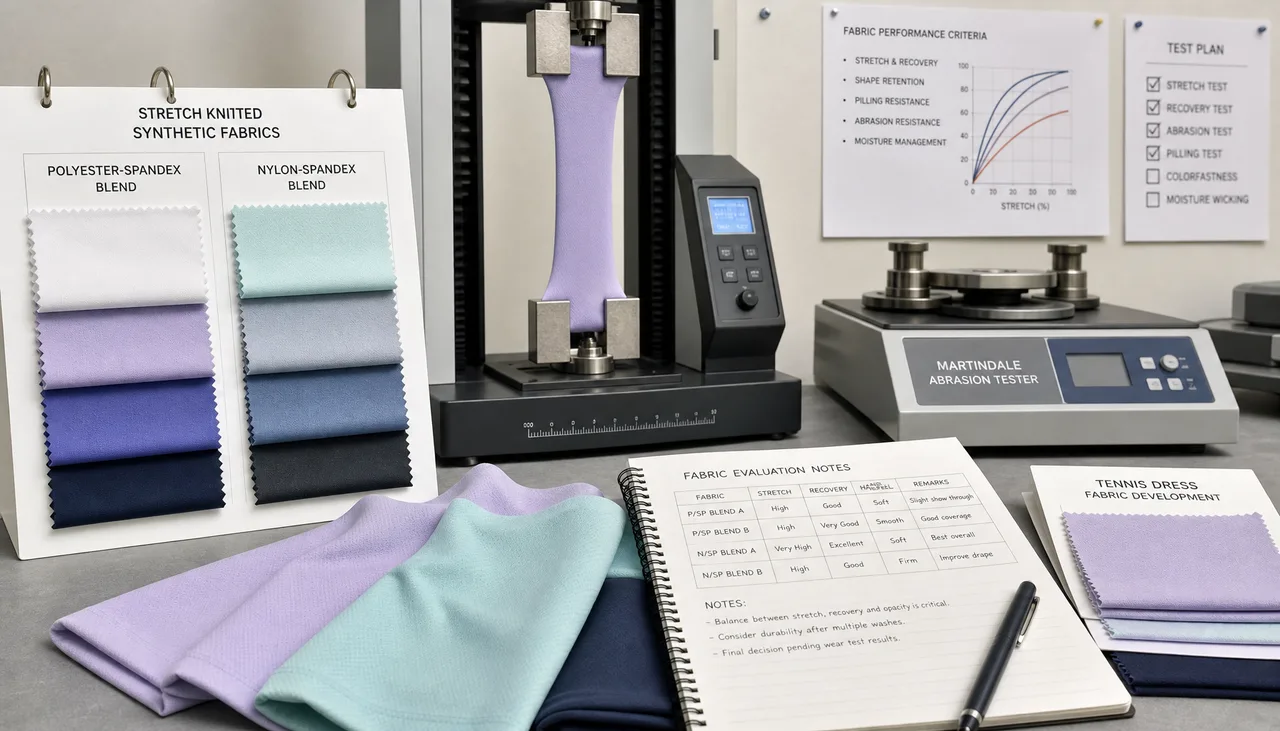
Maximum stretch is confused with fit and support
A fabric may reach the required extension but apply too much or too little force, recover slowly, or retain growth after movement. These problems appear as restricted movement, waistband pressure, bagging, a loose pocket, or an inner short that rides up.
For each body zone, record:
- fabric direction in the pattern;
- expected garment extension;
- force at the specified extension;
- loading cycles, hold time, and recovery interval;
- residual growth before and after laundering;
- appearance and cover at the same extension.
Spandex percentage is not a support specification. Compare candidates only under the same specimen dimensions, direction, conditioning, rate, cycling, and wash history.
GSM and usable width are approved without a marker
GSM affects fabric mass, but it does not independently establish drape, opacity, airflow, or durability. Usable width affects pattern nesting and consumption, particularly when the skirt and inner short have different panel shapes or stretch orientations.
Ask the garment factory to run a marker using the supplier's minimum acceptable usable width. Record whether width excludes selvedges, edge curl, pin marks, shade variation, or unstable zones. A bulk roll that is narrower than the approved marker basis can force recutting, extra fabric, or pattern changes late in development.
Finishing changes the approved hand and dimensions
Dyeing, heat setting, brushing, moisture-management finishing, printing, or another treatment can change hand, GSM, width, stretch force, recovery, surface appearance, and dimensional stability. A stock swatch may be suitable for early pattern work but should not automatically become the bulk reference for a custom color or finish.
The approval record should identify:
- the sample source and lot;
- finished composition, construction, GSM, and usable width;
- color and viewing conditions;
- finish and fabric face;
- wash history and relaxation condition;
- which characteristics must be reconfirmed on pre-production or bulk material.
Assembly problems are discovered after fabric approval
Tennis dresses can combine high-stretch seams, bonded edges, elastic, grippers, pockets, zippers, lining, mesh, or molded components. Fabric properties that look acceptable in a swatch can change during cutting, sewing, pressing, bonding, or laundering.
Run process trials with the intended factory settings and components. Check:
- skipped stitches, seam grin, puckering, and needle damage;
- bond strength, hand, edge stiffness, and delamination where bonding is used;
- edge curl or laddering at free-cut areas;
- pocket distortion under phone or ball loading;
- elastic and fabric recovery after washing;
- print or surface damage caused by heat and pressure.
Fabric approval and assembly approval should be separate gates.
Functional claims are added without a matching test plan
Terms such as moisture-wicking, quick-dry, cooling, antibacterial, or UV protection require a defined method, specimen condition, acceptance criterion, and durability requirement. A finish offered as an option should not be treated as a standard property of every nylon-spandex or polyester-spandex construction.
Adding a claim after color and hand approval can restart finishing, testing, and wash validation. Decide which claims are commercially necessary before requesting development samples.
Too many variables are changed in one sampling round
Changing composition, GSM, color, finish, and pattern at the same time makes failure difficult to diagnose. Narrow the base construction first, then confirm color and finish, and finally validate the representative garment.
Illustrative development matrix — not a ClothFactory project record: if a team evaluates two outer fabrics, two inner-short fabrics, and three colors without narrowing candidates, it creates:
2 outer options × 2 inner options × 3 colors = 12 combinations
If each combination also has two finishes, the matrix becomes 24 combinations. The calculation shows why disciplined approval gates reduce sample volume and unclear results; it is not a recommended sample count.
Use a problem-to-decision checklist
| Delay signal | Likely unresolved question | Required decision or evidence |
|---|---|---|
| Inner short appears transparent | Was coverage approved at the garment extension and production color? | Extended-state visual standard and representative garment sample |
| Waist or liner loses shape | Were force, recovery, and growth conditions defined? | Direction-specific test results before and after washing |
| Skirt drapes poorly | Was outer-layer behavior separated from liner requirements? | Layer-specific fabric brief and movement sample |
| Consumption rises after grading | Was the marker based on minimum usable width and size ratio? | Approved marker assumptions and width tolerance |
| Hand changes in production color | Did the development swatch use the final dye and finish route? | Finished color sample and bulk reconfirmation point |
| Seams or bonds fail | Was the fabric trialed with production components and settings? | Seam or bonding mock-up plus laundering evaluation |
| Claim testing delays launch | Were function and durability criteria defined before sampling? | Agreed method, limit, and wash condition |
| Bulk differs from approved sample | Was sample-to-bulk traceability documented? | Fabric code, lot, specification, retained reference, and bulk inspection plan |
Use staged approval gates
- Define the outer, inner-short, waistband, pocket, and other relevant zones.
- Shortlist base constructions against GSM, usable width, hand, stretch force, recovery, and coverage.
- Confirm pattern orientation and run preliminary markers.
- Approve color and finish on the selected construction.
- Complete the agreed fabric tests before committing to the garment sample set.
- Trial seams, bonding, elastic, pockets, and other components.
- Fit and movement-test representative garments, then evaluate them after the intended care cycle.
- Retain the approved references and define which properties must be checked on bulk rolls.
Information to send with the development request
Provide:
- garment sketch and construction route;
- separate requirements for the outer dress and inner short;
- intended activity, fit, and body-zone extension;
- target composition, construction, finished GSM, and usable width;
- fabric direction and marker assumptions;
- color standard, finish, and required functional claims;
- seam, bonding, pocket, elastic, lining, or gripper details;
- care cycle, test methods, and acceptance limits;
- sample quantities, sizes, and approval responsibilities;
- target bulk quantity and required production-representative confirmation.
Procurement next step
Freeze the layer-by-layer brief before ordering multiple colors or finishes. Approve the base construction first, then the representative color and finish, and finally the complete garment and assembly system. ClothFactory can compare nylon-spandex or polyester-spandex candidates for the defined zones, while the garment factory should validate patterns, markers, seams, components, fit, and movement using the intended production construction.