
The approval phase between fabric sampling and bulk production is where technical claims become a measurement file. A sample shows that a construction is possible; an approval record states what will be delivered in bulk, how it will be measured, and which deviations will be rejected. In knitted spandex programs — nylon or polyester spandex for lingerie, sportswear, yoga wear and shapewear — this file decides both the landed cost per garment and the risk the buyer carries until the last roll is cut.
The phase ends with four signed documents rather than one stamp: a sealed sample in the buyer’s colour, a specification sheet covering GSM, nominal width and usable width with tolerances, a colour approval signed under a defined light source, and a test-and-sampling plan that names the methods and the accept or reject limits. Every bulk roll is judged against those four, so all of them should be in place before the first bulk lot enters the dyeing machine.
Four approval gates and what each one releases
Sampling and bulk approval are not one decision. They are four gates, each releasing a different risk. Treating them as a single “approved” status is the usual reason a repeat order arrives with a handfeel that no longer matches the sample that won the business.
| Gate | Evidence produced | Typical duration | What it locks |
|---|---|---|---|
| 1. Lab dip and handfeel | Dips submitted under the agreed light source; a handfeel reference retained by both parties | 3–7 working days per round | Colour standard and surface reference |
| 2. Sample yardage and garment trial | Fabric from a pilot lot, cut and sewn by the garment maker; opacity, stretch and recovery measured on the finished piece | 7–14 working days | Construction judged against the garment, not against a flat swatch |
| 3. Test plan and tolerance sign-off | Named test methods, sampling frequency, AQL and reject limits | 3–5 working days | The measurement rules used at inspection |
| 4. Pre-production lot approval | First bulk lot sampled and tested against gates 1–3; shade band and roll plan confirmed | Runs in parallel with bulk dyeing, typically 15–25 working days | Release of the bulk run and the repeat-order baseline |
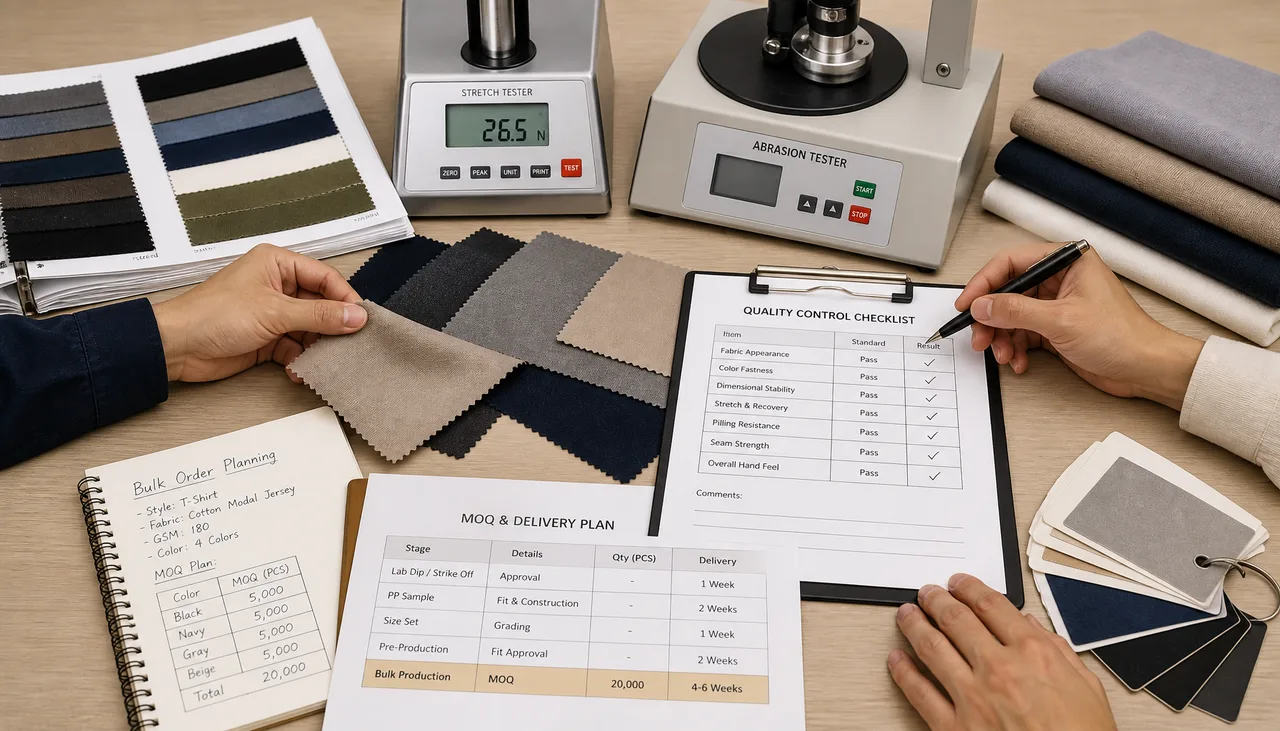
What a sample has to prove before gate 3 can be signed
Approving on appearance alone leaves the specification undefined. Six properties decide whether a knitted spandex fabric behaves the same way in bulk, and each one needs a method and a number before it can be accepted or rejected.
- Mass per unit area
- Measured with a 100 cm² cutter to ISO 3801. A 120 gsm fabric delivered at 114 gsm is 5% less material per square metre: enough to change opacity on a light colour and to move the cost per garment even when the price per metre does not change.
- Dimensional stability
- Washed and dried to ISO 6330 and measured to ISO 5077. Spandex knits are commonly specified at no more than 3% length and width change, with 5% accepted where the garment is cut loose and the pattern allowance absorbs it.
- Stretch and recovery
- Extension and growth measured to ASTM D2594 for low-power knits, or ASTM D6614 where the program measures elastane-rich high-stretch fabric. Recovery above 90% at the agreed extension is a common requirement for leggings and swimwear, because growth after wear appears as bagging at the knee and seat.
- Colour fastness
- Wash, rubbing and perspiration to ISO 105-C06, ISO 105-X12 and ISO 105-E04. Grade 4 on the grey scale covers most apparel programs; swimwear and deep shades are often written at grade 4–5 because chlorinated and salt water accelerate bleeding.
- Surface behaviour
- Pilling and snagging to ISO 12945-2. Grade 3–4 and above is typical for cut-and-sew sportswear. Brushed surfaces, loop structures and open-filament yarns lower the result, so the test belongs on the finished surface rather than on a flat swatch.
- Usable width, not nominal width
- Nominal width includes the edge that will be trimmed or rejected. A 165 cm fabric with 2 cm edge bands offers roughly 161 cm of usable width, and every yield calculation should be run on that figure.
Worked example: what one 150 kg lot of a 120 gsm cooling knit covers
Take a summer base-layer program that needs a light matte knit with a cooling finish. The candidate construction is H213, an 85% nylon / 15% spandex knit at 120 gsm and 165 cm, quoted at a nominal yield of 5.0 m/kg with a 150 kg minimum per colour. The approval question is not whether the swatch feels right; it is whether one minimum lot covers the pilot run, and what the buyer owns if it does not.
- Usable width. 165 cm nominal minus 2 cm of edge trim on each side leaves 161 cm usable (assumed trim; confirm against the finished roll).
- Mass per linear metre. 0.120 kg/m² × 1.61 m = 0.193 kg/m.
- Catalogue yield against the physics. 1 ÷ 0.193 ≈ 5.2 m/kg theoretical. The quoted 5.0 m/kg already carries the finishing and sampling allowance, so planning above 5.0 m/kg plans into a shortage.
- What 150 kg buys. 150 kg × 5.0 m/kg = 750 m of usable fabric.
- Garment coverage. At 0.60 m per garment plus 8% spare (0.648 m), 750 m covers about 1,150 pieces — a pilot run, not a season (assumed consumption and spare rate; replace with the marker consumption from the buyer’s CAD file).
Two decisions follow from that arithmetic. Colours must be approved before the lot is dyed, because re-dyeing 150 kg for a colour change consumes a full dyeing cycle and risks a shade break against the approved dip. And if the program grows past roughly 1,150 pieces, the next lot is a new dyeing lot with its own shade band, which belongs in the approval record rather than in a surprise at final inspection.
Where programs lose money between sample and approval
- Approving colour under undefined lighting. A dip that matches in an office can read red under D65 and green under TL84. Name the light source on the approval, submit the dip under both, and record the measured difference: ΔE ≤ 1.0 against the standard is a common laboratory-dip target, with bulk lots accepted in a wider band such as ΔE ≤ 2.0.
- Approving a hand sample the production line cannot repeat. Hand-knitted and pilot-machine swatches hide the tension and heat-setting behaviour of a production line. Require gate 2 yardage to come from the same knitting machines, dyeing machine and finishing line that will run the order.
- Locking colour but not width or GSM. A lot that arrives 5% light in GSM and 2 cm narrow removes material from every garment while the price per metre stays fixed. Both tolerances belong on the same sheet as the colour reference.
- Testing only the first lot. Dye lots drift after two or three cycles. Keep a retained sample per lot and re-test every third or fifth lot on the properties that reach the garment: shade, GSM, width and stretch recovery.
- Leaving both test layers to the garment factory. Fabric-level results (GSM, width, dimensional change, stretch) and garment-level results (appearance after wash, seam slippage, opacity on the finished piece) fail for different reasons. Split the responsibility in writing, or a claim is resolved by the mill and the garment maker blaming each other.
Why MOQ is a machine number, not a sales threshold
Minimum order quantities for dyed knit fabric come from the dyeing vessel, not from a negotiating position. A 500 kg overflow machine running at one third of a batch is roughly 150–200 kg, which is why 150 kg per colour is a common floor for a single shade. The consequence for the buyer is arithmetic:
- Six colours at 150 kg each is 900 kg before the first garment is cut.
- The same 900 kg in three colours is 300 kg per colour, with fewer dye lots and a lower probability of a shade break between lots.
- Fewer colours with more metres per colour lower the cost per metre, because machine time, laboratory work and lot administration spread over more fabric.
The practical move is to align the colour count with the first production plan before the sampling stage closes. Keeping a colour that will sell 200 garments is not a quality decision; it is a decision to fund extra dye lots.
Acceptance standards to write into the approval
| Item | Method | Typical acceptance |
|---|---|---|
| Usable width | Measured on each roll, three points minimum | Nominal ± 2 cm, with usable width stated separately |
| Mass per unit area | ISO 3801, 100 cm² cutter | Nominal ± 5% |
| Dimensional change | ISO 6330 + ISO 5077 | ≤ ± 5%, commonly ≤ ± 3% for spandex knits |
| Stretch and recovery | ASTM D2594 or ASTM D6614 | Recovery ≥ 90% at the agreed extension |
| Colour fastness | ISO 105-C06, ISO 105-X12, ISO 105-E04 | ≥ grade 4 on the grey scale |
| Pilling and snagging | ISO 12945-2 | ≥ grade 3–4 |
| Surface defects | Four-point system, assessed per roll | ≤ 20 points per 100 yd², threshold agreed in the record |

What the approval record should contain
- Fabric code, composition, and the reference number of the sealed sample held by both parties
- GSM with tolerance, nominal width, usable width, and yield expressed in m/kg
- Colour reference, the light source used for approval, and the measured difference from the standard
- Test methods, sampling frequency and accept or reject limits for every property in the table above
- Defect classification, and the rework, replacement or credit path for a lot that fails
- Spare allowance, roll length, put-up and packing specification
- Sampling and production lead times, and the dyeing capacity reserved for repeat lots
- Payment milestones tied to bulk approval rather than to shipment, with the repeat-order baseline attached
Questions buyers ask before signing
Does approval freeze the fabric for the life of the program?
No. It freezes the specification and the reference sample for the lots named in that approval. A change of yarn supplier, finishing route or dyeing machine creates a new approval, and programs that state this in the record can measure the next lot against the same numbers instead of arguing about what the sample looked like.
How long does the whole stage take?
Three to six weeks for an existing construction: one or two lab-dip rounds at 3–7 working days each, 7–14 working days for sample yardage and the garment trial, then 3–5 working days to sign the test plan. Bulk dyeing runs in parallel with gate 4, typically 15–25 working days after colour and finish confirmation.
Who pays for a second round of dips?
The first round is usually included in the quotation and later rounds are charged per dip. Put the number of included rounds in the quotation, because the charge matters most in the case where a colour changes after the bulk lot has been dyed.
Key takeaways
- Treat sampling, testing, MOQ and quality alignment as four separate releases, each with its own evidence.
- Approve on numbers — GSM tolerance, usable width, dimensional change, stretch recovery, colour fastness — each with a stated method.
- Run yield calculations on usable width and on the quoted m/kg, never on the theoretical figure.
- Size the colour count against the first production plan so the MOQ arithmetic works before the design is locked.
- Write the repeat-order baseline into the approval record, including the light source and the retained samples.