Ask the independent laboratory to verify more than a single recovery percentage. The request should define the test method, fabric direction, extension or load, cycle count, hold and relaxation periods, conditioning, specimen number, calculation, and reporting unit. Require individual results tied to the fabric lot and sample identity. Without these controls, two laboratories can test the same stretch knit and produce numbers that answer different questions.
Define the garment failure the test must address
Stretch recovery may relate to bagging at knees, waistband growth, loss of compression, restricted movement, seam strain, or size instability. Each failure occurs under different directions and deformation levels. Tell the laboratory whether the fabric is intended for yoga leggings, cycling shorts, sports bras, underwear, or another garment, and identify the critical direction. The lab can then help select an appropriate method, but the brand must set acceptance criteria from product requirements and validated reference materials.
Ask the laboratory to record every test variable
- Method name and edition, laboratory environment, conditioning time and specimen state.
- Course, wale or other test direction and how specimens were cut from the roll.
- Specified extension or applied load, extension rate, hold time and cycle count.
- Recovery interval before measurement and the formula used for the reported result.
- Individual values, average, dispersion, specimen count and any excluded result.
- Fabric code, color, finish, lot, roll and sampling location.
Do not confuse extension, growth, and recovery
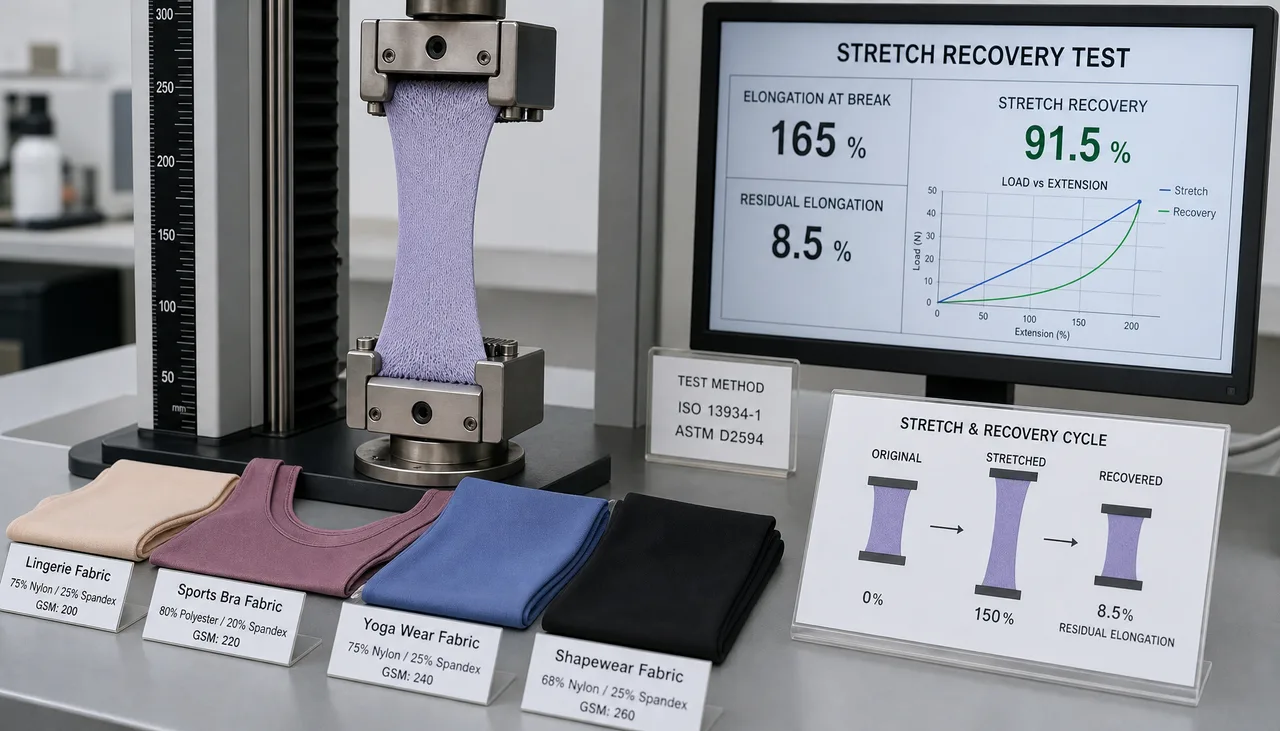
Extension describes how far a specimen lengthens under defined force or to a defined elongation. Growth describes retained deformation after the force is removed and a stated relaxation period. Recovery expresses the amount returned under the method’s calculation. Elongation at break is a destructive strength-related measurement and does not substitute for recovery at normal garment strain. Ask the laboratory to define each reported term so purchasing teams do not compare different metrics under one “stretch” heading.
Require both directions when the garment uses both
A knitted fabric can behave differently in course and wale directions, while garment panels may be oriented to use one direction for body circumference and the other for length. If a cycling-short panel requires circumferential support and longitudinal movement, a single unspecified result cannot confirm both functions. Provide the intended panel orientation and request direction-specific data. If the fabric is marketed as four-way stretch, that phrase still needs numerical requirements and a defined method for each direction.
Interpret results with an explicit calculation
Hypothetical calculation: a marked 100 mm specimen is extended to 150 mm, released, and measures 104 mm after the agreed relaxation period. Residual growth relative to the original gauge length is (104 − 100) ÷ 100 × 100 = 4%. This example is not a universal pass limit and does not prescribe a standard formula; the laboratory must use the selected method’s calculation, and the buyer must establish an acceptable threshold for the garment.
Test the approved state and relevant aged states
Recovery can change after dyeing, heat setting, brushing, chemical finishing, printing, laundering, or heat exposure. Specify whether the laboratory tests as-received fabric, conditioned finished fabric, washed fabric, or several states. Use the intended care procedure and record the number of cycles. Results from undyed development fabric should not automatically approve a dark bulk color, and an optional finish should not be assumed durable unless the post-care test confirms the required behavior.
Review sampling and repeatability
Several specimens from one small swatch measure test repeatability more than lot uniformity. For bulk acceptance, define how rolls are selected and where specimens are cut while avoiding creases, edges, and known defects unless investigating them. Ask the report to preserve roll-level results instead of presenting only a combined average. If variation is commercially important, agree on maximum individual values or another lot rule so one unstable roll cannot be hidden by conforming material.
Connect the report to garment approval
Use laboratory recovery data to compare candidate fabrics and monitor bulk consistency, then verify fit retention in sewn garments under representative movement and care. Waistbands, seams, panel orientation, lining, and garment dimensions alter the strain applied to the fabric. Send the laboratory and ClothFactory the same use case, approved construction, directions, processing route, and acceptance matrix. The report should support the sourcing decision, not replace a production-relevant wear and wash evaluation.