
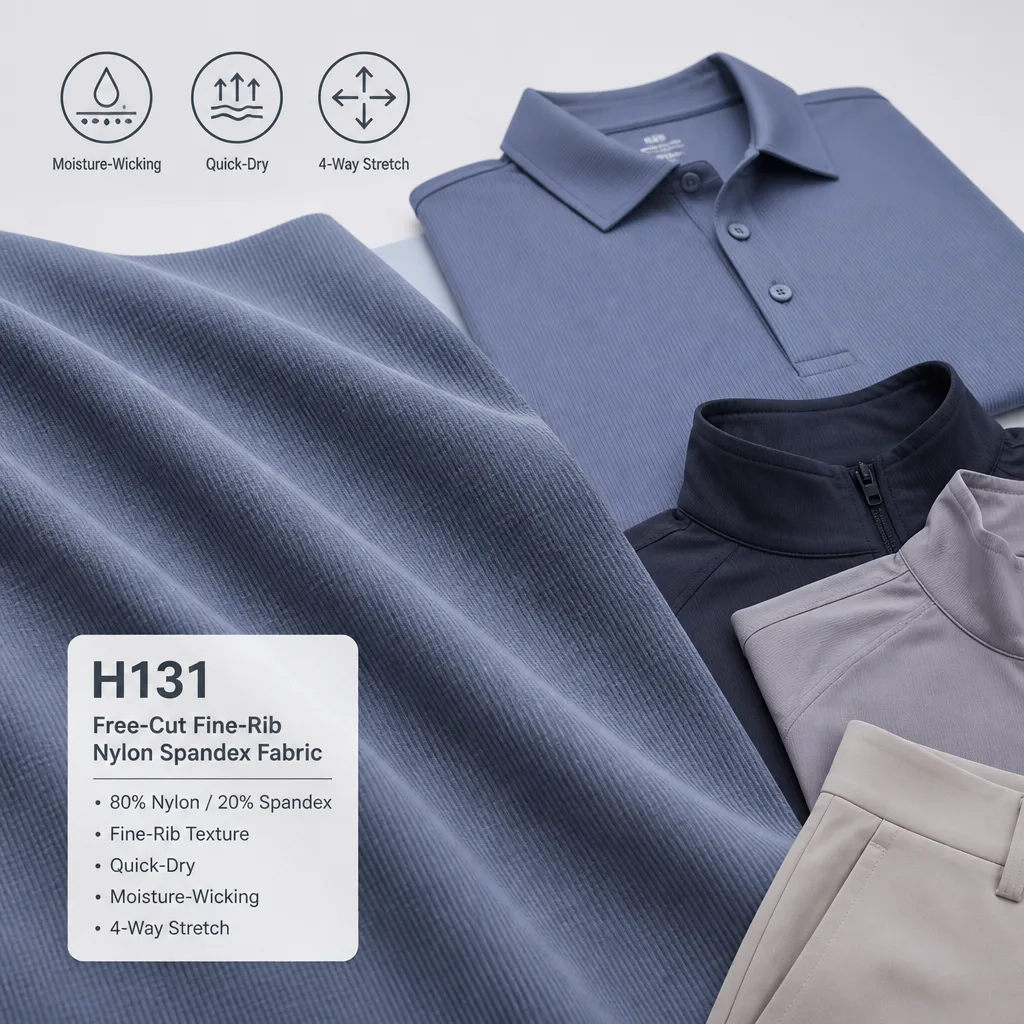
H131 is a fine-rib nylon-spandex candidate for performance polos and lightweight athleisure when the product brief requires a refined surface, stretch, and low garment bulk. The available product description identifies an 80% nylon/20% spandex composition and 160 gsm finished weight; buyers should confirm the current specification, usable width, stretch response, finish, and edge stability on the actual sample before approval.
Match H131 to the garment architecture
The fine vertical rib can give a knitted fabric a cleaner, more structured appearance than a plain smooth surface. That makes H131 relevant to polo bodies, fitted training tops, technical undershirts, and business-athleisure layers where the garment must look polished while allowing movement.
The application still controls the decision. A polo body requires drape and recovery, while collars and cuffs may need separate materials or reinforcement to maintain shape. A close-fitting base layer places more emphasis on next-to-skin hand, seam comfort, moisture behavior, and recovery after repeated extension. Buyers should not assume one fabric will satisfy every panel in the garment.
Confirm composition, weight, and usable width together
Composition and GSM do not define fabric yield on their own. Costing also depends on finished usable width, edge loss, shrinkage, shade continuity, and marker efficiency. Record all of these values on the approved specification rather than relying on a sales sample label.
Illustrative calculation — not H131 production data: if a 160 gsm fabric has an assumed usable width of 1.50 m, 100 linear metres contain approximately:
160 g/m² × 1.50 m × 100 m ÷ 1,000 = 24 kg
Changing the usable width changes the linear yield even when GSM stays at 160. This is why a metres-per-kilogram figure cannot be evaluated without the finished width and agreed conditioning state.
Treat cooling and quick-dry language as test requirements
Fiber composition alone does not prove cooling, wicking, or quick drying. Yarn cross-section, knit geometry, capillary pathways, finishes, fabric thickness, air movement, and garment fit all affect moisture and thermal behavior.
If a performance polo or training top will carry a cooling or quick-dry claim, ask for the test method, conditioning, specimen orientation, result, and acceptance criterion for the finished fabric. Confirm whether the effect comes from the yarn or an applied finish, and repeat the relevant check after the intended care cycle. A water-drop demonstration or a general statement about nylon is not sufficient evidence for a product claim.
Verify free-cut performance on the intended process
“Free-cut” should be treated as a manufacturing condition, not an unconditional fabric property. Edge curling, fraying, laddering, distortion, and delamination risk can change with cut direction, rib alignment, cutting method, wash treatment, seam design, and the distance between the cut edge and bonded or stitched area.
Before approving a raw-edge, laser-cut, ultrasonic-cut, or bonded construction:
- cut specimens in both fabric directions and across the intended panel geometry;
- inspect the edge relaxed and under the garment's expected extension;
- complete the planned bonding or sewing operation using production equipment;
- wash the sample according to the intended care label;
- check edge stability, seam slippage, curl, appearance, and recovery after laundering.
Passing one straight-edge trial does not establish that every curved opening or cut direction will remain stable.
Control rib direction and sewing trials
Fine ribs make panel rotation and grain misalignment easier to see. The marker plan should preserve the approved rib direction unless a deliberate contrast is part of the design. Check shade and surface reflection from the same viewing direction before cutting bulk fabric.
Needle point, needle size, thread, stitch type, presser-foot pressure, and feed settings should be selected through a sewing trial on conditioned production fabric. The correct settings depend on the machine, seam construction, fabric lot, and elastic demand; a fixed needle recommendation without that context is not a reliable production standard. Inspect for skipped stitches, needle cutting, seam grin, puckering, and recovery after extension.
Compare the sample against measurable acceptance points
| Decision area | What to record | Why it matters |
|---|---|---|
| Identity | Composition, knit construction, product reference, dye lot | Links the sample to the bulk specification. |
| Weight and yield | Finished GSM, usable width, shrinkage, edge loss | Supports comparable costing and marker planning. |
| Fit response | Stretch and recovery by direction, extension, hold time, recovery time | Shows whether the fabric can support the intended silhouette. |
| Surface | Rib alignment, hand, pilling, snagging, abrasion | Protects appearance in polos and fitted layers. |
| Moisture claim | Defined test method and post-wash result | Separates verified performance from marketing language. |
| Edge process | Cutting method, panel direction, bonding or sewing condition, wash result | Confirms whether the intended free-cut construction is production-ready. |

Avoid common sourcing errors
- Using 160 gsm as proof of structure. Weight does not establish collar support, opacity, drape, or recovery.
- Assuming spandex percentage defines stretch. Yarn placement and knit construction affect extension and growth.
- Approving “quick dry” without a method. Test conditions and post-wash retention must be stated.
- Applying “free cut” to every panel. Curves, cut direction, bonding, and laundering can change edge behavior.
- Rotating panels without checking rib direction. The finished garment may show visible texture or shade mismatch.
Procurement next step
Send the supplier the garment type, panel use, target fit, finished GSM and width, stretch and recovery conditions, color, care cycle, moisture claim, and intended edge process. Request an identified H131 swatch, current specification sheet, test evidence for any performance claim, and enough material for cutting, sewing, bonding, washing, and garment-fit trials. Approve bulk fabric only after those conditions are recorded against a sealed reference sample.