
Brands should compare stretch before and after washing only when specimens are tested in the same direction, under the same load or extension, after the same conditioning period, and with the wash procedure recorded. Stretch, recovery, dimensional change, and residual growth are separate results; one percentage cannot describe all four.
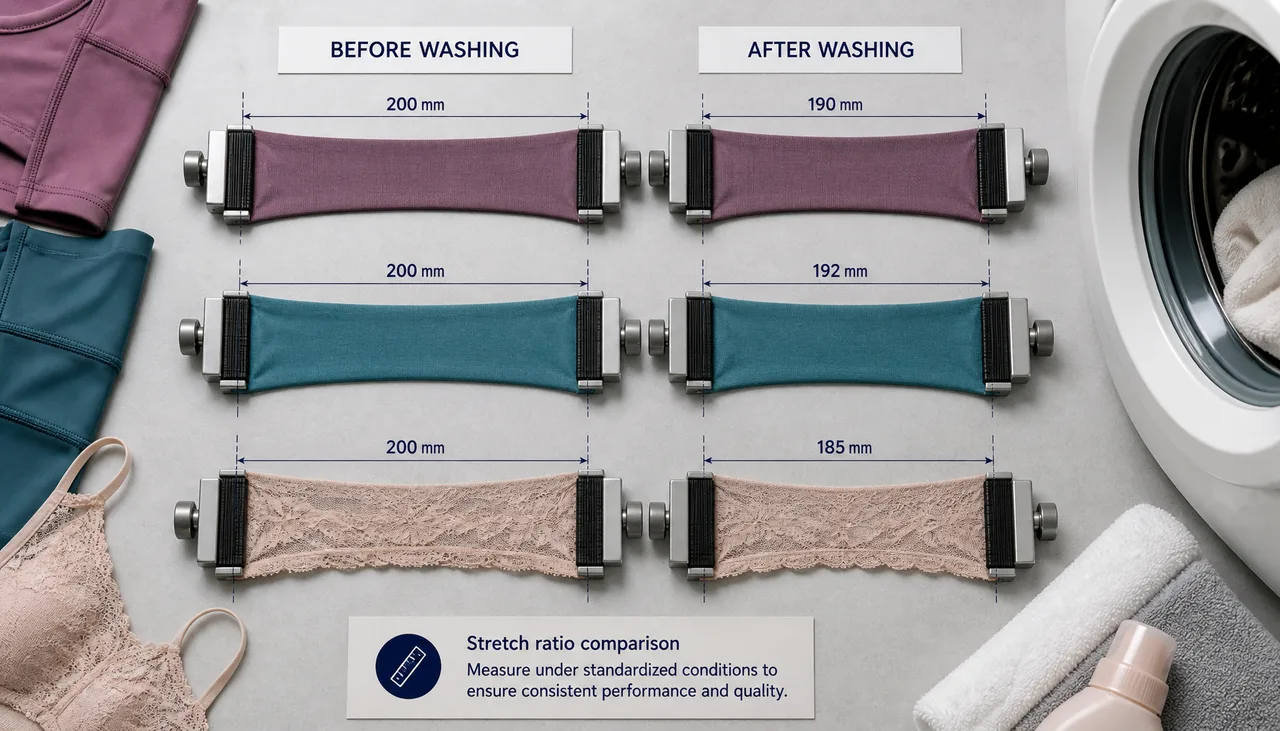
Define what “stretch ratio” means in the specification
The phrase “stretch ratio” is ambiguous unless the measurement procedure is stated. A buyer may measure the extension reached under a specified force, the force required to reach a specified extension, or the growth remaining after the specimen is released. These results answer different questions and should not be mixed in one acceptance limit.
For a test based on extension from an initial gauge length, stretch can be calculated as:
Stretch (%) = (extended length − initial length) ÷ initial length × 100
The report should state the initial gauge length, fabric direction, applied force or target extension, loading time, number of cycles, recovery time, specimen conditioning, and wash procedure. If any of these variables changes, the before-and-after numbers may not be comparable.
Separate washing shrinkage from stretch performance
Washing can relax knitting tension, change dimensions, alter a finish, or affect the relationship between yarn and fabric structure. Measure dimensional change independently before cutting new stretch specimens or establishing a new conditioned gauge length.
If a pre-wash specimen begins at 100 mm and the washed fabric shrinks, reusing the original marked distance can combine shrinkage with stretch in the same result. A clearer comparison conditions the fabric after washing, prepares the specimen according to the agreed method, and then measures stretch under the same procedure used for the unwashed specimen.
Compare percentage-point and relative changes correctly
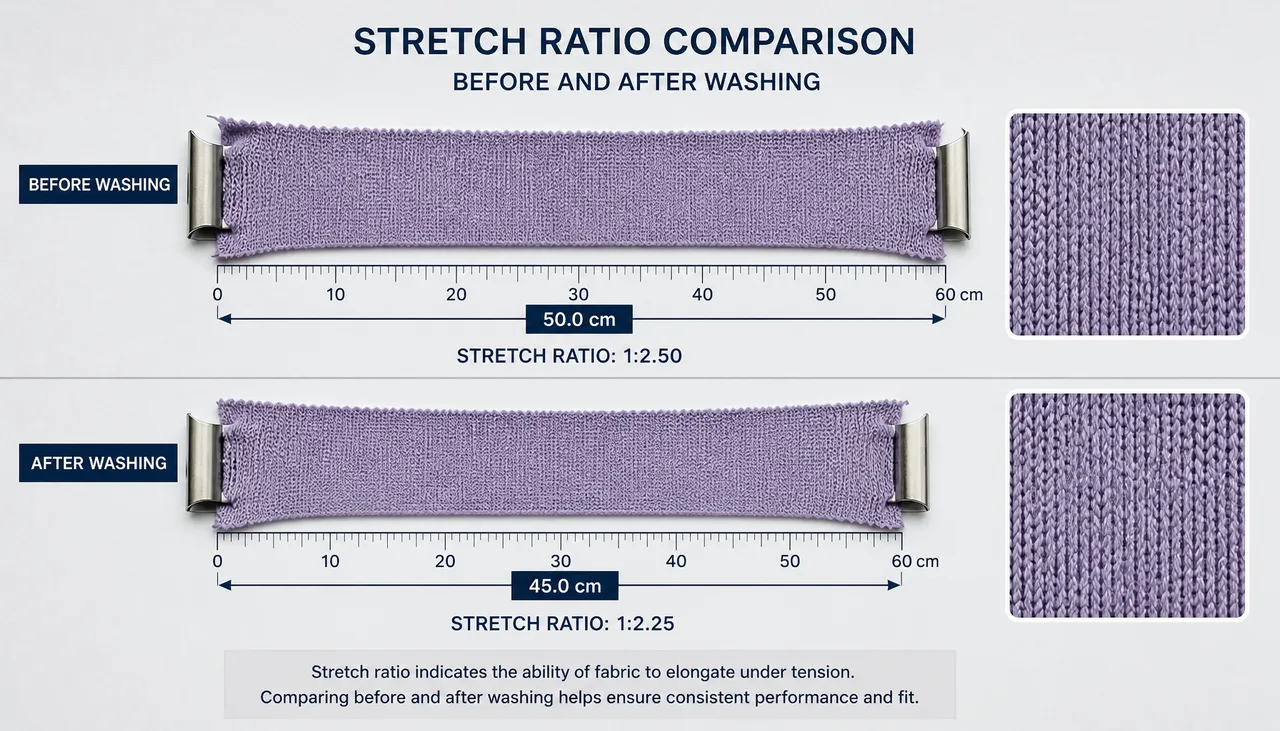
Hypothetical calculation — not ClothFactory test data: assume separate conditioned specimens are tested with a 100 mm initial gauge length under the same stated load.
- Before washing, the specimen extends to 150 mm:
(150 − 100) ÷ 100 × 100 = 50% stretch. - After washing, the specimen extends to 145 mm:
(145 − 100) ÷ 100 × 100 = 45% stretch.
The result decreased by 5 percentage points. Relative to the original 50% result, the decrease is 10%: (50 − 45) ÷ 50 × 100. Reports should identify which expression is being used because “a 5% reduction” would be unclear.
This calculation does not show whether the fabric recovers after extension. Recovery or residual growth must be measured and reported separately.
Measure both directions and the relevant garment extension
Knitted nylon-spandex and polyester-spandex fabrics can behave differently in the wale and course directions. Record specimen orientation and test both directions when the garment uses both. For leggings, lingerie, fitted tops, and compression-style garments, the buyer should also identify the extension expected in the critical body zone.
A fabric may reach a high maximum extension but show excessive force at the normal wearing extension, or it may stretch easily and retain unacceptable growth after release. Garment fit therefore depends on the relationship among extension, force, recovery, pattern reduction, seam construction, and body movement—not on maximum stretch alone.
Keep wash and conditioning variables identical
The comparison should record:
- wash temperature, programme, detergent, load, and number of cycles;
- drying method and temperature;
- relaxation and conditioning time before testing;
- specimen size, gauge length, and direction;
- applied load or target extension;
- loading cycles, hold time, and recovery time;
- results for stretch, recovery or growth, and dimensional change.
Do not compare a line-dried specimen with a tumble-dried specimen or a one-cycle result with a multi-cycle result. If the care label permits several wash routes, select the route that matches the approval purpose and state it in the purchase specification.
Use the result to make a garment decision
| Result | Procurement interpretation | Follow-up action |
|---|---|---|
| Stretch decreases after washing | The garment may feel tighter or require more force to reach the intended fit. | Review garment extension, pattern reduction, and washed fit sample. |
| Stretch increases after washing | The structure may have relaxed or the finish may have changed. | Check dimensional change, recovery, and bagging risk. |
| Stretch remains similar but growth increases | Maximum extension appears stable, but shape retention may deteriorate. | Set a separate recovery or residual-growth limit. |
| One direction changes more than the other | Garment response may become unbalanced. | Review panel orientation, seams, and critical body zones. |
| Results vary widely among specimens | The lot, conditioning, or method may be inconsistent. | Investigate sampling and repeat matched tests before approval. |
There is no universal acceptable change for every stretch garment. The buyer's limit should reflect the fit, support level, care label, fabric construction, and garment validation. A lingerie panel and a loose sports top should not share a threshold merely because both contain spandex.
Build the test into sample and bulk approval
Use the same documented method during development, first production, and bulk verification. Identify the sample by fabric code, lot, color, finish, and construction so the result remains traceable. If buyer and supplier laboratories disagree, exchange matched specimens and compare equipment, conditioning, calculation, and operator procedure before deciding whether the fabric fails.
Fabric results should be confirmed with a washed garment sample. Seams, elastic, panel orientation, and pattern reduction can change fit even when the fabric result remains within tolerance.
Procurement next step
Add the test direction, loading condition, wash and drying procedure, conditioning time, calculation, and separate recovery or growth limit to the fabric specification. Send ClothFactory the garment application, expected extension by body zone, composition and construction target, care cycle, and required reporting format so candidate nylon-spandex or polyester-spandex fabrics can be compared under one controlled method before bulk approval.