
Free-cut fabric can be used without a sewn hem only when the raw edge remains stable, comfortable, and durable in the finished garment. Buyers should approve the actual fabric construction, cut method, edge treatment, garment zone, and wash cycle together; a nylon-spandex or polyester-spandex label alone is not enough.
Treat free-cut as a construction decision
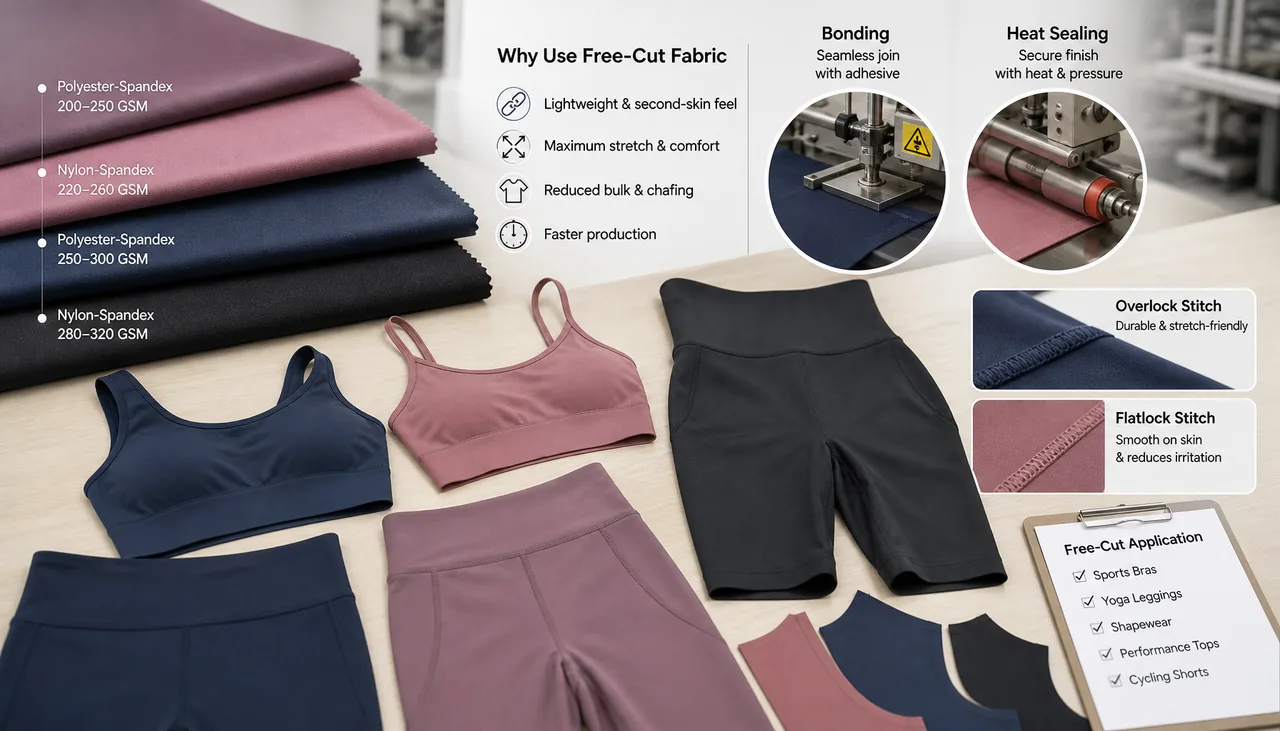
In this context, free-cut means a panel is cut to its final outline without a traditional folded hem. The edge may remain raw, or it may be stabilized by laser cutting, heat sealing, ultrasonic bonding, binding, or another process. These methods are not interchangeable. A raw knitted edge and a bonded edge have different failure risks and must be specified separately.
The correct question is not whether a fabric is “free-cut.” It is whether the chosen edge can maintain its shape and appearance at the garment’s actual extension, abrasion points, and care conditions.
Check the fabric before choosing the edge treatment
Composition and knit construction
Nylon-spandex and polyester-spandex knits are common candidates for activewear, but composition does not determine edge performance. Record the knit type, yarn information available from the supplier, finished GSM, usable width, stretch direction, and any finishing treatment. Compare samples from the same construction and finish when evaluating edge behavior.
Curl, fray, and recovery
Inspect cut strips in both principal directions. Record whether the edge rolls, curls, ladders, frays, or develops a hard line after cutting. Then extend the strip to the level expected at the waistband, leg opening, bra armhole, or shapewear opening and check whether the edge returns without permanent distortion.
GSM and edge stability
GSM can help compare mass and cover, but it is not an acceptance rule. A heavier fabric may still curl if the knit structure is unstable, while a lighter fabric may perform well when the edge is bonded or placed in a low-stress zone. Confirm edge behavior on the finished fabric rather than approving by weight alone.
Match the edge method to the garment zone
| Garment use | When a free-cut edge may be considered | What must still be checked |
|---|---|---|
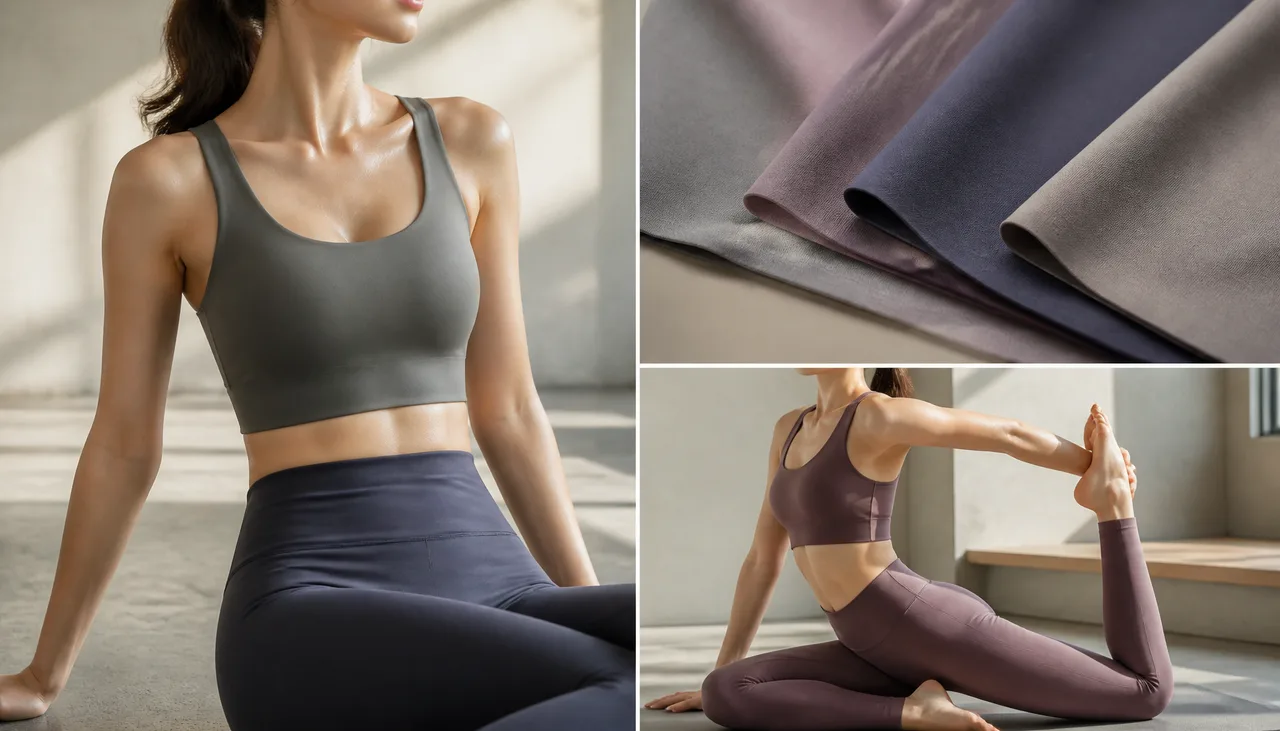
| Sports-bra armhole or hem | A stable knit with a controlled raw, laser-cut, or bonded edge in a low-abrasion zone | Skin comfort, repeated extension, edge rolling, and wash durability |
| Compression short or shapewear opening | A construction that holds the edge under sustained extension and pressure | Local pressure, growth, adhesive or bonding durability, and recovery after laundering |
| Yoga-legging hem or panel edge | A stable fabric and edge process that match the pattern and movement range | Cover, appearance under stretch, snagging, and abrasion at the hem |
| Lingerie edge | A soft edge treatment with controlled contact against skin | Friction, irritation, colorfastness, and dimensional stability |
| High-abrasion or load-bearing edge | Usually requires a hem, binding, enclosed seam, or another reinforcement | Whether the edge survives wear testing and production handling |
This table is a screening framework, not a blanket approval. A design that works on a sports-bra armhole may fail at a leg opening because the extension, friction, and seam forces are different.
Separate raw edges from bonded or enclosed edges
Heat sealing and ultrasonic bonding can stabilize an edge without a folded hem, but they introduce their own development variables: equipment settings, adhesive or film compatibility where applicable, line strength, hand feel, and wash durability. Overlock and flatlock stitching secure an edge through sewing and should not be described as an unprocessed free-cut edge.
Ask the garment factory to identify the edge process on the tech pack. The fabric supplier should then evaluate the matched fabric and process combination, not an isolated swatch cut with an unrelated tool.
Use a defined edge-approval test
- Cut specimens in the main and crosswise directions using the intended production method.
- Record the initial edge length, width, GSM, and visual condition after relaxation.
- Extend the edge to the garment’s intended strain and record curl, fray, laddering, and residual growth.
- Launder the specimens using the planned care cycle, then repeat the relaxed and extended inspection.
- Expose the edge to the relevant abrasion or repeated-extension condition.
- Make a garment or seam mock-up and inspect comfort, appearance, and edge stability at the actual placement.
- Approve a sealed reference sample with the cut method, edge treatment, tolerances, and wash condition recorded.
Illustrative calculation — not a ClothFactory test result: if a 100 mm raw edge is extended by 30%, its temporary length is:
100 mm × (1 + 0.30) = 130 mm
After release, measure the remaining length and edge shape. This calculation defines the extension condition; it does not establish a universal pass limit. The buyer and supplier must agree the acceptable residual growth and appearance for the garment zone.
When hemming or reinforcement is usually safer
Use a hem, binding, enclosed seam, or another edge reinforcement when:
- the knit is open, lightweight, or visibly prone to laddering or fraying;
- the edge carries high tension, repeated abrasion, or concentrated seam load;
- the edge will contact skin and a raw or bonded line feels harsh;
- the design requires a precise visible edge or stable opening dimension;
- the cut process or bonding method is not controlled in bulk production;
- wash or wear testing shows permanent curl, growth, delamination, or distortion.
Information to include in a sample request
Send the supplier and garment factory the same brief:
- garment type and exact edge location;
- fabric composition, knit construction, finished GSM, and usable width;
- stretch direction and expected extension at the edge;
- intended cut tool or edge process;
- wash method, number of cycles, and any abrasion or wear condition;
- required appearance, comfort, recovery, and dimensional tolerances;
- reference sample or pattern section showing the edge geometry.
Do not approve a free-cut construction from a relaxed fabric swatch alone. A successful sample must represent the production fabric, cut method, edge process, garment pattern, and care cycle.
Procurement next step
For a free-cut activewear request, send a pattern section or edge sketch together with the target composition, GSM, extension, finish, cut process, and care requirements. Ask for cut-edge specimens and a small garment or seam mock-up before bulk approval. ClothFactory can compare a suitable nylon-spandex or polyester-spandex construction, but the final decision should remain tied to the tested edge process and garment placement.