
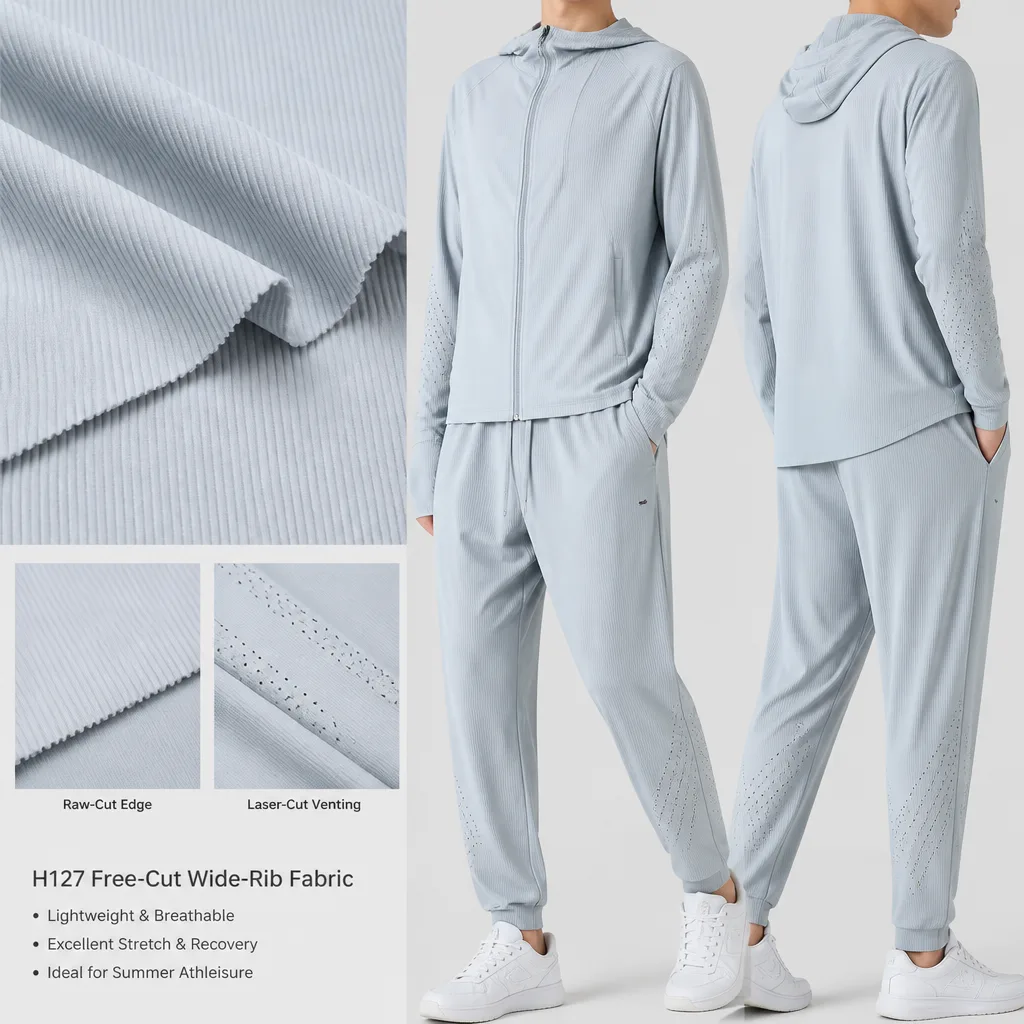
H127 is a candidate for lightweight joggers, summer jackets and textured athleisure when the design requires a 160 GSM wide-rib fabric with a stated 20% spandex content. Its free-cut suitability, edge stability, moisture performance and sun-protection level must still be validated on the selected color, cutting method and finished garment; none of these results can be confirmed from GSM, rib texture or composition alone.
Define the application before approving the fabric
The three proposed applications place different demands on the material. Joggers require recovery at the knee and seat, waist-seam stability and acceptable coverage. A lightweight jacket requires controlled drape, seam stability and comfort during arm movement. A sun jacket also needs a defined ultraviolet-protection requirement, supported by testing on the finished fabric rather than by fabric weight or coverage claims alone.
The sourcing brief should identify the garment, fit, intended climate, lining arrangement, edge construction and care cycle. Without these conditions, a sample can look suitable on the table but fail after cutting, stretching or laundering.
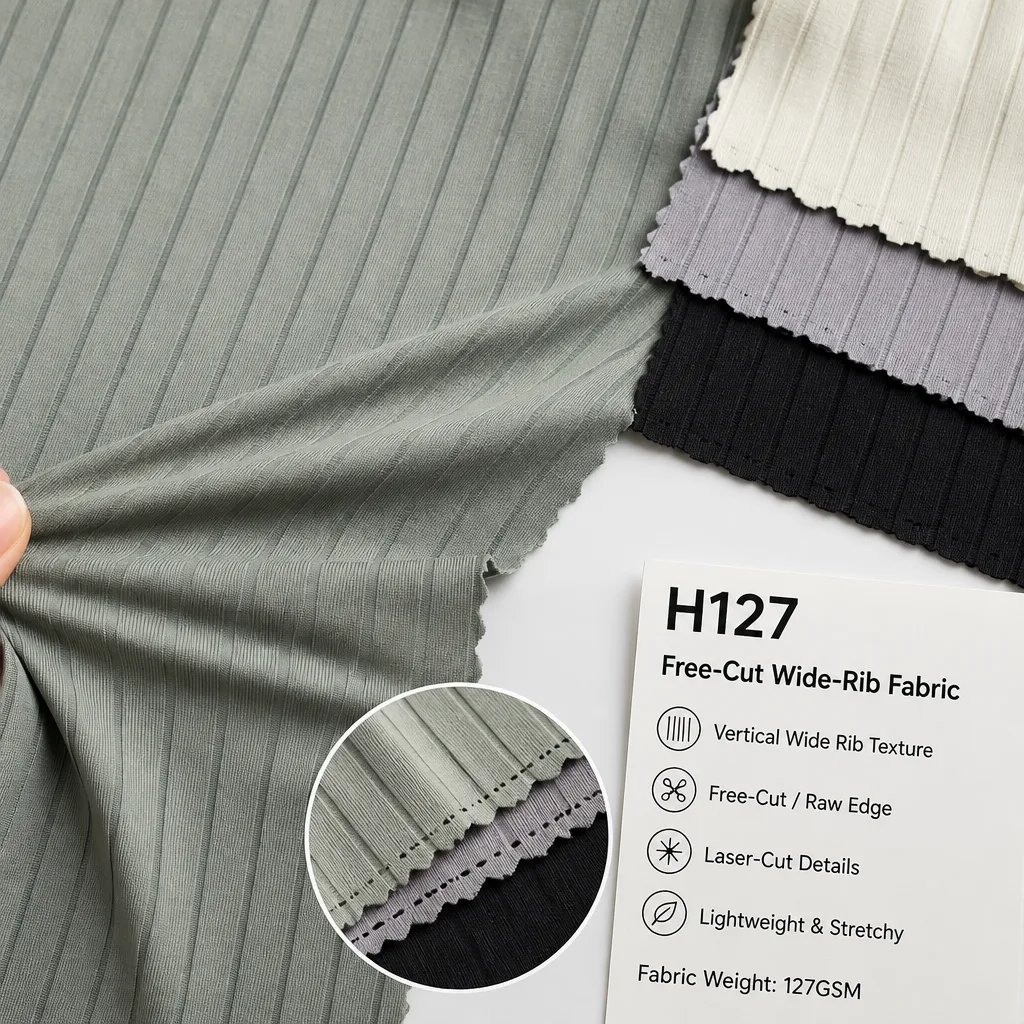
Treat the supplied specification as the starting point
| Supplied detail | Procurement relevance | What still requires approval |
|---|---|---|
| 160 GSM finished weight | Supports comparison with the target garment-weight range | Thickness, coverage, drape and finished-weight tolerance |
| 20% spandex | Indicates the stated elastane share | Stretch, recovery, residual growth and seam behaviour |
| Wide vertical rib surface | Provides a visible and tactile design feature | Rib scale, straightness, distortion and alignment across panels |
| Free-cut positioning | May support selected raw-edge details | Fraying, curling and edge stability after wear and washing |
Do not use the original statement about moisture management as an acceptance result. Wicking and drying depend on yarn, knit construction, dyeing, finishing and test conditions, so they require separate evaluation if they are part of the product claim.
Validate free-cut performance on the actual design
“Free-cut” should be written as a measurable sample requirement, not treated as permission to remove every hem or binding. Test the exact cutting process intended for production—such as blade, die or laser cutting—because heat, pressure and cut direction can change the edge.
Prepare sample pieces in the course, wale and bias directions, then assess them after handling and the agreed wash cycles. Record edge fraying, curling, splitting, rib distortion and surface discoloration. Raw edges at a pocket opening, cuff or ventilation detail may experience different stress, so each critical placement should be included in the garment trial.
Laser-cutting suitability also cannot be assumed. A trial is required to check whether the edge hardens, discolors or leaves residue, and whether the result remains acceptable against the skin.
Account for weight, usable width and rib alignment
GSM determines fabric mass per unit area, not the finished garment weight by itself. An illustrative calculation, not ClothFactory production data, can be used during early costing. If a style consumes 1.40 m² before cutting loss, its estimated fabric mass is:
1.40 m² × 160 g/m² = 224 g
The final value will change with actual marker consumption, usable width, relaxation, matching loss, trims and construction. Wide ribs can increase cutting loss when panels must follow the same vertical direction or when visible seams require rib alignment. Buyers should therefore cost from the production marker rather than from nominal width alone.
Separate sun coverage from verified UV protection
A lightweight fabric may be suitable for the silhouette of a sun jacket, but the term “sun protective” requires a defined test and acceptance level. Results can vary with color, stretch, moisture and finishing. If ultraviolet protection is a sales claim, specify the relevant test method, the condition of the specimen and whether performance must be confirmed after laundering. Approval of one dark color should not be extended automatically to pale colors.
The same discipline applies to cooling, breathability and moisture-wicking claims. Evaluate only the properties required by the product brief and record the test conditions so candidates can be compared on the same basis.
Check stretch, recovery and garment construction
For joggers, compare dimensional change and residual growth at the knee and seat after wear simulation and laundering. For jackets, check arm mobility, seam extension and whether the ribs distort around curved panels. The stated 20% spandex content does not establish the extension or recovery of the finished knit.
The sewing trial should determine needle, thread, stitch type, differential feed and presser-foot pressure. Inspect for skipped stitches, seam puckering, needle cutting, visible pressure marks and seam grin. Pattern pieces should use a controlled rib direction unless the design intentionally varies it.
Build a comparable H127 sample request
Provide the supplier with:
- garment type, intended climate, target fit and use conditions;
- stated composition, 160 GSM target and agreed tolerance;
- required finished usable width and rib orientation;
- exact raw-edge locations and the planned cutting process;
- stretch, recovery and dimensional-stability methods;
- color standard and shade evaluation conditions;
- any required moisture-management or UV-protection tests;
- wash cycles and acceptance criteria for edge stability;
- enough sample yardage for a full cutting and sewing trial.
Approve the fabric only after the material test, raw-edge trial and fitted prototype meet the same written brief. ClothFactory can then compare the approved sample with bulk rolls for weight, width, shade, rib consistency and the specific performance conditions agreed for the garment.