
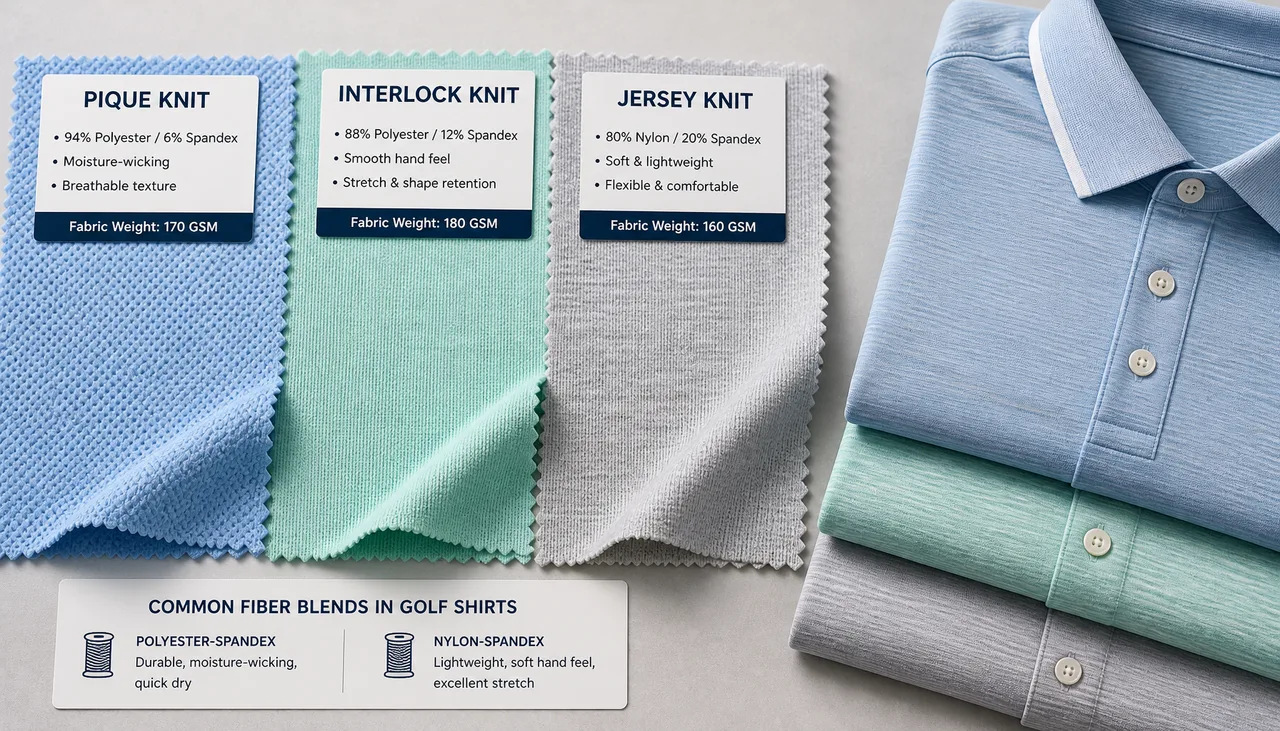
Pique, interlock and jersey are all candidates for golf shirts; none is automatically best. Choose the structure against the intended silhouette, playing conditions, logo process and care expectations. Fibre composition, yarn specification, fabric density and finishing must be considered alongside the knit name. A “performance pique” label is not evidence of airflow, recovery or moisture management.
Start with the shirt’s commercial role
A club-uniform polo may need a consistent textured appearance, reliable embroidery and repeat ordering. A lightweight tournament shirt may prioritise freedom of movement and reduced material mass. A premium travel polo may prioritise a smooth face and a stable silhouette. Those briefs can lead to different structures even when all three use polyester-spandex or nylon-spandex yarns.
Set the non-negotiable requirements first: fit, opacity in selected colours, care procedure, logo method and target material cost. Treat hand feel and surface character as approved references rather than trying to describe every preference with “soft” or “premium.”
Understand what each structure offers to the design
| Candidate | Reason to sample it | Question to resolve |
|---|---|---|
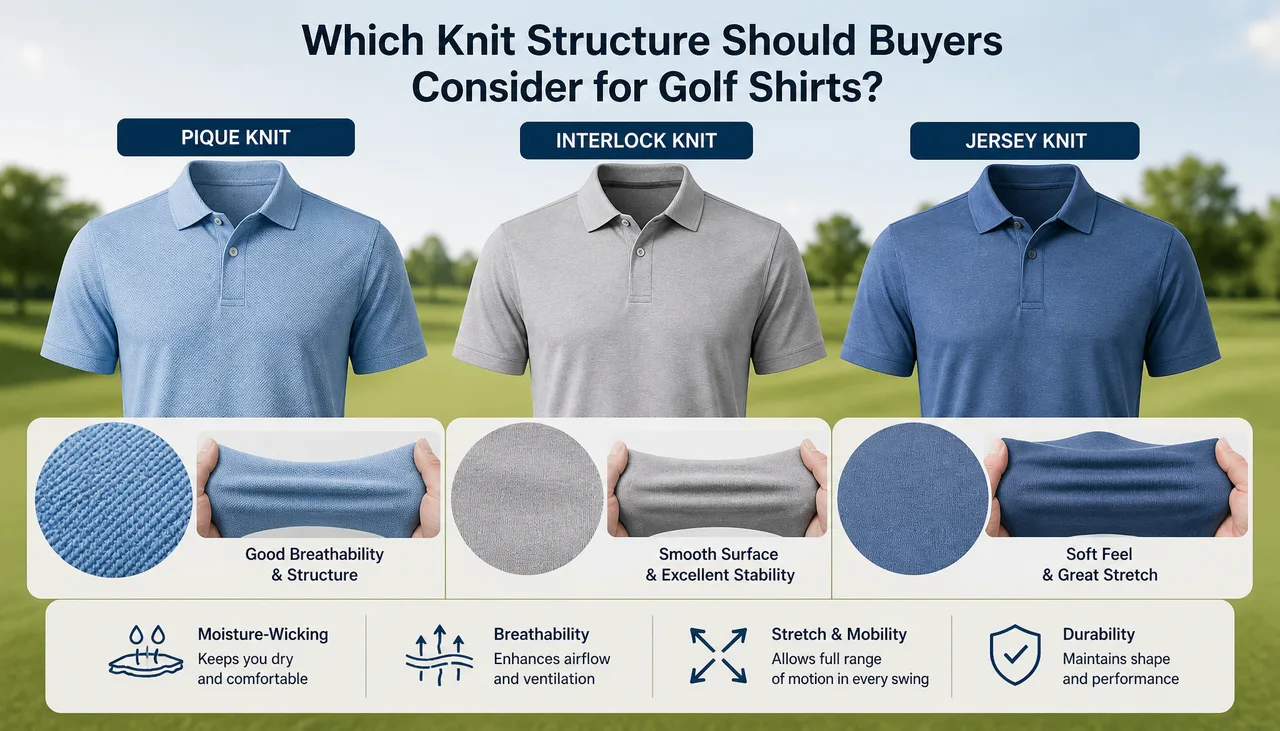
| Pique | A textured face associated with classic polo styling. | Does the actual construction deliver the desired texture, snag resistance and logo appearance? |
| Interlock | A double-knit option for a smooth, substantial appearance. | Can the chosen weight and finish meet the brief without excessive warmth or stiffness? |
| Single jersey | A candidate for a lighter, more fluid silhouette. | Will edge behaviour, dimensional change and placket assembly remain controlled? |
Ask suppliers to identify the actual construction rather than relying only on a trade name. Pique variants can differ, and a photograph cannot reliably identify yarns or loop geometry. Compare finished samples with their technical sheets and relevant measurements.
Evaluate movement at the shoulder and sleeve
A golf swing places directional demands on the back, armhole and sleeve. More spandex does not automatically mean easier movement: extension force and pattern geometry both matter. Trial the shirt during address, backswing and follow-through, checking hem lift, placket distortion and pulling across the shoulder.
For an illustrative strain estimate, a fabric span increasing from 42 cm to 50.4 cm extends by 20%. A laboratory comparison at that extension should examine the force required and subsequent recovery, not merely whether both materials can be pulled to that length. Confirm the actual critical strain on the garment before setting a test condition.
Separate texture, mass and comfort evidence
A visibly textured surface does not prove higher air permeability than a smooth one. Compare the candidate fabrics under the same method and preparation. ISO 9237 measures air permeability; drying and liquid-moisture behaviour require different evaluations. If sun protection is part of the sales claim, obtain relevant UV evidence rather than inferring it from colour or density.
Fabric mass also needs a garment context. If an illustrative shirt contains 0.85 m² of net fabric area, a 160 g/m² material contributes 136 g, while a 190 g/m² material contributes 161.5 g: a 25.5 g difference before trims. This is not purchased marker consumption or total garment weight. Decide whether that difference is meaningful to the brief instead of treating lower GSM as an automatic quality improvement.
Approve the collar, placket and decoration as an assembly
The body fabric cannot solve every collar or placket problem. Interfacing, collar construction, sewing feed and component dimensional change affect whether the front stays flat. Wash the assembled sample under the intended care conditions and inspect twisting, puckering, collar shape and differential shrinkage between components.
Run embroidery or transfer trials at the intended logo size and location. Check local stiffness, distortion, surface damage and durability after care. A logo that looks acceptable on an unstretched swatch may pucker on a lightweight chest panel or restrict movement on a fitted sleeve.
Choose the production option through a controlled trial
Shortlist structures using the technical brief, then make comparable garments with documented construction settings. Where pattern or process adjustments are necessary, record them and include their cost. Compare measured usable width, marker consumption, sewing time and the cost of achieving the approved appearance.
Release the selected fabric against a named construction and finish revision, approved colours, dimensional requirements and garment standard. Keep a retained washed sample for production comparisons. The right structure is the one that meets the shirt’s performance and appearance requirements repeatedly at an acceptable cost, not the one with the most familiar marketing name.