
When reviewing gym shorts fabric samples, buyers should approve the finished construction against the garment brief—not just the fiber blend or hand feel. The critical checks are stretch and recovery, coverage and weight, moisture and air behavior, surface durability, colorfastness, and consistency after the agreed care cycle.
Define the gym-shorts brief before judging the swatch
Gym shorts may use a loose outer shell, a close-fitting liner, or both. A shell intended for high-sweat training has different priorities from a liner that must stay opaque and recover after repeated extension. Before comparing samples, record the garment layer, body coverage, target fit, climate, color range, wash method, and whether the fabric will be used next to skin.
For example, a buyer developing a close-fitting training short should review the fabric at the extension expected around the seat and thigh, not only in its relaxed state. A looser shell may place more weight on drape, air exchange, and abrasion at the hem. These are application decisions; no single GSM or composition is correct for every gym-short design.
Check composition and construction together
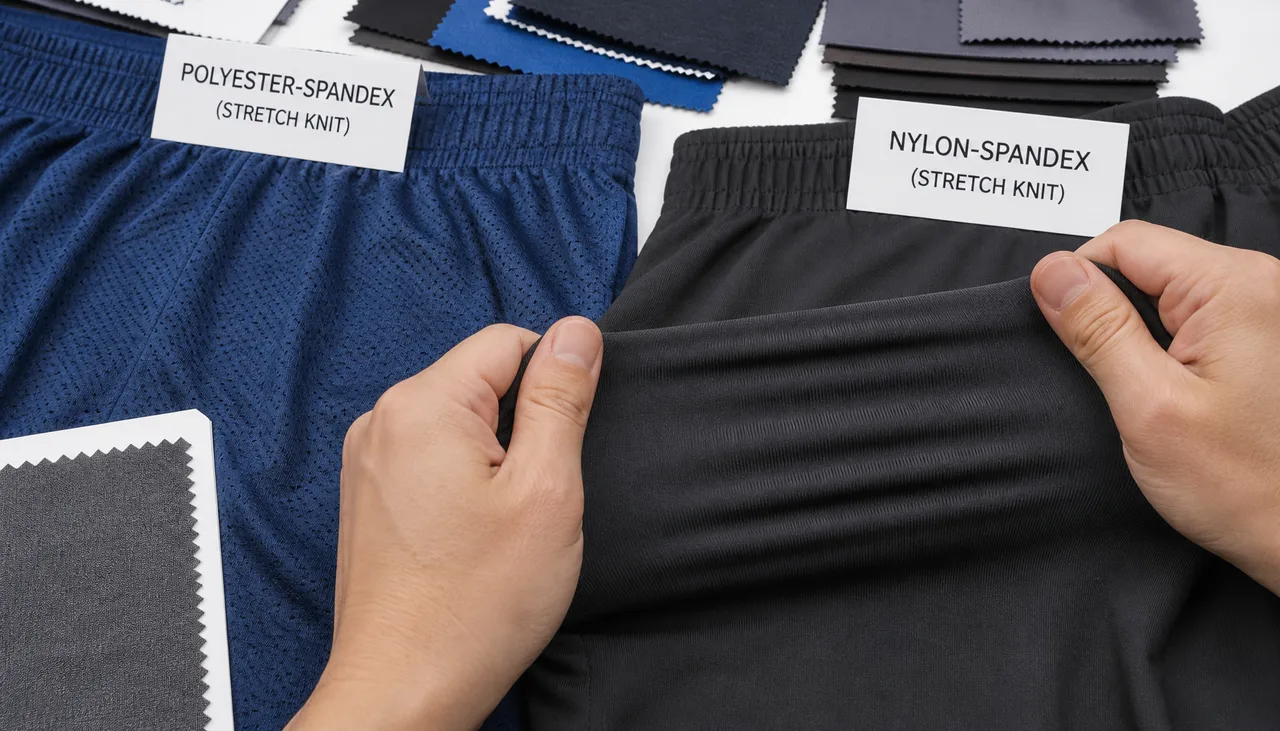
Nylon-spandex and polyester-spandex knitted fabrics are both reasonable starting points. Nylon-spandex may be shortlisted when a smooth hand and close-to-skin comfort are important. Polyester-spandex may be considered for constructions targeting quick drying or repeated-use durability. Neither conclusion is automatic: yarn, knit geometry, finishing, color, and garment design can change the result.
Ask the supplier to state the fiber composition, knit construction, finished GSM, usable width, and any finishing treatment on the sample sheet. Do not treat a reference color card or a blend name as proof of a finished performance property.
Evaluate stretch and recovery under defined conditions
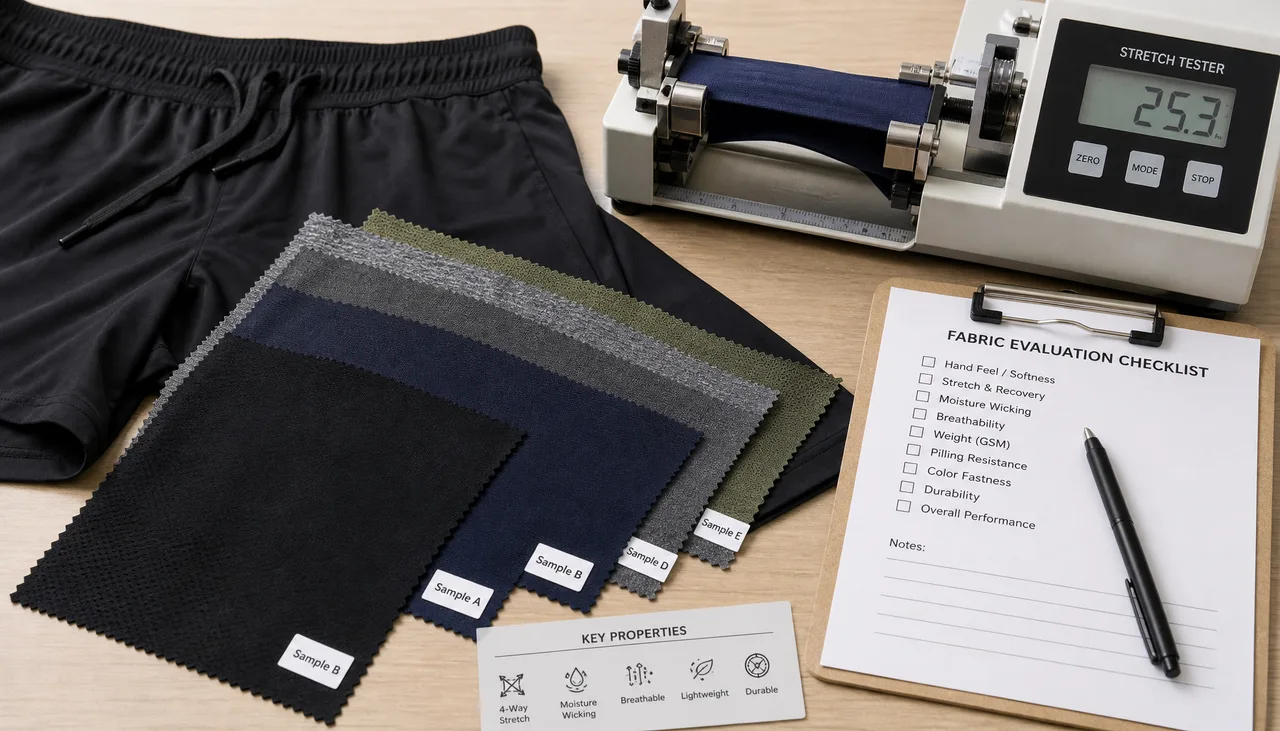
Hand-stretching a swatch is useful for screening, but it cannot replace a comparable measurement. Request stretch and recovery in the main and crosswise directions, with the extension level, hold time, recovery time, conditioning, and wash history recorded. A fabric can feel flexible while still showing unwanted growth after wear.
Review the sample both relaxed and extended. Look for loss of cover, distorted courses, shine, or a recovery delay that could affect the waistband, leg opening, or liner fit. Approve the final construction only after a garment sample confirms that the fabric response matches the pattern and seam design.
Use GSM to compare weight and consumption, not to promise comfort
GSM helps estimate garment mass, marker consumption, and the amount of material used in each size. It does not independently establish breathability, opacity, or durability. Thickness, cover, yarn size, loop structure, and finishing must be reviewed with it.
Illustrative calculation — not a ClothFactory test result: assume a finished gym short uses 0.9 m² of one fabric before cutting waste. At 180 gsm, the fabric contribution is:
0.9 m² × 180 g/m² = 162 g
At 220 gsm, the same area contributes approximately 198 g, a difference of 36 g before seams, trims, waste, and any lining. Use this calculation to compare weight and costing. Confirm comfort and coverage with the finished garment rather than inferring them from GSM alone.
Check moisture behavior, surface durability, and color
If the product brief includes moisture-management language, request a defined test on the finished fabric. A topical treatment or a supplier description is not enough to support a garment claim. Record the test method, conditioning, and pass requirement so results from different samples remain comparable.
For repeated gym use, review pilling, abrasion, snagging, dimensional stability, and seam-area distortion. Inspect the fabric after the agreed wash procedure and compare the surface before and after laundering. Confirm colorfastness for the actual shade range; one approved color does not automatically represent every dark, bright, or neon color.
Request evidence that can be compared
| Sample item | What to request | Why it matters |
|---|---|---|
| Construction | Composition, knit type, finished GSM, usable width, and finish | Links the swatch to a reproducible specification. |
| Stretch response | Direction, extension, hold time, recovery time, and post-wash result | Shows whether the sample can support the intended fit. |
| Coverage | Relaxed and extended appearance, thickness or opacity requirement where relevant | Reduces the risk of show-through or panel mismatch. |
| Moisture behavior | Defined wicking or drying method and conditioning | Prevents unsupported quick-dry claims. |
| Durability | Pilling, abrasion, snagging, and dimensional-stability results | Connects sample approval to expected use and care. |
| Color and lot control | Shade standard, dye-lot identification, and colorfastness requirements | Helps control variation during bulk production. |
Send identical requirements to each candidate supplier. Comparing one supplier’s finished GSM with another supplier’s greige GSM, or comparing recovery values from different test conditions, produces misleading conclusions.
Use a controlled sample-approval workflow
- Confirm the garment brief, pattern intent, color standard, and care label.
- Record each sample’s composition, construction, GSM, width, finish, and supplier reference.
- Screen hand, drape, stretch, recovery, and coverage in relaxed and extended states.
- Run the agreed laboratory and wash checks on matched specimens.
- Make a garment sample and inspect waistband, leg opening, seams, opacity, and post-wash shape.
- Approve a sealed reference swatch and written tolerances before bulk production.
Avoid common sample-review mistakes
- Approving by touch alone. A soft hand does not confirm recovery, coverage, or durability.
- Treating fiber content as a complete specification. The same blend can behave differently at different GSMs, constructions, and finishes.
- Using GSM as a comfort guarantee. Added mass may increase weight without improving airflow or wear comfort.
- Testing only a relaxed swatch. Gym shorts experience extension at the waistband, seat, and leg opening.
- Assuming one color represents the range. Dye depth and finishing can affect hand, stretch response, and fastness.
- Leaving test conditions open. Results cannot be compared reliably when extension, wash, conditioning, or recovery time changes.
Procurement next step
Send the supplier a one-page brief stating the gym-short layer, target composition, GSM and width, fit, color, finish, care cycle, and required tests. Ask for identified swatches and a specification sheet, then approve the fabric only after the garment sample and test conditions match the intended product. ClothFactory can use that brief to compare an existing nylon-spandex or polyester-spandex construction with a development option without treating an unverified performance claim as a finished specification.