
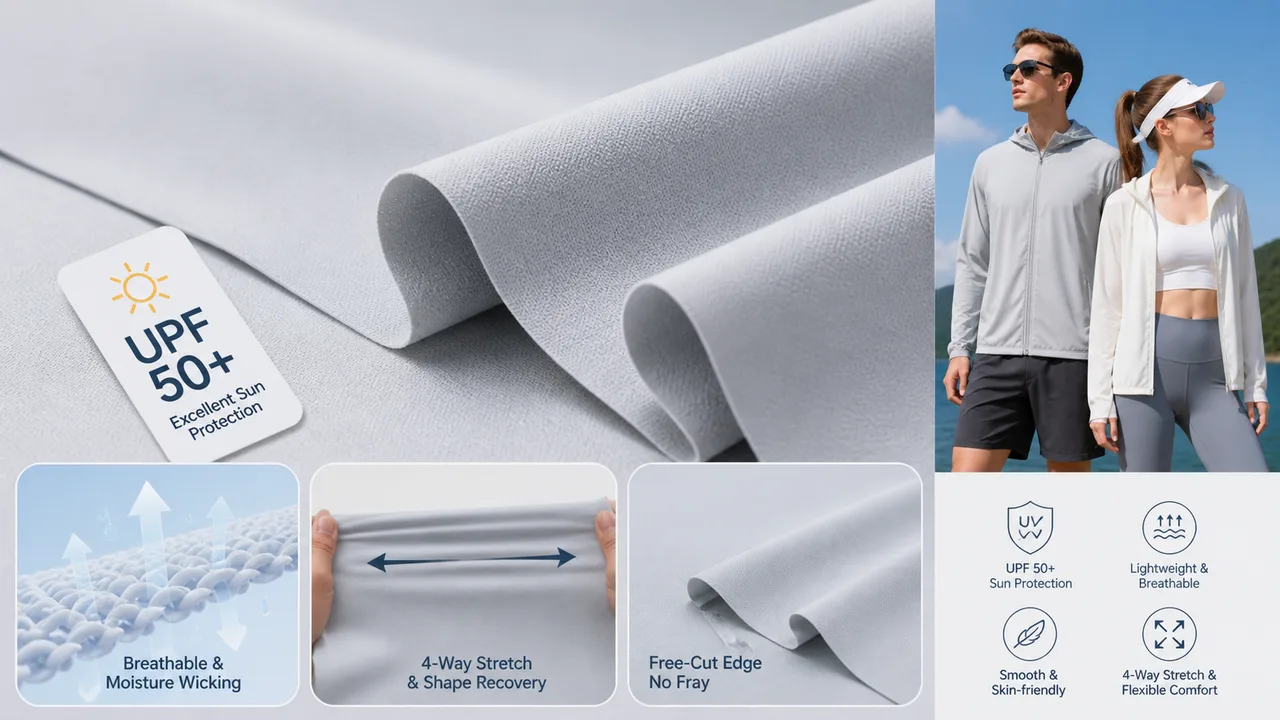
H168 can be evaluated for lightweight sun-protection jackets, but “free-cut” construction and a UPF claim are separate approval decisions. ClothFactory’s catalogue lists 74% nylon, 26% spandex, 170 g/m² and 165 cm width. Treat those figures as nominal specifications. The title’s UPF 50+ positioning must be supported by a relevant report for the supplied fabric and the intended market; composition alone cannot establish it.
What free-cut construction can actually change
A free-cut fabric is intended to leave selected edges unfinished without unacceptable curling or unravelling. It does not make a sewn jacket seamless, and it does not automatically qualify the fabric for bonding. An exposed hem, a curved cuff and a thumb opening experience different strain and abrasion, so each proposed edge needs its own trial.
For a sun jacket with extended cuffs, inspect the cut edge immediately after cutting, after repeated hand insertion and after the agreed care sequence. Record cut direction, cutting equipment and edge geometry. A straight swatch edge that lies flat on a table is insufficient evidence for a small-radius thumb opening under tension.
Release the sun-protection claim through evidence
Ask for a report identifying the article, colour, finish, specimen preparation and test method. AATCC TM183 measures ultraviolet radiation transmission or blocking through fabric, including dry or wet evaluation. A test result and a market-compliant garment label are not the same deliverable; confirm the applicable labelling requirements separately.
Establish whether stretching, wetting and care treatments relevant to the garment are covered by the evaluation. A relaxed dark swatch must not be used as blanket evidence for a stretched pale sleeve. Request the supporting report before printing hangtags, and avoid explanations about “embedded UV particles” unless the material supplier has documented that mechanism for the actual article.
Balance coverage, fit and summer comfort
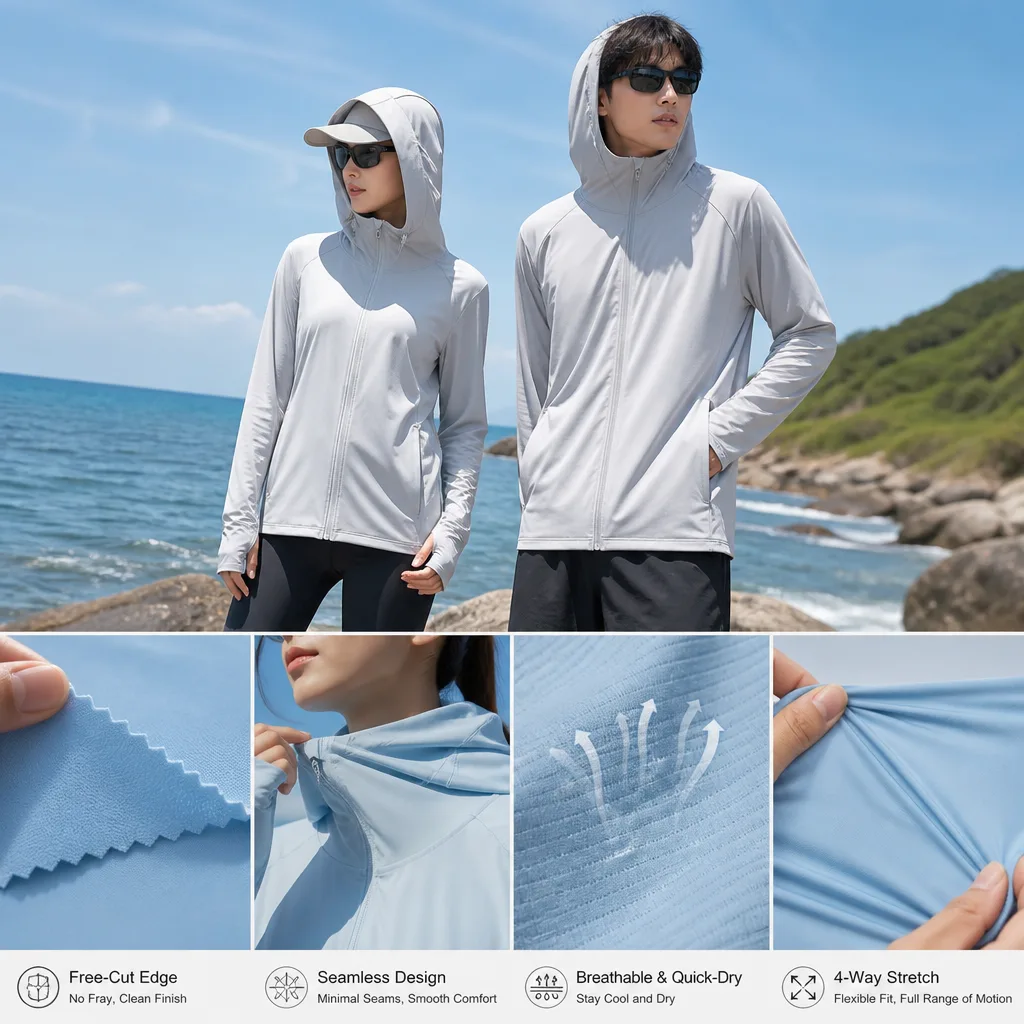
A close-fitting sleeve can reduce loose fabric around the wrist, but it also increases local fabric extension. A roomier sleeve changes coverage, air exchange and fabric consumption. Evaluate the garment during reach, elbow flexion and thumb-loop use, not only in a standing fit photograph.
Do not combine contact coolness, airflow, moisture transport and drying into one “breathability” result. They describe different behaviour. For example, ISO 9237 addresses air permeability; it does not prove ultraviolet protection or drying speed. Specify the property that matters to the end use and compare candidates under the same test conditions.
Check whether removing a hem really reduces cost
Use an assembly trial to calculate the value of a free-cut edge. In a hypothetical costing exercise, removing one operation saves $0.08 per jacket. If edge-related rework affects 5% of jackets and costs $1.20 per affected piece, its expected cost is $0.06 per jacket. Only $0.02 of the initial saving remains, before inspection, scrap or any fabric premium. These are illustrative inputs, not ClothFactory prices or defect rates.
At 170 g/m² and 1.65 m full width, nominal fabric mass is 0.2805 kg per linear metre, equivalent to about 3.57 m/kg before losses. Compare actual marker consumption at the approved usable width. Eliminating a folded hem may change the pattern allowance, but the saving cannot be assumed until the pattern and cutting plan are revised.
Write a sample-to-bulk control plan
Approve the fabric, edge treatment and garment claim as three linked records. The fabric record should contain the agreed weight, width, composition and elasticity requirements. The edge record should show acceptable curl, fraying and appearance at defined garment locations after the specified evaluation. The claim record should link each supported colour or product grouping to its evidence.
Any change in yarn, construction, colour, finish or garment fit should be reviewed for its effect on those approvals. H168 is commercially useful when the production garment passes both the edge and protection requirements at an acceptable cost. Neither a smooth hand feel nor a UPF icon in an image is sufficient authority to release bulk production.