
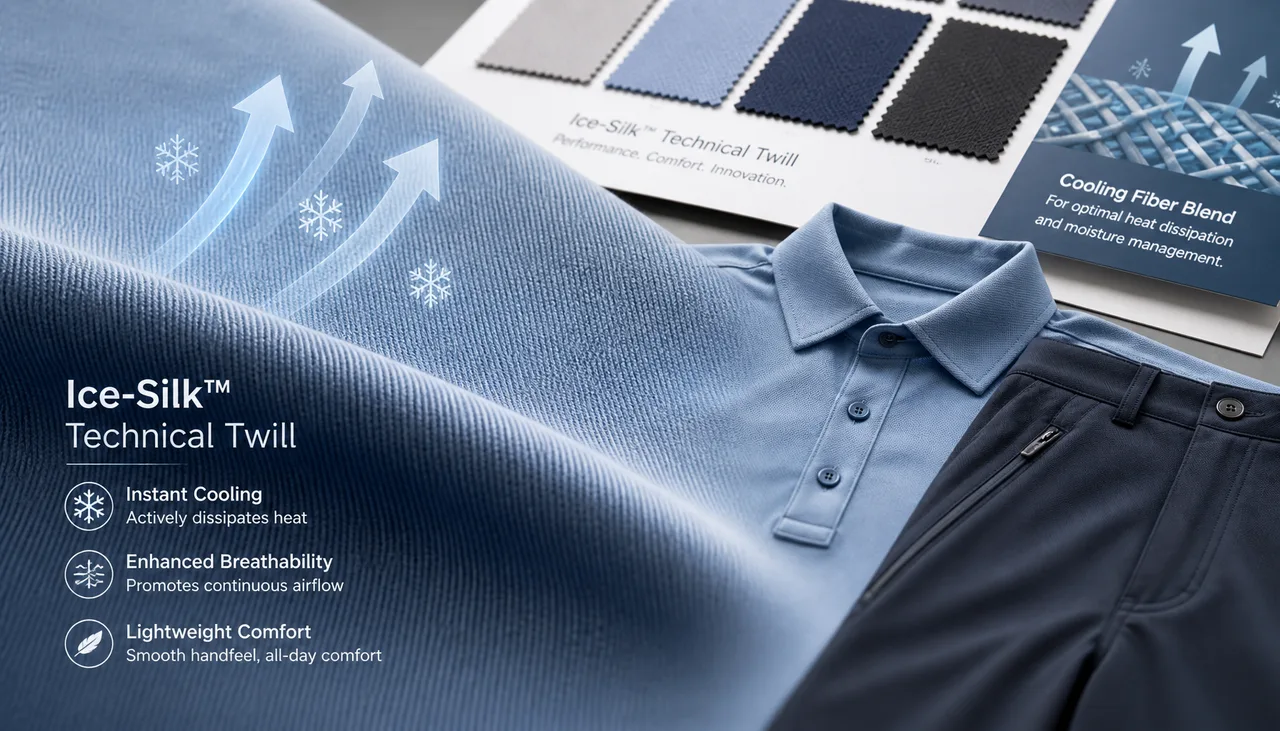
Ice-Silk Technical Twill Jersey is an 86% nylon/14% spandex candidate specified at 165 GSM and 165 cm finished width. For performance polos or trousers, buyers should approve its thermal and moisture behavior, drape, recovery, crease appearance, colorfastness and wash durability rather than rely on the “ice-silk” name or cool first touch.
Separate cool touch from sustained wear comfort
A fabric can feel cool at first contact because heat moves quickly from the skin into the material. That sensation does not establish how the garment will behave after the fabric warms, absorbs moisture, or is worn in still air and direct sunlight.
Ask the supplier to define the cooling claim. It may refer to initial contact cooling, moisture spreading, drying, air permeability, thermal resistance, or a finish. Each mechanism requires a different measurement and gives a different procurement conclusion. The report should identify the method, specimen conditioning, fabric color, and whether the sample was tested before or after laundering.
Match twill structure to the garment
A twill-like knitted surface can provide a cleaner diagonal texture and more visual structure than a plain jersey. For a polo, buyers should check collar compatibility, placket stability, drape, and seam puckering. For trousers, the priorities may shift toward seat and knee recovery, abrasion, pocket opening stability, and crease appearance.
Do not assume one construction is automatically suitable for both. A sample that drapes well in a polo body may lack the recovery needed at the trouser knee, while a more substantial trouser fabric may create excessive bulk in a polo collar or placket.
Compare candidates under one specification
| Requirement | Polo-shirt check | Trouser check |
|---|---|---|
| Stretch and recovery | Shoulder movement, sleeve opening and hem recovery | Seat, thigh and knee extension after wear |
| Surface appearance | Placket puckering, collar transition and shade | Creasing, abrasion and pocket-edge distortion |
| Moisture behavior | Drying and cling during upper-body activity | Comfort at seat and thigh contact zones |
| Weight and thickness | Drape and layering comfort | Coverage, structure and seam bulk |
| Dimensional stability | Body length and placket alignment after washing | Inseam twist, leg length and waistband fit |
Record finished GSM, usable width, construction, composition, finish, and care conditions for every swatch. Without those values, a “cooling twill” comparison is not reproducible.

Verify any finish after the intended care cycle
If cooling or moisture performance comes from an applied finish, ask whether the quoted result is for an unwashed sample or a specified number of care cycles. Evaluate hand, shade, dimensional stability, and performance after the wash route intended for the garment label. A finish that changes drape or color may create a commercial tradeoff even when its laboratory result is acceptable.
Color also matters. Dark shades can behave differently in sunlight from pale shades, and dyeing or finishing can affect hand and moisture spreading. Do not extend a result from one color to an entire range without an agreed validation plan.
Procurement next step
Prepare separate briefs for the polo and trouser applications. State the target fit, fabric weight and width, stretch direction, care cycle, color range, cooling claim, and required test method. Request identified finished samples, supporting data for the exact construction, and sufficient yardage for sewing and washed-garment trials before approving bulk production.