
Approve jogger fabric only after confirming knee and seat recovery, pocket stability, dimensions after care, surface durability, and cutting yield in the intended garment. Tie that approval to an identified fabric version, physical reference, and numerical tolerances so bulk inspection can reproduce the decision.
Begin with the worn silhouette
A tapered travel jogger worn while seated has a different brief from a brushed lounge jogger or a lightweight training style. Define fit, intended season, pocket load, cuff construction, and wear duration. A soft hand alone does not establish resistance to knee bagging, and a higher spandex percentage does not establish the desired support.
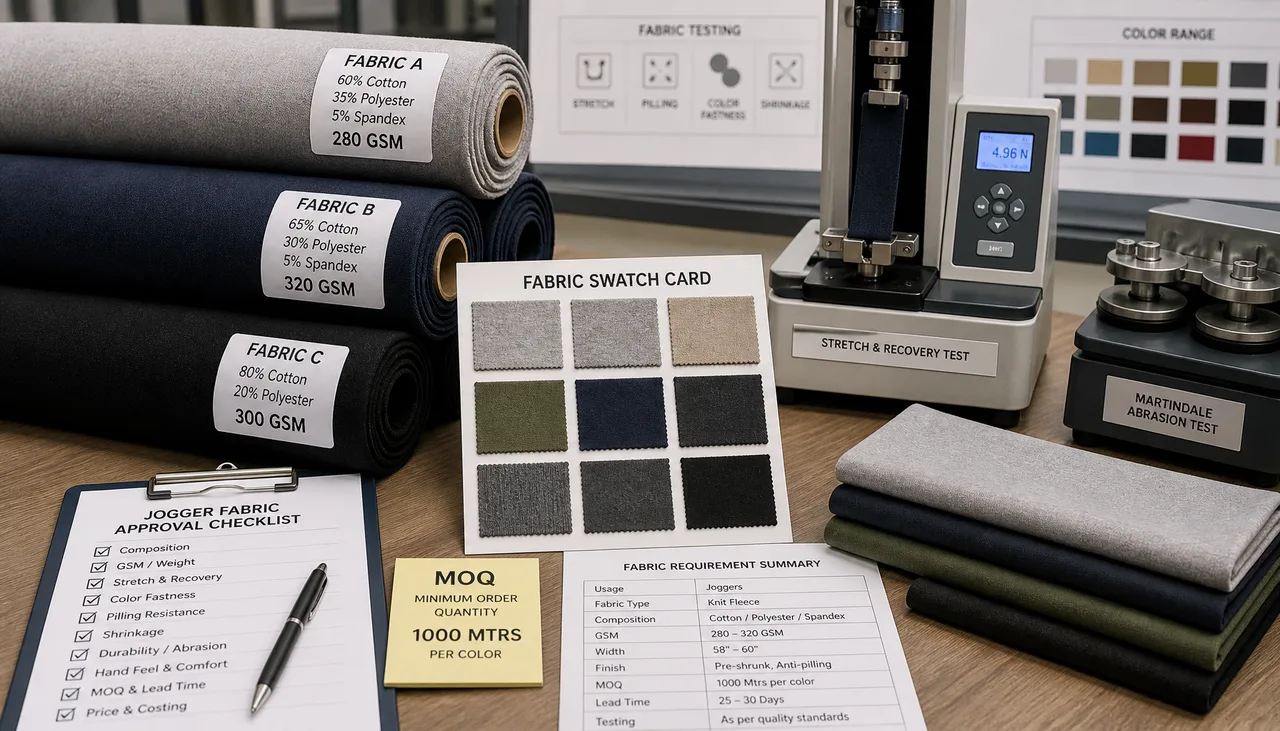
Use sitting and pocket load to reveal fit problems
Assess repeated sitting, knee flexion, and recovery after the agreed rest period on the sewn prototype. Check the intended pocket contents: a phone can pull a lightweight pocket area out of shape even if the body fabric passes a strip recovery test. Record garment size, panel orientation, seam and pocket construction so a fit problem can be traced to material behavior or design.
Measure the consequence of dimensional change
Hypothetical calculation: an 80 cm inseam that shortens by 3% becomes 77.6 cm, a 2.4 cm change. This is an illustration, not an acceptance limit. Establish the finished-garment tolerance first, then evaluate fabric dimensional change and prototype measurements under the intended washing and drying procedure.
Adding pattern length can compensate for predictable length change, but does not correct twisting seams or unequal behavior between body fabric, waistband and cuffs. Review those components together before adjusting the pattern.
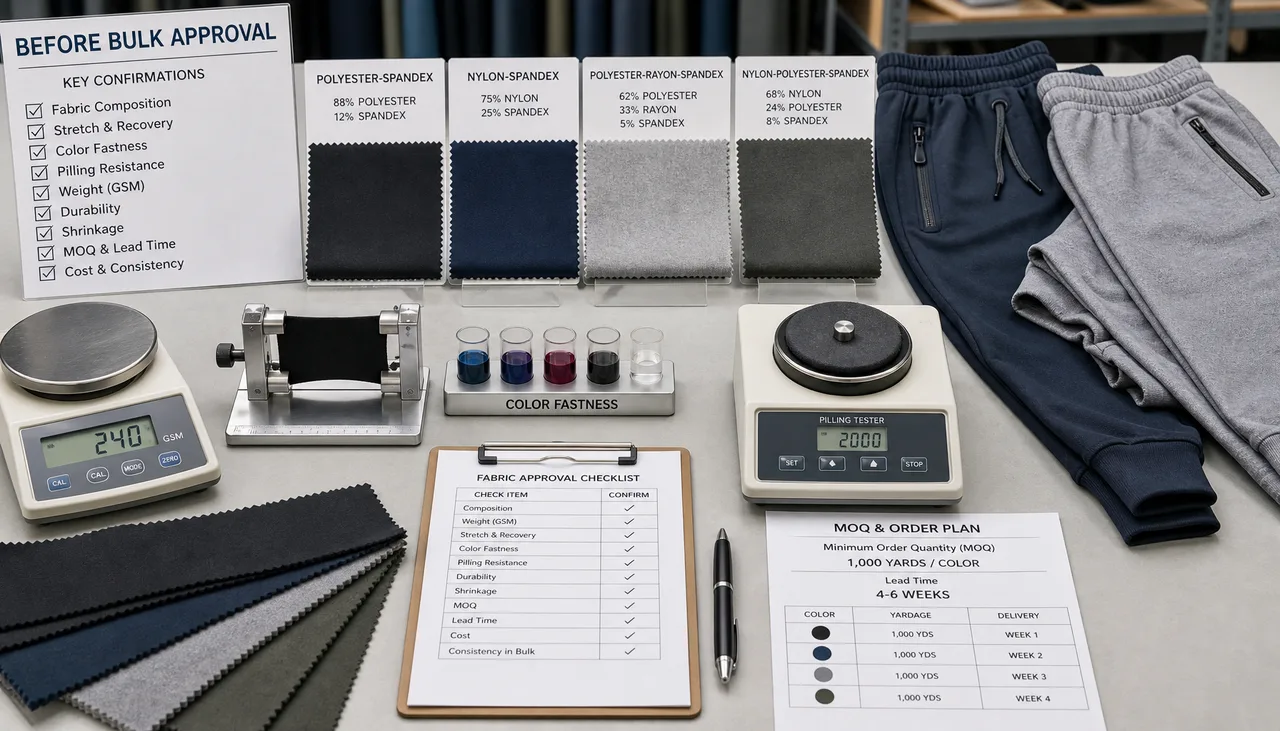
Distinguish softness from surface durability
For brushed or sueded candidates, inspect how the surface changes at the inner thigh, seat and pocket openings after relevant wear and care. Ask the laboratory to use the agreed pilling or abrasion method and report the exposure conditions. Pilling appearance, abrasion damage and hand are separate judgments; one passing result should not stand in for the others.
Check cutting economics before freezing the quality
Run the graded production marker at the minimum accepted usable width. Where the surface has a directional appearance, confirm whether panels must face one way; that constraint can change yield. Record finished GSM, billed width, usable width, and the conversion from weight price to garment consumption. A softer or heavier version may require a fresh costing even if the fiber percentages remain unchanged.
Release bulk against a defined record
- Sealed hand and appearance reference, approved colors and construction revision.
- GSM and usable-width limits with agreed measurement conditions.
- Direction-specific recovery and post-care dimensional requirements.
- Colorfastness and surface-durability criteria tied to named methods.
- Roll identification, sampling coverage and action for failed results.
Request production-relevant yardage for sewing and care trials before bulk authorization. Once approved, require notification of changes to yarn specification, construction, brushing or finishing that could alter the result. Release each shipment using its own identified records rather than relying solely on the development sample.