
Twill fabric is defined by its characteristic diagonal surface ribs, known as wales. For sourcing teams, the decisive split comes down to construction: woven twill interlaces warp and weft yarns at right angles to deliver rigid dimensional stability with low stretch (under 2% to 3% naturally, or 10% to 20% when blended with elastane), while knit twill arranges interlocking loops to produce multi-directional elasticity and continuous recovery.
What Is Twill Material and How Is the Diagonal Wale Formed?
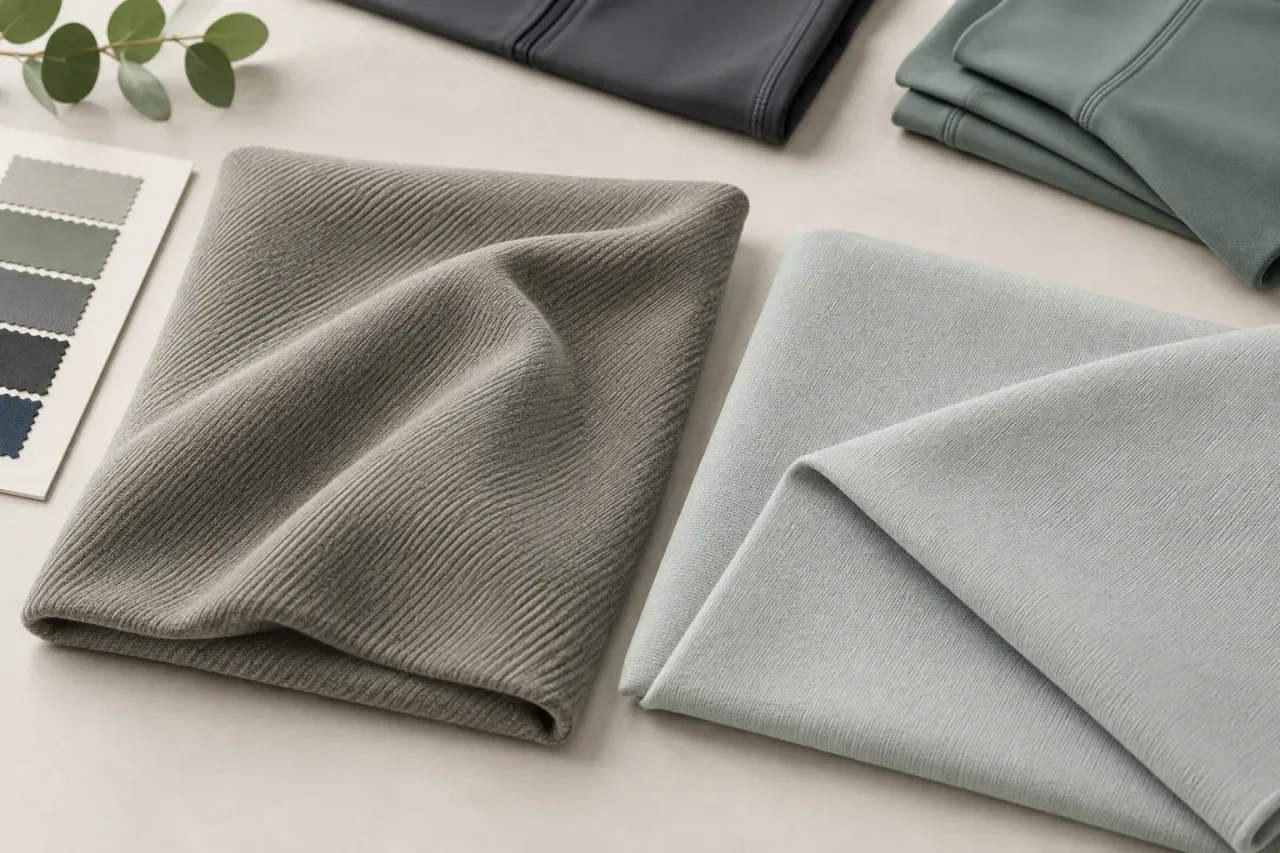
A twill fabric is recognized by the diagonal texture running across its face. In traditional woven twill, this texture is produced on a loom by passing each weft yarn over and under two or more warp yarns, stepping the interlacing point across by one yarn on each successive pick. This repeating offset creates a visible diagonal rib, delivering tear resistance, wrinkle resistance, and a softer drape than a basic plain weave.
Knit twill achieves a matching diagonal wale through loop formation on knitting machinery rather than over-and-under yarn crossing. Needle selection and loop transfers offset the knit courses and wales diagonally. Because the surface texture comes from connected yarn loops rather than rigid perpendicular interlacing, knit twill preserves the structural flexibility of a knit while presenting the visual texture of twill.
Knit Twill vs. Woven Twill: Comparing Stretch, Recovery, and Durability
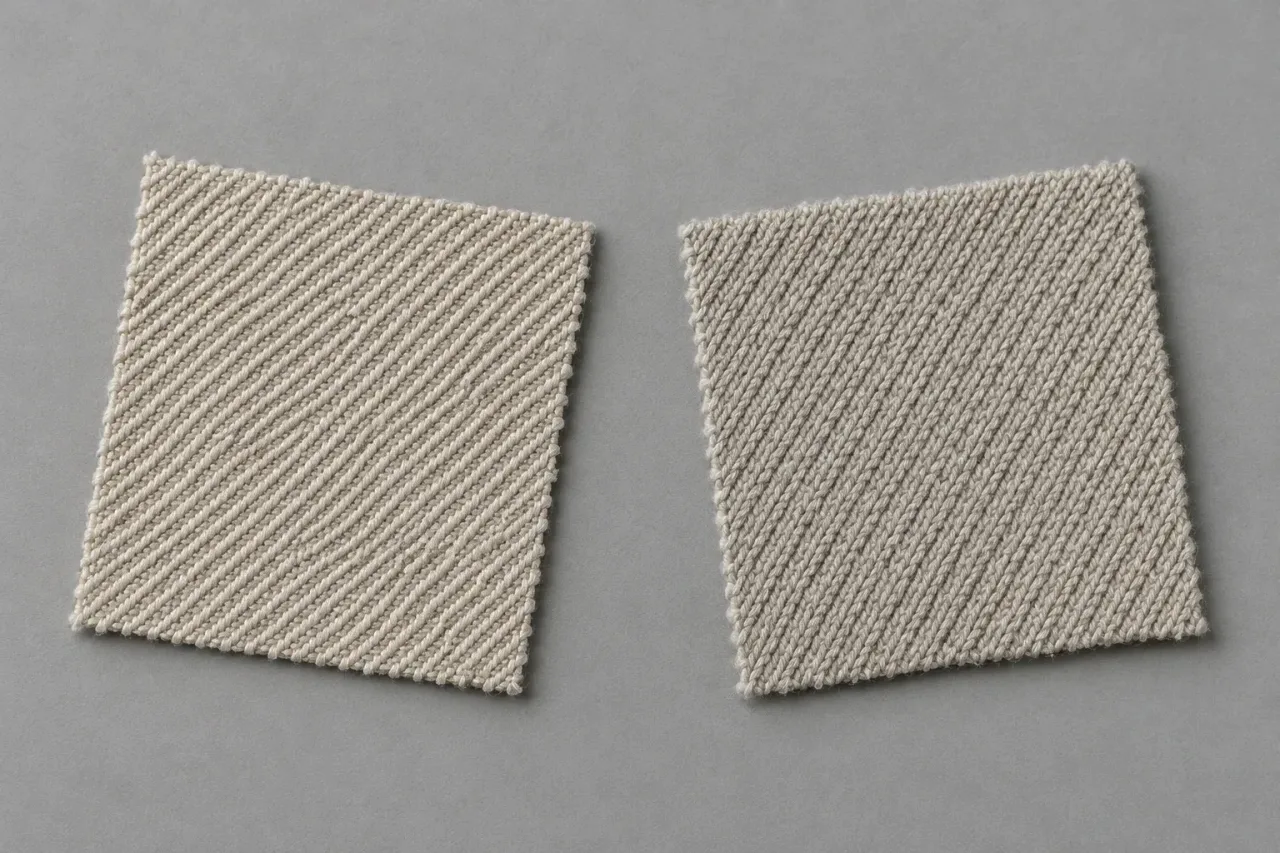
The structural differences between interlaced yarns and interconnected loops dictate how each twill responds to tension, washing, and cutting.
|
Property |
Rigid Woven Twill |
Stretch Woven Twill |
Synthetic Stretch Knit Twill |
|---|---|---|---|
|
Structural Formation |
Offset warp/weft yarn interlacing |
Offset interlacing with elastane core |
Intermeshing loops with synthetic elastane |
|
Elongation Range |
Under 2% to 3% along grain |
Typically 10% to 20% |
High multi-directional stretch |
|
Shape Recovery |
Low mechanical return |
Moderate recovery |
Elastic spring-back prevents bagging |
|
Drape & Hand |
Firm, crisp, structured |
Semi-structured with slight give |
Soft, pliable, body-contouring |
|
Cut Edges |
Prone to fraying |
Prone to fraying |
Resists fraying; raw edges may curl |
|
Target Silhouettes |
Chinos, jackets, utility trousers |
Tailored trousers, workwear |
Leggings, activewear, athleisure bottoms |
Standard woven twill maintains excellent dimensional stability and high tensile strength, but its rigid geometry limits body movement unless cut on the bias or blended with elastane. Furthermore, woven twill edges fray when cut and require overlocking or clean-finished seam allowances. In contrast, knit twill offers natural two-way or four-way stretch. When constructed as a double-knit, it provides balanced stability across width and length without fraying at open seams, though loose loop structures can carry higher snagging risks if exposed to abrasive contact.
Application Guide: Specifying Woven Twill vs. Nylon-Spandex Knit Twill
Garment pattern ease and required mobility determine which twill construction to select:
- Specify woven twill for structured garments that demand sharp creases, defined lines, and load-bearing pockets. Outerwear shells, workwear chinos, and utility jackets benefit from the fixed tensile strength and tear resistance of offset woven yarns.
- Specify nylon-spandex knit twill for close-to-body activewear and flexible athleisure trousers. The combination of nylon's abrasion resistance and high spandex content provides a soft hand feel and the high elastic recovery required to prevent bagging at the knees and seat during wear.
For lightweight performance bottoms and fitted training tops, CF-NS-0009 230 GSM Matte Second-Skin Nylon Spandex Double-Knit provides a supportive double-knit construction with a smooth matte finish in a 75% nylon, 25% spandex blend at 230 g/m² and 160 cm width. For cold-weather activewear, H3268 250 GSM Brushed Nylon Spandex Double-Knit Fabric delivers 250 g/m² thermal retention with a 78% nylon, 22% spandex profile at 165 cm width. Verify physical roll samples to assess wale definition, recovery tension, and finished width before final cutting marker layout.