
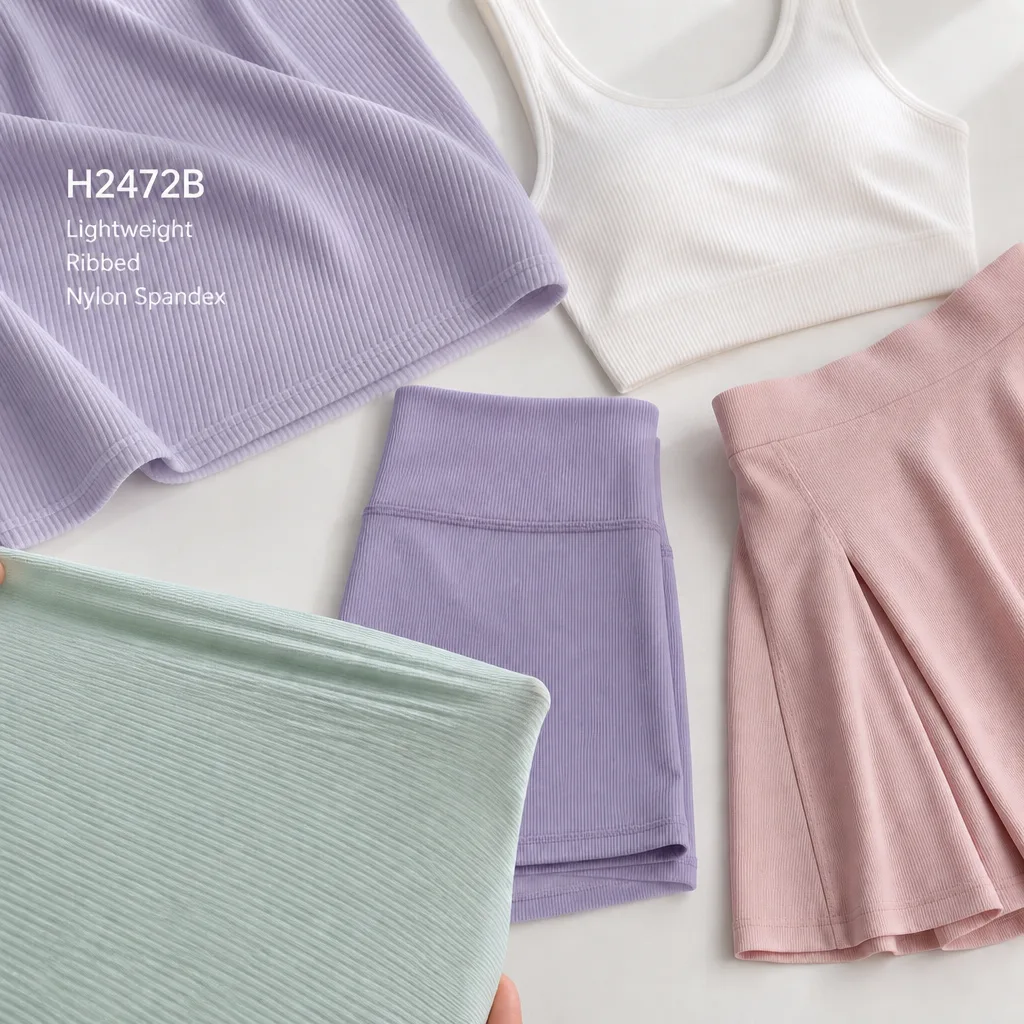
H2472B is a 250 GSM ribbed nylon-spandex fabric with 24% spandex, developed as a lighter alternative to H2472 for fitted athleisure and activewear. Buyers should evaluate it as a medium-weight candidate—not assume that “lightweight” guarantees coolness—and confirm stretch recovery, moisture handling, opacity, and comfort in the intended garment and climate.
Position H2472B against the product brief
The 250 GSM construction is 30 GSM lighter than the stated 280 GSM H2472 reference. That difference can reduce fabric mass while retaining a substantial ribbed surface, but it does not automatically establish better breathability or faster drying. Knit density, air permeability, finishing, color, garment coverage, and fit all affect thermal comfort.
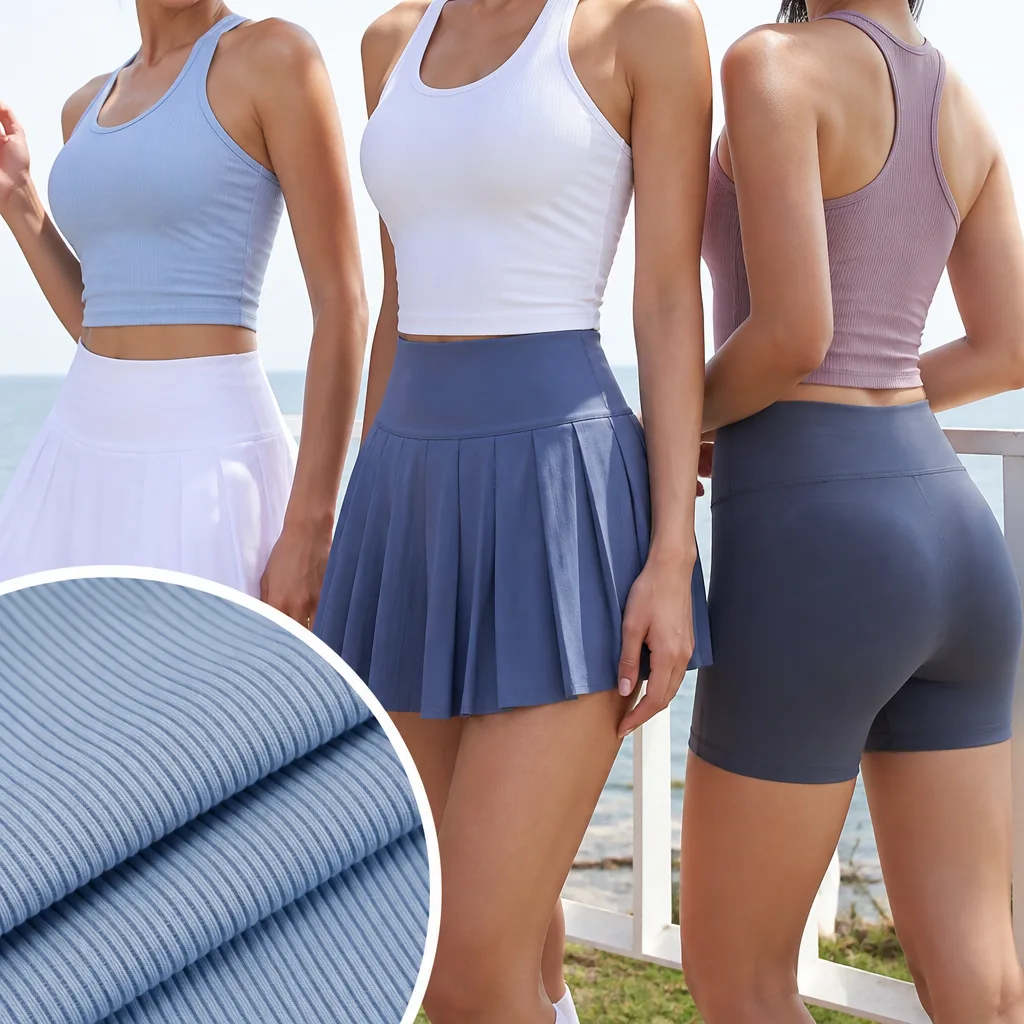
H2472B is most relevant when a brand wants visible rib texture in products such as fitted tanks, strappy tops, yoga shorts, tennis skirts, or everyday athleisure. The first sourcing decision is whether that texture and weight fit the product's use conditions, rather than whether the fiber label sounds appropriate for summer.
Interpret the 24% spandex correctly
Spandex percentage is a composition value, not a complete performance specification. It cannot confirm extension in both directions, recovery after repeated wear, holding power, or garment support without test conditions.
Request finished-fabric results that state:
- stretch in the wale and course directions;
- applied load or extension target;
- hold and relaxation time;
- recovery calculation;
- number of cycles where cyclic testing is required;
- dimensional change after the agreed wash and drying procedure.
Use the same method and conditioning requirements for every candidate fabric. Two percentages obtained under different loads or recovery times are not directly comparable.
Compare garment mass before committing to “lighter”
An early mass estimate helps buyers understand whether the 30 GSM difference is meaningful for the intended pattern:
estimated fabric mass = garment fabric area × GSM
Illustrative calculation, not ClothFactory production data: a fitted top using 0.75 m² of finished fabric would contain about 0.75 × 250 = 187.5 g of H2472B before cutting loss. At 280 GSM, the same area would contain about 210 g, a difference of 22.5 g. Actual consumption depends on usable width, marker efficiency, size ratio, rib direction, and cutting waste.
The calculation quantifies weight, not perceived coolness. Air permeability, moisture transport, drying behavior, and the amount of skin covered still require separate evaluation.
Validate each proposed application
Tanks and strappy active tops
Check whether the fabric recovers at necklines, straps, and armholes without excessive reinforcement. The 250 GSM body may support a clean silhouette, but seam and binding construction determine whether edges stretch out during wear.
Yoga shorts and tennis skirts
Confirm opacity at the maximum garment extension and inspect the fabric after repeated sitting, bending, and laundering. If a skirt includes an inner short, evaluate heat and moisture comfort as a complete layered garment rather than testing the shell fabric alone.
Everyday athleisure
For pieces expected to move between training and casual use, assess pilling, abrasion, shade consistency, and appearance after the specified care cycle. A smooth initial hand does not prove that the surface will remain unchanged after use.
Control rib direction during production
Rib alignment should be included in the cutting and workmanship standard. Record the approved grain direction, identify panels that must be symmetrical, and check whether relaxed fabric remains straight after spreading. Misaligned ribs can make otherwise acceptable seams appear twisted.
Needle, thread, stitch type, stitch density, and differential feed should be established through sewing trials. Inspect for needle cutting, skipped stitches, seam grin, waviness, and restricted extension. There is no single “fine needle” or elastic thread specification that is correct for every machine, seam, and garment design.
Avoid these purchasing shortcuts
- Using “summer fabric” as a substitute for measurable comfort requirements.
- Accepting moisture-wicking or quick-drying claims without a defined method and result.
- Assuming 24% spandex proves balanced four-way stretch or recovery.
- Approving opacity in one dark shade and applying the result to all colors.
- Comparing samples before confirming equal GSM, width, finish, and conditioning.
Build a comparable sample request
Specify the garment type, use environment, fit, size range, target color, intended care cycle, finished GSM range, usable width, and required performance methods. Request enough material for a full prototype, not only a small swatch. Approve H2472B only after the finished garment meets the agreed standards for comfort, opacity, recovery, seam performance, laundering, and visual rib alignment.