
Choose a matte nylon-spandex fabric only after garment testing. The fabric must stay opaque at working stretch. It must recover after wear. Its seams must also survive the intended care cycle. Fiber content and GSM are useful filters. They do not prove that a fabric is suitable for yoga leggings.
Define the garment before comparing fabrics
Start with the intended fit. Record the size range and panel layout. Note the areas with the highest strain. For leggings, these are often the seat, knee and upper thigh. A fabric that works in a relaxed top may fail in a close-fitting legging.
Set measurable requirements before requesting samples. Include finished weight, usable width and stretch direction. Add coverage, recovery and care requirements. State the target color and surface appearance. This gives suppliers one brief to answer.
Test coverage at the real working stretch
A matte surface does not guarantee opacity. Dark colors can also hide problems that appear in pale shades. Test every production color against a contrasting backing. Use the same lighting and viewing distance each time.
Stretch the fabric to the extension expected in the garment. Then repeat the check on a sewn sample. A flat swatch does not reproduce strain around the seat or across curved seams.
Negative ease must be calculated from the relaxed garment measurement. If an 80 cm panel must fit a 100 cm body circumference, the panel extends by 25%. The calculation is (100 − 80) ÷ 80 × 100. Use this as a starting point. Confirm the result on the finished garment.
Measure stretch and recovery separately
Stretch percentage shows how far a fabric can extend. Recovery shows what remains after the load is removed. Buyers need both results. A fabric can feel elastic and still grow at the knee or waistband.
Ask the supplier to report the test direction, specimen size, applied load, hold time and recovery time. Without those conditions, two percentages may not be comparable. ISO 20932-1 is one recognized strip-test method for fabric elasticity. The purchase specification must still define the required result.
Repeat extension several times before judging recovery. Inspect the fabric after it rests. Then check the sewn garment after wear and washing. Record any knee bagging, waistband growth or surface distortion.
Approve seams with the fabric
A fabric does not perform alone. Thread, needle, stitch type and machine settings affect the result. Heat-transfer decoration can also change the surface.
Run a sewing trial with the intended production setup. Check for skipped stitches and needle damage. Stretch the seam to the garment requirement. Look for thread breakage, seam grin and poor recovery. Repeat the inspection after laundering.
Keep the accepted settings with the sample record. Do not rely on a general instruction such as “use a stretch needle.” Production needs a repeatable setup.
Check washing and surface durability
Use the care procedure planned for the garment label. Measure the sample before and after washing. Record length and width change. Check shade, hand feel and surface appearance.
Inspect high-friction areas. Inner thighs and waistbands receive repeated contact. Brushing, pilling or glazing may appear before the fabric tears. If abrasion or pilling is critical, agree on a laboratory method and acceptance grade before bulk production.
Compare usable cost, not only price per kilogram
Convert the quotation to usable garment cost. Confirm finished GSM and usable width. Exclude damaged edges and unacceptable defects. Then compare marker consumption on the intended pattern.
For example, 230 g/m² at a full width of 1.65 m equals about 0.3795 kg per linear metre. That is about 2.64 metres per kilogram. This is a theoretical conversion. It is not guaranteed cutting yield.
A cheaper fabric may need lining or extra seam correction. It may also produce fewer acceptable panels. Include those effects in the comparison.
Use the product specification as a shortlist
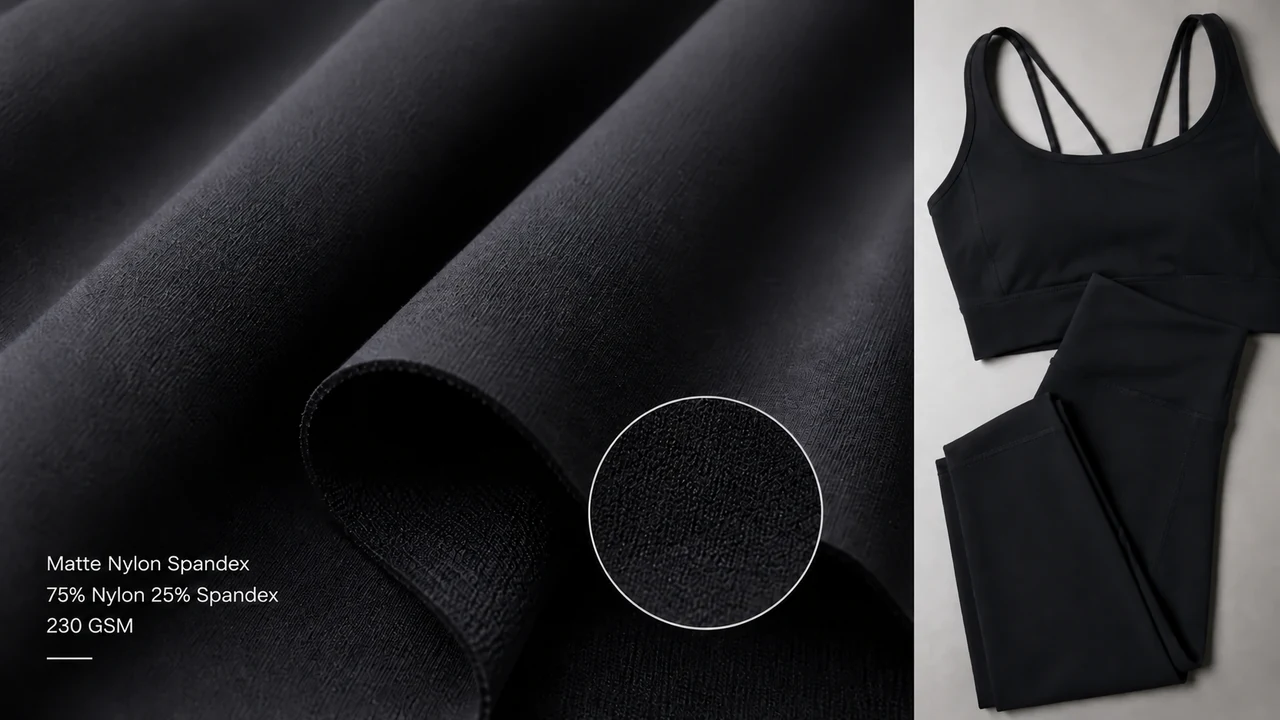
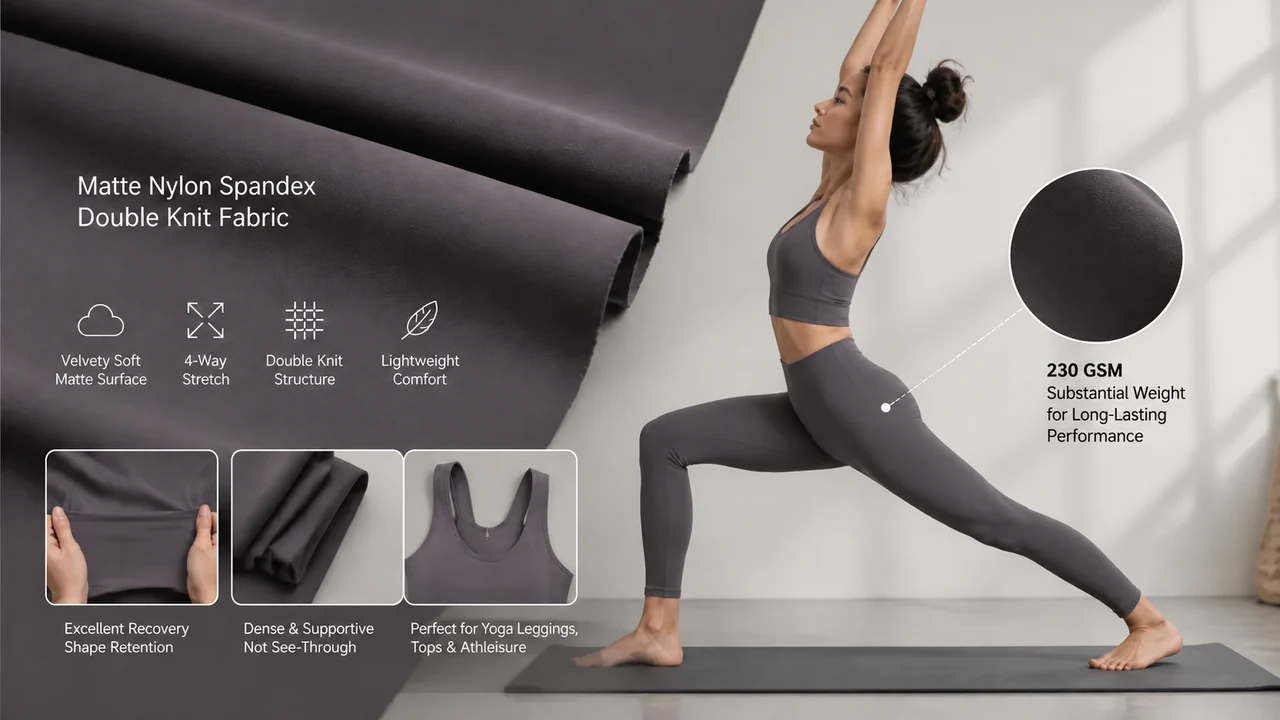
CF-NS-0003 is one candidate for this application. Its catalogue specification is 75% nylon and 25% spandex. The nominal weight is 230 g/m². The nominal width is 165 cm.
These values can support an initial comparison. They do not confirm opacity, compression or recovery. Request the intended color. Test it at garment strain. Approve the sewn and washed sample before placing a bulk order.
Release bulk production with a written record
The approval record should identify the fabric revision and color. It should state finished weight and minimum usable width. Add the agreed test conditions and acceptance limits. Attach a retained cutting and approved garment.
Require reapproval when the yarn, construction, color route or finish changes. This keeps the buying decision tied to evidence. It also gives the supplier a clear production target.