
Before accepting a fabric MOQ, buyers should verify what the minimum applies to, how much usable garment output it creates, and which costs remain at risk if demand changes or the fabric fails approval. The policy should identify the unit, construction, color, finish, tolerance, delivery arrangement, and payment commitment rather than state only one minimum number.
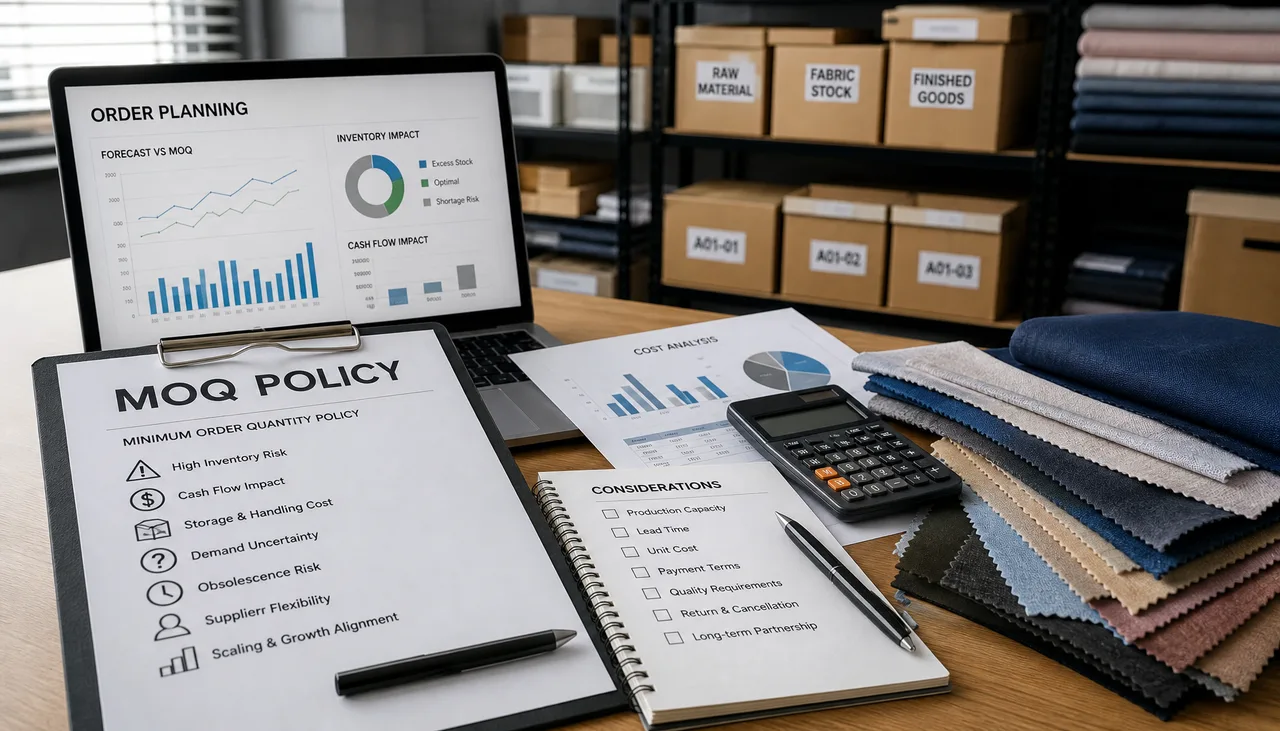
Confirm what the MOQ actually covers
An MOQ may apply per fabric construction, color, finish, print design, dye lot, production run, or purchase order. It may be quoted in kilograms, linear meters, yards, rolls, or another unit. These bases are not interchangeable.
Before comparing suppliers, ask:
- Is the MOQ per color or for the complete order?
- Does it apply to greige material, finished fabric, or shipped quantity?
- Are width, GSM, composition, or finish changes treated as separate constructions?
- Is the quantity measured by ordered, produced, inspected, or usable material?
- What overproduction or under-delivery tolerance is permitted?
- Are sampling, lab dips, strike-offs, setup charges, and freight separate?
- Does a repeat order use the same minimum, or must it be reconfirmed?
A low headline MOQ may still create a large commitment when it applies separately to every color or specification.
Convert kilograms and meters using the real specification
Buyers should not rely on a fixed conversion between kilograms and linear meters. The relationship depends on finished GSM and usable width:
Approximate kg = linear meters × usable width (m) × finished GSM ÷ 1,000
Illustrative calculation — not a ClothFactory MOQ or production result: assume 600 m of finished fabric, 1.5 m usable width, and 200 gsm:
600 m × 1.5 m × 200 g/m² ÷ 1,000 = 180 kg
If width or GSM changes, the kilogram requirement changes even when the linear meters remain the same. Confirm whether commercial settlement uses actual delivered weight, invoiced meters, or another agreed basis.
Calculate usable garment output, not only ordered quantity
MOQ risk depends on how many saleable garments the fabric can produce. Include marker consumption, size mix, cutting loss, inspection defects, shade segregation, testing allowance, and replacement material.
Hypothetical planning example: if an order contains 600 usable meters, theoretical consumption is 0.80 m per garment, and the buyer assumes a 92% usable yield:
600 m ÷ 0.80 m × 92% = 690 garments
This is a planning example, not a universal yield or ClothFactory output. The actual result must use the approved marker, usable width, defect map, size ratio, and production allowance.
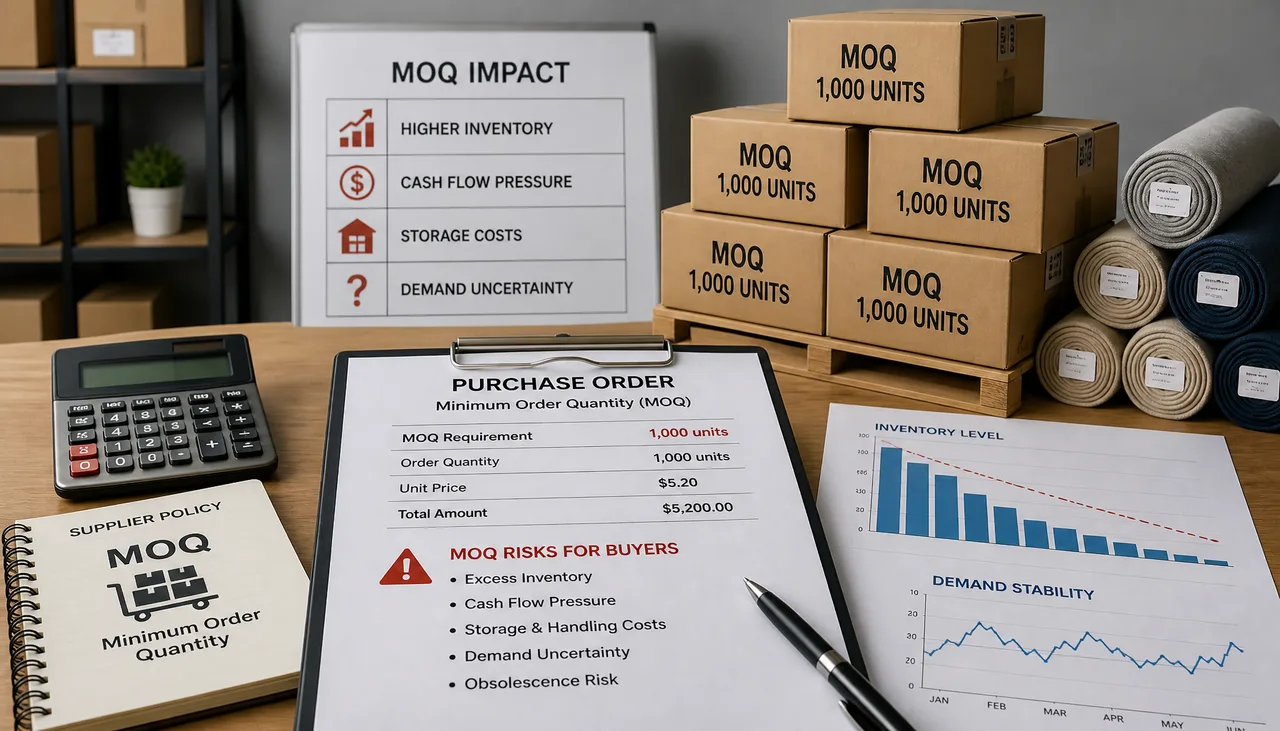
Review the main commercial risks
| Risk | What can go wrong | What buyers should confirm |
|---|---|---|
| Demand risk | Forecast demand is lower than the garment output created by the MOQ | Launch quantity, replenishment plan, season length, and exit route for unused fabric |
| Cash-flow risk | Deposit and balance payments are committed before garment sales | Payment schedule, approval gates, cancellation terms, and working-capital impact |
| Color fragmentation | Each color carries a separate MOQ, multiplying inventory | MOQ basis per color, permitted color grouping, and whether repeat shades can be reordered |
| Specification fragmentation | Small changes in GSM, width, composition, finish, or print create separate minimums | Which changes require a new production run or setup charge |
| Approval risk | Material is produced before color, hand, print, or performance is approved | Lab-dip, strike-off, development-sample, testing, and written bulk-release sequence |
| Yield risk | Ordered meters do not equal usable garment output | Usable width, roll length, defect allowance, shade grouping, and over/under-delivery tolerance |
| Obsolescence risk | Custom color or finish cannot be redirected to another style or season | Compatibility with future styles, storage conditions, and ownership of unused material |
| Supply risk | A low MOQ is accepted, but repeat availability is uncertain | Repeat-order policy, raw-material continuity, lead-time confirmation, and lot-to-lot controls |
Separate sampling quantity from bulk MOQ
Sample yardage, lab dips, print strike-offs, and development lots serve approval decisions; they should not be assumed to follow the same quantity or pricing as bulk production. Confirm which samples are available, what each sample proves, and whether sample or setup charges are credited to the bulk order.
Do not approve a bulk MOQ merely because a small swatch looks acceptable. The approval plan may need to cover color, hand, finished GSM, width, stretch and recovery, dimensional stability, colorfastness, surface durability, and any claimed functional finish.
Link payment to approval and production events
The quotation or purchase agreement should state:
- what payment reserves or purchases;
- whether raw materials are committed before lab-dip or sample approval;
- which approval authorizes dyeing, finishing, printing, or bulk production;
- whether setup and development charges are refundable or creditable;
- what happens after buyer-requested specification changes;
- how rejected material, short delivery, excess production, or delayed approval is handled;
- when ownership and storage responsibility transfer to the buyer.
An MOQ does not by itself guarantee refund rights, production priority, repeat availability, or acceptance of unused material. Those outcomes require written commercial terms.
Check whether customization increases commitment
Custom dyeing, printing, brushing, moisture-management finishing, or other treatments can reduce the supplier's ability to redirect unused material. The buyer should confirm whether each treatment creates its own MOQ, setup charge, color minimum, or lead-time condition.
Optional finishing should not be treated as a standard property of every fabric. Approve the finished sample and define the performance requirement before allowing the customization to proceed across the MOQ.
Compare total qualified cost instead of unit price
The lowest fabric price per kilogram or meter may not produce the lowest qualified garment cost. Compare:
- material price and setup charges;
- testing, sampling, courier, and inspection costs;
- marker consumption and usable-width efficiency;
- expected cutting loss and defect allowance;
- financing and storage cost;
- risk of markdown, redesign, or unused stock;
- cost of replacement if a lot fails the agreed specification.
This comparison helps explain why accepting a higher unit price at a more suitable commitment can be commercially safer than purchasing excess material at a lower price.
Questions to resolve before accepting the MOQ
- What exact fabric code, construction, color, finish, width, and GSM does the MOQ cover?
- What quantity unit appears on the purchase order and invoice?
- What production tolerance may be shipped and billed?
- How are unusable defects, shade groups, and short rolls treated?
- Which approvals must be completed before production starts?
- Can delivery be split, and who owns undelivered material?
- Are repeat orders subject to new raw-material or color confirmation?
- Which changes trigger a new MOQ or setup cost?
- What records will connect the bulk rolls to the approved sample?
Procurement next step
Convert the quoted MOQ into kilograms, usable meters, estimated garment output, color-level inventory, and committed cash before approving it. Send the supplier a written specification and approval schedule, then record the quantity basis, tolerance, payment events, and treatment of excess or rejected material in the purchase agreement. ClothFactory can confirm the applicable MOQ for a selected nylon-spandex or polyester-spandex construction only after the color, finish, width, GSM, and development scope are defined.