
For relaxed everyday pants in mild or warm weather, many people find cotton more comfortable because it usually feels soft, breathable, and natural against the skin. For workout pants, travel pants, rain-prone conditions, or cold-weather activewear, polyester can be more comfortable because it can dry faster, hold its shape better, and work well in stretch or brushed constructions.
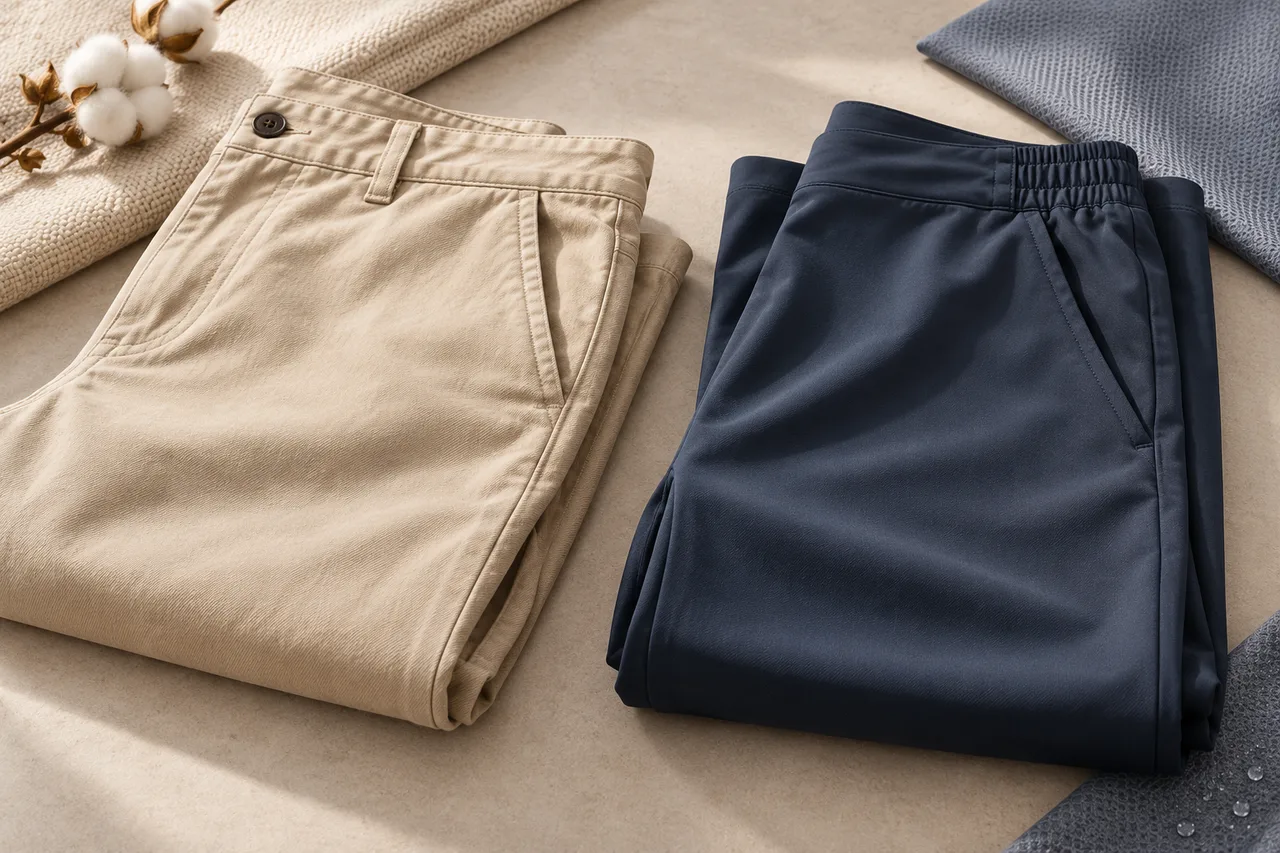
So the practical answer is: cotton often wins for dry, low-intensity comfort, while polyester often wins when sweat, weather, stretch, or repeated wear matters. The fiber name alone does not decide comfort. Knit or woven structure, fabric weight, fit, finishing, and garment design can change the result substantially.
Why cotton pants often feel more comfortable
Cotton is a common choice for chinos, joggers, lounge pants, and casual trousers because it can offer a familiar, soft hand. It also absorbs moisture, which may feel comfortable when perspiration is light and the fabric remains relatively dry.
Cotton may be the better starting point when the wearer wants:
- a natural hand feel;
- comfortable casual or office wear;
- low static buildup;
- softness for lounging or low-intensity activity;
- a fabric that does not feel slick or technical.
However, absorption is not the same as moisture management. Once cotton becomes wet, it may retain water, feel heavier, dry slowly, and cling to the body. A heavy cotton sweatpant can also feel too warm in humid weather. Repeated wear may lead to knee bagging or dimensional change unless the yarn, construction, finishing, and garment care are properly controlled.
Why polyester pants can be more comfortable
Polyester absorbs much less moisture into the fiber than cotton. In a suitably engineered fabric, that can support faster drying and a lighter feel during activity. Polyester also tends to offer good dimensional stability and abrasion resistance, which is useful for training pants, travel pants, uniforms, and outdoor trousers.
Polyester may be more comfortable when the wearer needs:
- quicker drying after sweat or washing;
- better shape retention at the knees and seat;
- a lightweight performance construction;
- a brushed or fleece interior for cold weather;
- durability for frequent wear and laundering;
- stretch when polyester is combined with spandex.
Polyester is not automatically cool, breathable, or moisture-wicking. A dense polyester fabric can trap heat, and an unsuitable surface or finish may feel less pleasant against the skin. Odor retention, static, and pilling should also be evaluated on the finished fabric rather than predicted from the fiber label.
Cotton versus polyester for different pants
| Pants type or use | More likely comfort starting point | Reason | What to verify |
|---|---|---|---|
| Casual chinos or everyday trousers | Cotton or cotton-rich blend | Natural hand and familiar dry comfort | Wrinkling, shrinkage, knee recovery, and colorfastness |
| Lounge pants | Cotton for a soft casual feel; brushed polyester for warmth | Comfort depends on season and desired surface | Fabric weight, interior hand, airflow, and wash stability |
| Running or gym pants | Polyester-rich performance fabric | Lower water uptake and potential for faster drying | Wicking, drying rate, stretch, recovery, and chafe points |
| Travel pants | Polyester or a polyester blend | Shape retention, durability, and easier drying | Breathability, odor behavior, static, and pocket or seam comfort |
| Cold-weather leggings or training pants | Brushed or bonded synthetic construction | Insulation, stretch, and weather-oriented layering | Thermal comfort, bulk, breathability, pilling, and seam performance |
| Hot and humid casual wear | Lightweight cotton or an engineered synthetic | Cotton may feel natural; synthetics may dry faster | Air permeability, drying, cling, transparency, and garment fit |
This is why a buyer should not ask only, “Is it cotton or polyester?” A more useful question is, “How should these pants feel and perform during their actual use?”
Fabric construction matters as much as fiber
Two fabrics with the same polyester content can feel completely different. A lightweight jersey, dense double-knit, brushed fleece, and bonded composite do not provide the same airflow, drape, warmth, or skin contact. The same is true for cotton twill, cotton jersey, and cotton fleece.
When comparing samples, keep the following variables visible:
- finished fabric weight in GSM;
- knit or woven construction;
- thickness and usable width;
- face and back surface;
- stretch force and recovery in both directions;
- air permeability and drying behavior;
- dimensional stability after the intended wash cycle;
- pilling, abrasion, snagging, and colorfastness;
- waistband, pocket, seam, and lining construction.
A soft hand evaluation should use an approved reference sample and consistent conditions. Terms such as “buttery,” “breathable,” or “quick-dry” are not complete acceptance criteria without a test method or comparison standard.
Are there suitable ClothFactory products?
Yes, for a specific part of this question: cold-weather stretch pants and leggings that use polyester on the inner layer. ClothFactory's current catalog is focused on nylon-spandex and polyester-backed performance knits rather than conventional cotton trouser fabrics, so it would not be accurate to present these products as direct cotton replacements for chinos or casual woven pants.
Two relevant options are:
- H3231 Shark-Skin Composite Polar Fleece: a 430 GSM bonded construction with an 80% nylon/20% spandex face and a 95% polyester/5% spandex back. It is positioned for winter compression gear, thermal outdoor leggings, and extreme-cold athleisure.
- H2872 Shark-Skin Composite Brushed: a 370 GSM bonded construction with the same stated face and back compositions, positioned for mid-winter performance wear and outdoor training gear.
These are not pure-polyester fabrics. Their comfort proposition comes from the full composite: a stretch nylon-spandex face combined with a polyester-spandex thermal back. They are candidates when warmth, stretch, coverage, and shape retention matter more than the natural hand associated with cotton.
Both styles are heavyweight development options with a listed 1,000 kg MOQ. Before selection, buyers should confirm whether the garment really needs a bonded fabric of this weight and should test breathability, thermal comfort, stretch recovery, pilling, seam bulk, wash stability, and performance at the intended activity level.
For lightweight casual pants, ClothFactory's present catalog does not show a direct cotton-versus-polyester trouser fabric that should be recommended without further development. A buyer with that requirement should provide a reference swatch and a measurable brief rather than select from composition alone.
How brands should compare comfort before ordering
Start with two or more finished samples that are realistic for the same pants design. Comparing a lightweight cotton twill with a heavy polyester fleece would reveal more about weight and construction than about the fibers themselves.
Use the same garment pattern or comparable test panels, then assess:
- Dry hand and next-to-skin feel. Check softness, surface friction, stiffness, and any irritation at seams or the waistband.
- Heat and moisture comfort. Evaluate the fabric during the intended activity and climate, not only on a table.
- Wet comfort and drying. Record water pickup, cling, drying time, and whether the surface remains comfortable after perspiration.
- Movement and recovery. Check extension at the knee, hip, and seat, then measure residual growth after wear and laundering.
- Garment weight and bulk. Include pockets, waistband, lining, bonding, and seams rather than judging fabric GSM alone.
- Care durability. Reassess dimensions, surface, hand, pilling, and stretch after the planned wash cycles.
The most comfortable sample is the one that remains acceptable through the wear conditions that matter to the customer—not simply the one that feels softest during the first hand touch.
Bottom line
Choose cotton when the priority is soft, natural-feeling comfort for dry, casual wear. Choose polyester when the priority is quicker drying, shape retention, durability, or engineered warmth. For many pants, a blend or layered construction can balance these needs better than either fiber alone.
For cold-weather performance leggings or training pants, H3231 and H2872 are relevant ClothFactory candidates because their polyester-spandex backs are designed as part of a thermal composite. For ordinary cotton-style casual trousers, the current catalog does not provide a direct equivalent, so development should begin with the intended garment, reference fabric, target GSM, hand feel, stretch, and care requirements.