
Choose nylon-spandex or polyester-spandex by comparing the finished fabric against the garment's hand, stretch-force, recovery, moisture, color, durability, and cost requirements. Fiber family is a useful starting point, but it does not determine performance without yarn, knit construction, finishing, and test conditions.
Start with the garment decision
A yoga legging, sports bra, fitted training top, and team jersey place different loads on fabric. Define the body zones, expected extension, fit, color range, care cycle, and required claims before choosing the fiber family.
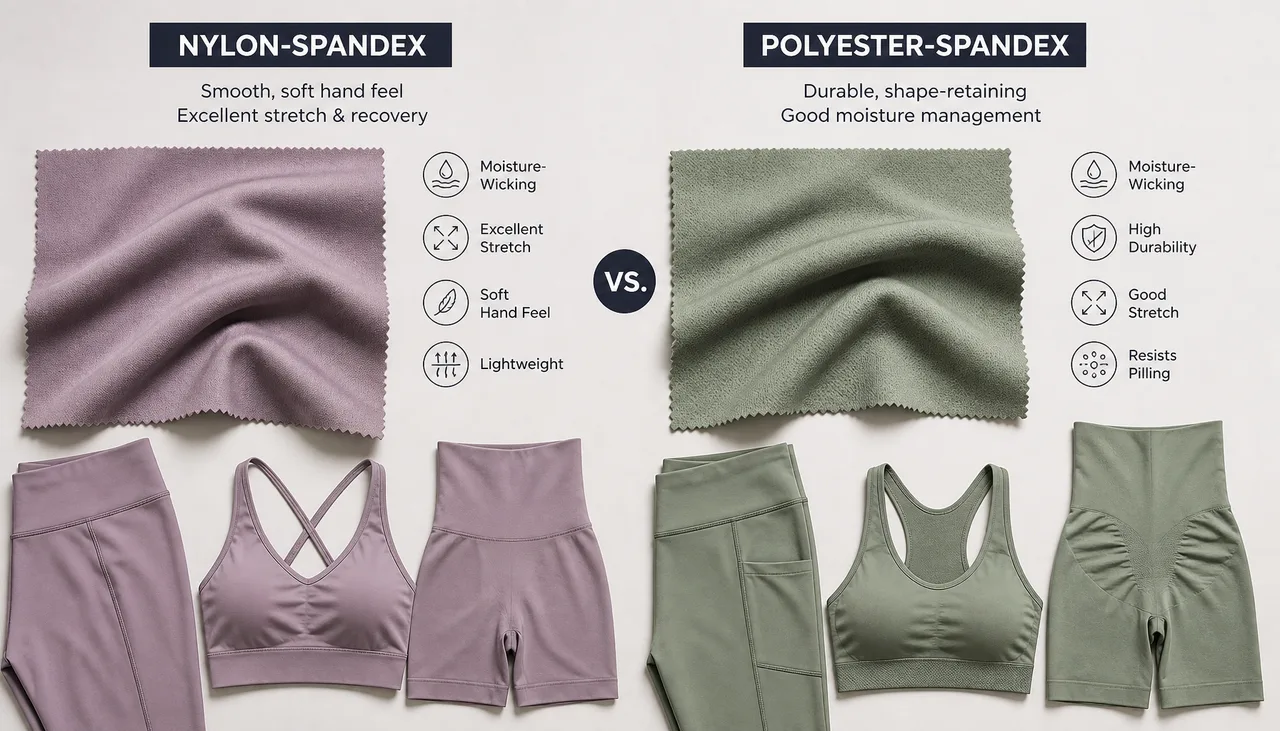
Nylon-spandex is often shortlisted when a smooth, soft hand is central to the product brief. Polyester-spandex can be shortlisted where the development programme emphasizes particular dyeing, repeated-use, or moisture objectives. These tendencies must be confirmed on finished samples; neither blend is automatically softer, quicker drying, more durable, or more supportive.
Compare finished constructions, not generic fibers
| Decision area | Nylon-spandex candidate | Polyester-spandex candidate | Required confirmation |
|---|---|---|---|
| Hand and surface | Often selected for smooth next-to-skin styles | Can be engineered across a wide range of hands | Approved finished swatch before and after washing |
| Stretch and recovery | Depends on yarn, spandex placement and knit | Depends on yarn, spandex placement and knit | Direction, force or load, cycles and recovery time |
| Moisture behavior | Must be measured on the construction | Must be measured on the construction | Wicking, spreading or drying method tied to claim |
| Color and heat response | Dyeing and finishing conditions matter | Dyeing and finishing conditions matter | Shade, colorfastness and process compatibility |
| Durability | Construction and surface control pilling and abrasion | Construction and surface control pilling and abrasion | End-use abrasion, pilling and snagging tests |
This comparison avoids a common error: attributing a result to nylon or polyester when it was actually produced by construction or finishing.

Treat GSM and spandex percentage as incomplete inputs
GSM helps estimate fabric mass and often affects coverage, but it does not specify thickness, density, opacity, or support. Spandex percentage does not define maximum stretch, force at garment extension, or recovery. Two blends with similar labels can behave differently because their yarn sizes and knit geometries differ.
Record finished GSM, usable width, thickness where relevant, and conditioned test results. Evaluate coverage in the selected colors and at the extension expected in the garment.
Compare commercial cost through garment yield
Price per kilogram is not enough. Usable width, shrinkage, edge loss, shade grouping, defect allowance, and marker efficiency determine cost per accepted garment. Finishes may also add cost and require post-wash validation.
Do not assume a typical MOQ or lead time. Request current terms for the selected construction, color count, and development route, because those conditions are order-specific.
Procurement next step
Send identical briefs for nylon-spandex and polyester-spandex candidates. Include garment type, fit, expected extension, hand reference, target GSM and width, colors, care cycle, required tests, and planned claims. Compare identified finished swatches, measured data, and washed garment samples before choosing the fiber family or approving bulk production.