
Brands should choose GSM from the performance required in each skort layer and choose usable width from a verified marker, not from a generic activewear range. A performance skort often combines a draping outer skirt with a close-fitting inner short, so one fabric specification may not provide the best coverage, support, movement, and cutting efficiency for both zones.
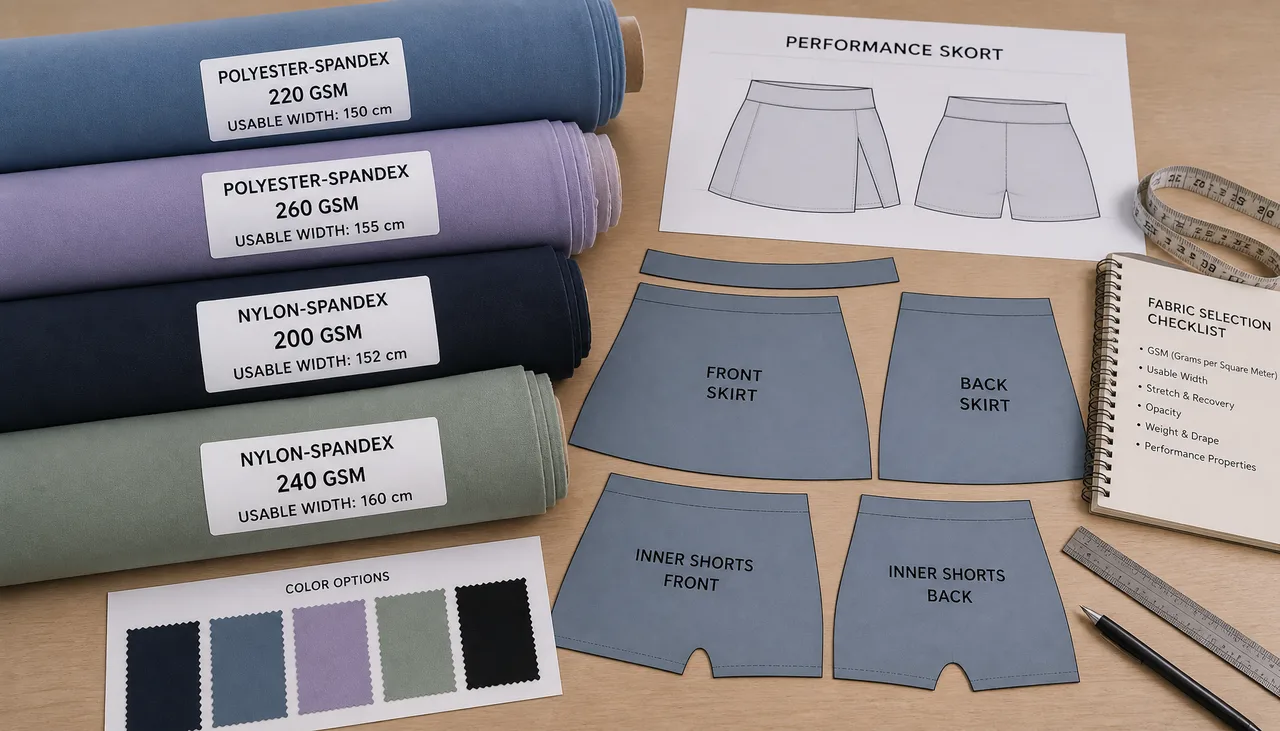
Separate the outer skirt from the inner short
The outer skirt and inner short perform different jobs:
- Outer skirt: usually prioritizes drape, movement, surface appearance, wind response, and low bulk.
- Inner short: usually prioritizes coverage under extension, recovery, support, next-to-skin comfort, and resistance to riding up.
A single nylon-spandex or polyester-spandex construction can be considered when the design and sourcing plan favor simplicity, but it must pass both sets of requirements. If it cannot, specify two fabrics and calculate their consumption separately.
Use GSM as a mass-control value, not a performance shortcut
GSM records fabric mass per square meter. It affects garment weight and material consumption, but it does not independently determine opacity, breathability, support, drape, or durability. Those outcomes also depend on yarn, knit structure, thickness, surface finish, color, and stretch condition.
For the inner short, review coverage and appearance at the extension expected over the seat and thigh. For the outer skirt, assess drape and movement in a garment sample. A heavier fabric may still lose cover under stretch, while a lighter construction may provide acceptable coverage through knit density and yarn selection.
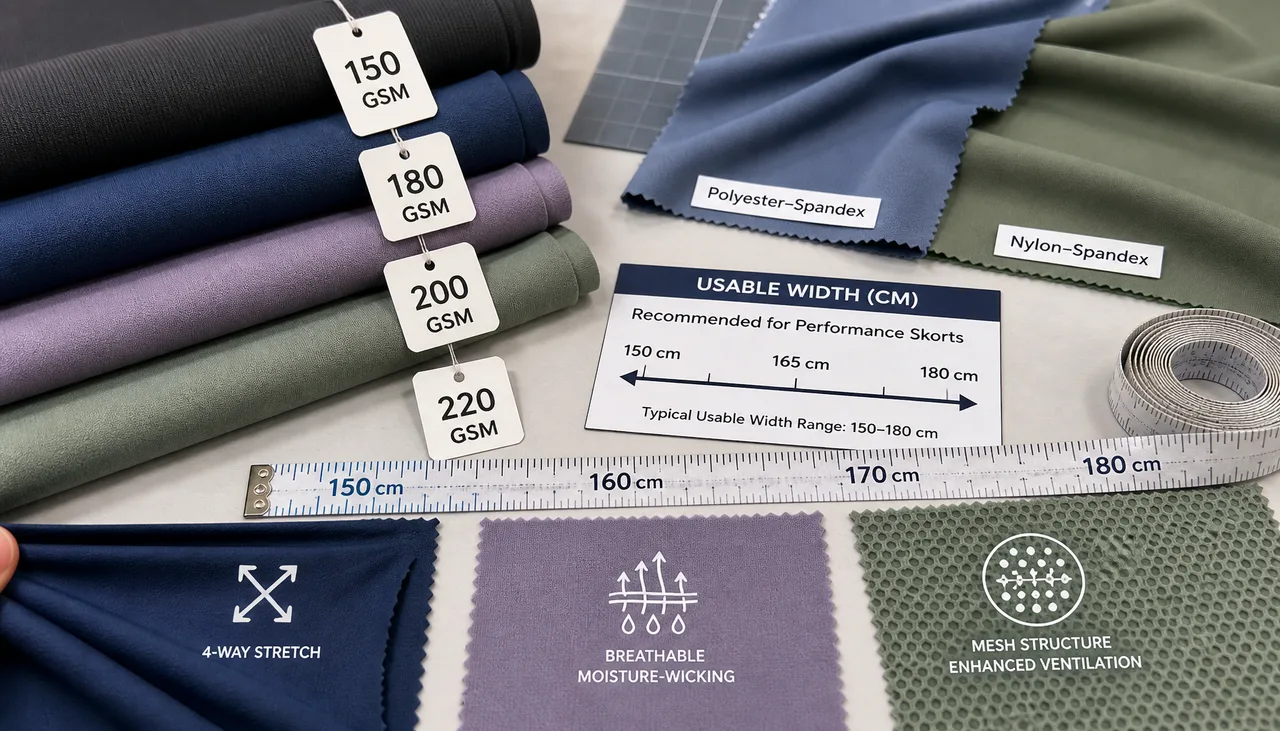
Define usable width precisely
Usable width is the portion of finished fabric that can be placed in the production marker while meeting the approved quality standard. It may be narrower than the nominal or total width because of selvedges, edge curl, pin or clip marks, coating or print limitations, shade variation, or unstable edge zones.
The purchase specification should state:
- whether width is open, tubular, total, cuttable, or usable width;
- the finished and relaxed condition used for measurement;
- whether selvedges and unstable edge zones are excluded;
- the minimum usable width and permitted variation;
- how width is checked along each roll;
- whether the fabric must be relaxed before cutting;
- which direction provides the required garment stretch.
Do not compare one supplier's nominal width with another supplier's usable width.
Let the marker determine width efficiency
A wider fabric does not automatically reduce cost. Efficiency depends on pattern geometry, size ratio, grain or stretch direction, print direction, panel pairing, and whether the largest pattern pieces can nest across the width.
Ask the garment factory to run markers using the supplier's confirmed usable width. Compare:
- linear meters per garment;
- marker efficiency;
- cutting loss and end allowance;
- size-ratio sensitivity;
- panel orientation and stretch direction;
- whether the outer skirt and inner short require separate markers.
If a small width change forces one fewer panel across the marker, consumption can increase sharply. Record the width used in the marker so production material is not accepted against a different basis.
Compare mass per linear meter and mass per garment
The approximate mass of one linear meter is:
kg per linear meter = usable width (m) × finished GSM ÷ 1,000
Linear-meter consumption must then be included to compare options.
Illustrative calculation — not a ClothFactory production result:
- Option A: 1.50 m usable width, 180 gsm, and a hypothetical marker consumption of 0.90 m per garment.
- Option B: 1.70 m usable width, 200 gsm, and a hypothetical marker consumption of 0.78 m per garment.
Option A fabric mass per garment:
1.50 m × 180 g/m² × 0.90 m = 243 g
Option B fabric mass per garment:
1.70 m × 200 g/m² × 0.78 m = 265.2 g
The wider option uses fewer linear meters but more fabric mass in this example. Compare both the supplier's pricing unit and the qualified garment output; meters alone do not show the full material commitment.
Verify GSM and width on finished production material
Dyeing, heat setting, relaxation, brushing, coating, printing, or another finish can change GSM, width, hand, and stretch response. Approve values on the finished construction intended for production rather than relying on greige-fabric data.
The supplier and buyer should agree:
- sampling locations across the roll width and length;
- specimen conditioning and relaxation;
- GSM and width methods;
- tolerance and rounding rules;
- how individual rolls and the lot are evaluated;
- the action required for narrow rolls or out-of-tolerance GSM.
An average should not conceal a roll whose usable width disrupts the approved marker.
Connect GSM and width to the remaining approval tests
For a performance skort, the fabric plan may also need:
- stretch force, elongation, recovery, and residual growth by direction;
- coverage or opacity in relaxed and extended states;
- dimensional stability and spirality after the intended care cycle;
- pilling, abrasion, and snagging resistance;
- colorfastness to laundering, perspiration, and rubbing;
- moisture or drying performance only where a defined claim is planned;
- seam, waistband, gripper, pocket, or bonding compatibility;
- garment fitting and movement checks for both layers.
Composition and GSM do not replace these validations. A nylon-spandex and a polyester-spandex fabric with similar weight and width can behave differently because their constructions and finishes differ.
Avoid common sourcing mistakes
- Using one GSM target for both layers without testing. The outer skirt and inner short may require different drape, cover, and recovery.
- Approving nominal width. Costing should use the minimum acceptable usable width.
- Choosing the widest option automatically. Pattern nesting determines whether extra width provides value.
- Comparing only meters per garment. A heavier, wider fabric can use fewer meters while increasing mass and cost.
- Ignoring stretch direction. An efficient marker is unacceptable if panels are oriented against the required garment stretch.
- Using one color to approve all colors. Shade and finishing can affect cover, hand, GSM, and stretch behavior.
- Costing from development data only. Finished bulk material must remain within the specification used for the approved marker.
Information to include in the sourcing brief
Send the fabric supplier and garment factory:
- separate requirements for the outer skirt and inner short;
- fabric composition, construction, finish, and color;
- target finished GSM and tolerance;
- minimum usable width and measurement condition;
- expected stretch direction and garment extension;
- pattern files, size ratio, and marker assumptions;
- required test and care conditions;
- pricing unit and estimated order quantity;
- approval process for narrow rolls or GSM variation.
Procurement next step
Shortlist fabric by layer, then run garment samples and production markers using the confirmed finished GSM and minimum usable width. Compare linear consumption, fabric mass, qualified yield, and test results before approving the specification. ClothFactory can provide nylon-spandex or polyester-spandex candidates with identified GSM and width, while the garment factory should validate marker efficiency and finished-skirt construction against the actual pattern and size ratio.