The principal pre-production risk is approving an attractive sample without defining what bulk production must reproduce. Buyers should freeze the fabric construction, finished specifications, color standard, test conditions, garment validation, and change-control procedure before production starts. Every approval should identify the exact sample and version; verbal comments, unlabeled swatches, or a single “approved” email leave composition, performance, appearance, and tolerance disputes unresolved.
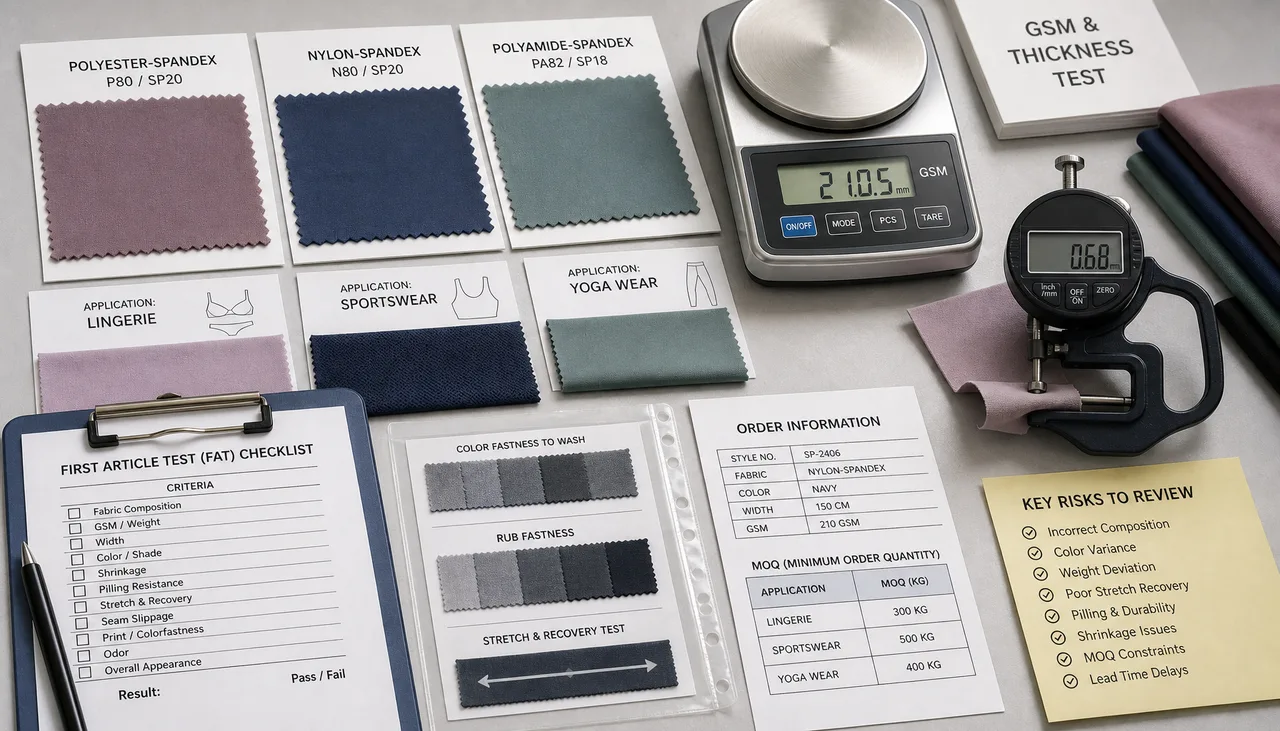
Risk 1: the approval sample is not production-representative
A handloom, laboratory-dyed swatch, available-quality cutting, and production trial may pass through different yarn, knitting, dyeing, and finishing conditions. Buyers should ask what the submitted sample represents and which steps can still change. If performance depends on bulk finishing, approve material from a production-relevant trial before releasing the order. Record fabric code, composition, knit structure, color, finish, date, lot identity, and approval status directly in the sample register.
Risk 2: subjective approval replaces measurable criteria
“Soft,” “supportive,” “quick-drying,” and “good recovery” are development directions, not acceptance limits. Convert critical requirements into agreed methods, specimen conditions, units, tolerances, and reporting rules. Keep an identified physical standard for hand, face, luster, color, and appearance, because these may not be captured fully by numbers. The physical standard and written specification must agree; when they conflict, the purchase contract should state which requirement controls and who authorizes an exception.
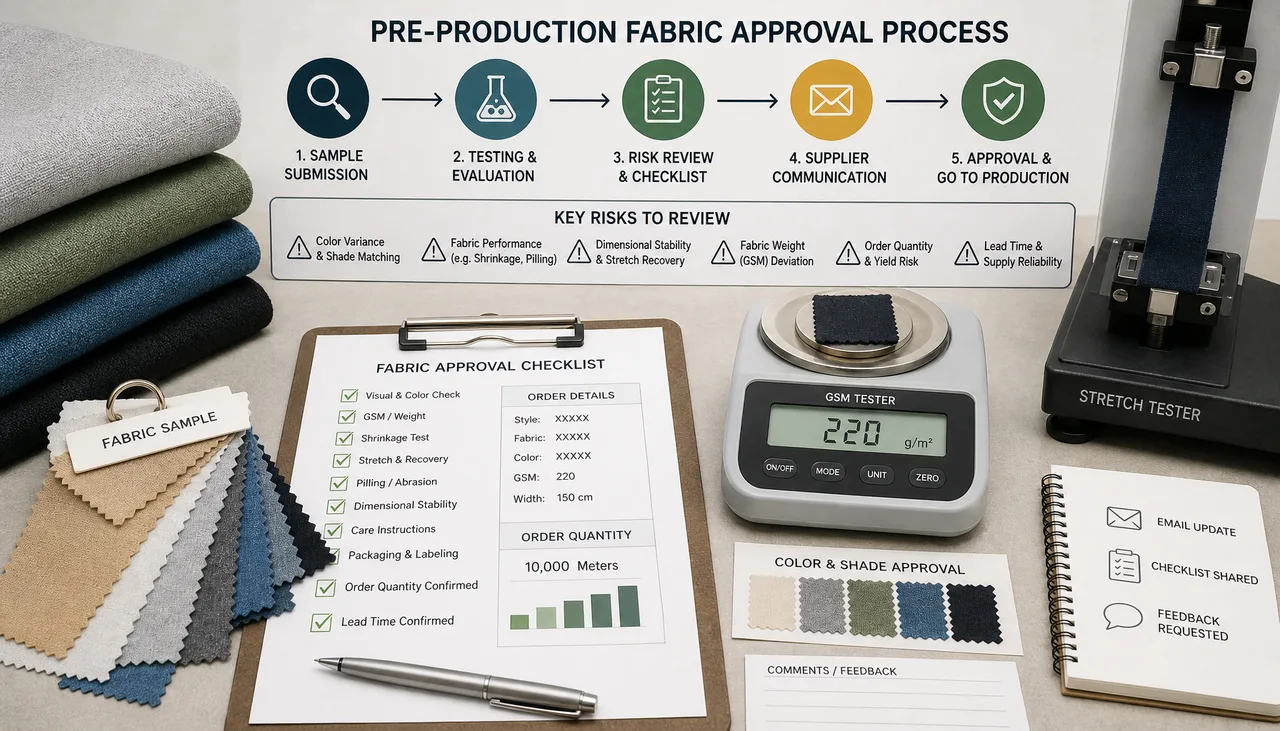
Risk 3: garment processes are excluded
A fabric can meet incoming tests and still fail after printing, heat transfer, bonding, washing, or sewing. For stretch garments, seam selection and panel direction may also change fit and recovery. The approval route should reproduce the intended decoration and care cycle, then assess dimensions, shade, surface, hand, stretch behavior, and fit on a sewn prototype. Approving blank fabric alone is insufficient when the garment process exposes it to heat, chemicals, tension, or multiple layers.
Risk 4: averages conceal roll-level failure
Hypothetical example: a four-roll lot has usable widths of 151, 150, 148, and 151 cm. The average is 150 cm, but the 148 cm roll may not fit a marker requiring a 149 cm minimum. Acceptance rules should therefore identify minimum or maximum roll-level limits as well as lot averages. Apply the same logic to GSM, shade, dimensional stability, bow and skew, and other properties where one nonconforming roll can interrupt cutting.
Risk 5: color approval has no controlled reference
Color decisions should identify the reference, illuminants, instrument conditions if used, visual assessment conditions, and acceptable lot-to-lot or roll-to-roll variation. A screen image or color name is not an approval standard. Confirm whether approval covers a laboratory dip, pilot dyeing, or bulk lot, and keep the signed reference protected from light and contamination. Dark, pale, fluorescent, and different fiber bases may require separate development; passing one color does not prove all colorways will behave identically.
Risk 6: unapproved process changes remain possible
Require written notification before changes to yarn source, yarn specification, knit settings, dye recipe, finishing route, plant, subcontractor, or test method. Define which changes require documentation, a new sample, garment validation, or full reapproval. This is particularly important when an optional finish supplies odor control, cooling sensation, moisture management, or another claimed function. A fiber blend should not be assumed to deliver a finish-dependent performance after the approved route changes.
| Record | Required control |
|---|---|
| Fabric specification | Composition, construction, finished GSM, usable width and tolerances |
| Physical standards | Identified hand, face, shade and appearance references |
| Performance evidence | Method, conditions, individual results, report date and sample identity |
| Garment validation | Decoration, sewing, wash, fit and end-use checks |
| Bulk plan | Sampling frequency, inspection rules, release authority and nonconformity action |
Before issuing bulk approval, hold a cross-functional review with purchasing, product development, quality, and the garment factory. Send the supplier one signed approval pack and require acknowledgment of every tolerance and exception. ClothFactory can align candidate knitted stretch fabrics with this pack, but the brand should retain approval authority and document any waiver. Production should begin only when unresolved items, test responsibility, and change-control triggers are visible to all parties.