
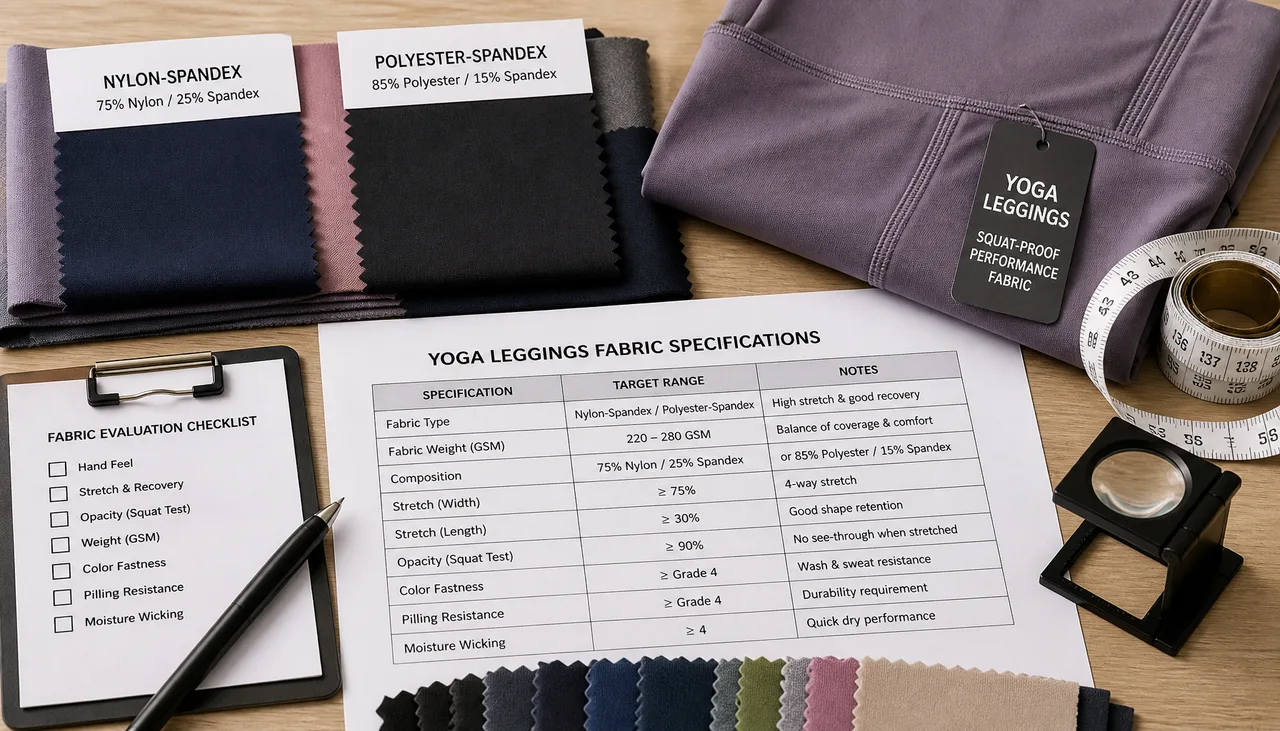
Specify squat-proof yoga-legging fabric through a defined garment coverage assessment, supported by construction, elasticity and production controls. Do not reduce the brief to a minimum GSM or spandex percentage. Coverage depends on the fabric, colour, pattern strain, seam placement and assessment conditions. A supplier cannot price the requirement reliably if “squat-proof” is the only acceptance instruction.
Translate the fit into a fabric-strain requirement
Start with the approved size chart, pattern and intended compression level. Identify high-strain locations during a squat, including the seat, upper thigh and seam intersections. A flat swatch stretched by hand does not reproduce the distribution of strain in a garment.
In an illustrative example, an 80 cm relaxed garment circumference fitted around a 100 cm body has 20% negative ease relative to the body. The fabric extension is (100 − 80) ÷ 80 × 100 = 25%. Confusing those two percentages can lead to an opacity assessment at insufficient extension. Use pattern calculations to plan the trial, then confirm the critical locations on the finished garment.
Size grading also matters. Do not assume that approving a medium size establishes coverage in every size. Review where the graded pattern produces the greatest local strain and include those fit conditions in the approval plan.
Make the coverage assessment reproducible
Agree the lighting arrangement, viewing distance, backing or underwear contrast, fabric extension, garment movements and pass/fail reference before comparing candidates. Photograph the setup and retain an approved garment for comparison. If appearance is judged visually, record that fact instead of presenting an invented numerical “opacity grade” as a recognised laboratory standard.
Evaluate relevant colours separately. A dark sample may conceal contrast that is visible through a pale colourway. Include dry and damp conditions when both are relevant to the use claim, and specify the care sequence before reassessment. The objective is a repeatable brand acceptance protocol, not a promise of invisibility under every possible light and viewing angle.
Connect the specification to the failure risk
| Field | What to define | Why it matters |
|---|---|---|
| Construction and finish | Approved article or construction revision; permitted changes. | A finish change can alter hand feel, dimensions and stretched appearance. |
| Finished mass and width | Agreed GSM range and minimum usable width after the specified preparation. | Controls consistency and marker feasibility without treating weight as proof of opacity. |
| Elasticity | Directions, load or extension, cycles, recovery interval and acceptance limits. | Separates support feel from residual growth. |
| Coverage | Colours, garment sizes, strain locations, lighting and visual reference. | Connects the material to the actual product claim. |
| Care and durability | Wash/dry procedure, evaluation stages and appearance limits. | Prevents approval from covering only an unwashed prototype. |
Set numerical limits with the garment team and laboratory using the approved reference and end use. A universal GSM threshold or arbitrary recovery percentage would create false precision rather than a defensible specification.
Measure support and recovery as different properties
A high-spandex fabric can feel easy to stretch or relatively firm depending on construction. Request force at a defined extension when support feel matters, and residual extension after a defined recovery period when bagging is the concern. Specify both fabric directions and the relevant care history.
ISO 20932-1 provides strip-test methods for elasticity. Agree the applicable procedure and conditions with the laboratory; the method name alone does not set a garment pass limit. Pair the report with a wear-and-movement assessment because seams, waistband construction and panel orientation change the finished result.
Ask for a quote against an approval sequence
Send suppliers the specification, colour quantities, usable-width requirement, target delivery basis and intended decoration. Ask them to identify deviations explicitly. An alternative composition may be worth testing, but it should not silently replace the quoted reference while retaining its approval status.
Separate initial sampling, colour approval, pilot-garment approval and bulk release. Require traceable sample identification and confirmation of whether the sample uses the proposed bulk construction and finish. A fabric chosen from stock for a fast fitting is not automatically representative of the later production lot.
Compare the cost of compliant garments
Consider an illustrative material option saving $0.20 per metre at 0.90 m consumption: the nominal saving is $0.18 per legging. If that option requires a lining costing $0.45 per garment to meet the coverage brief, it is already $0.27 more expensive before additional sewing. The comparison has changed from two equivalent fabrics to two different garment constructions.
Release the selected option only when the approved garment, colour scope, test records and bulk specification agree. Hold approval when the supplier can offer only a GSM number, a stretched-hand photograph or a generic “squat-proof” statement. The purchase requirement is demonstrable coverage in the intended leggings, with controlled repeatability across the order.