
Raw knit edges curl because cutting releases unbalanced loop stresses at the fabric boundary. Curl direction and severity depend mainly on knit structure, yarn and spandex arrangement, finishing, relaxation, cut direction, and panel geometry; fiber blend or GSM alone cannot predict the result.
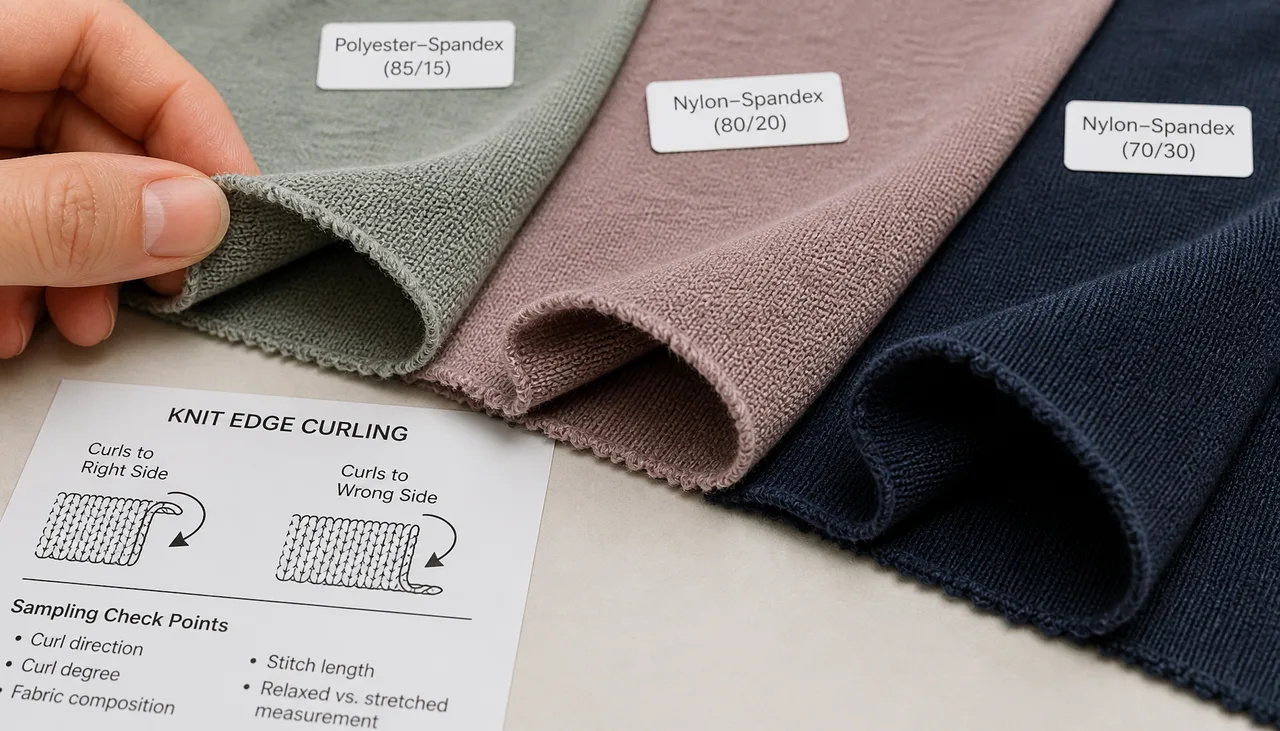
What causes the edge to move
Knitted loops are held in balance inside the fabric. At a cut edge, that balance is interrupted and stored tension can pull the edge toward one face or along one direction. Single-knit structures often behave differently from double knits, ribs, or bonded constructions, but actual curl must be checked on the finished fabric.
Dyeing, heat setting, brushing, compacting, and relaxation can change residual stress. A sample cut immediately after unrolling may behave differently after conditioning, so record relaxation time before comparing candidates.
Test both directions and the real panel shape
Cut straight strips in both fabric directions, then cut the curves, notches, and narrow sections used in the garment. A straight edge may remain manageable while an armhole, leg opening, or bonded curve rolls enough to affect alignment.
Observe the edge relaxed and at the extension expected during sewing and wear. Record curl direction, rolled width, consistency along the edge, and change after the intended wash cycle. The aim is not to eliminate every visible movement; it is to decide whether production can control it without unacceptable cost or defects.

Connect curl to the intended construction
For a conventional sewn seam, moderate curl may be manageable with spreading control, temporary stabilization, adjusted handling, or seam allowance. For bonded, laser-cut, or exposed raw-edge designs, the tolerance is usually tighter because the edge remains visible or must align precisely.
Do not label a fabric “free cut” from one hand sample. Test the selected cutting method, edge direction, bonding or stitching process, garment extension, and laundering. Edge stability is a system result involving fabric and process.
Check the production consequences
Curl can affect:
- marker accuracy and ply alignment;
- cutting speed and panel dimensions;
- seam allowance consistency;
- bonding width and adhesive contact;
- operator handling time;
- finished opening shape and symmetry.
A lower fabric price may be offset by slower cutting, extra stabilization, or panel rejection. Include these effects when comparing candidates.
Sampling record
Document composition, construction, finished GSM and width, finish, color, relaxation time, cut direction, panel geometry, cutting method, and care cycle. Photograph or measure the edge under a repeatable setup so buyer and supplier are discussing the same condition.
Procurement next step
Send the supplier the garment panel drawings, seam or raw-edge method, expected extension, cutting process, care cycle, and acceptable edge condition. Request enough identified finished fabric for directional cuts, curved panels, sewing or bonding, and washing. Approve the material only after the production trial shows that curl can be controlled within the intended garment process.