
Brands should retest thermal retention when a repeat order differs from the approved fabric in any variable that can affect heat transfer, or when inspection data suggests that the process is no longer stable. A repeat purchase order alone does not require a full retest, but an unchanged product code is not sufficient evidence that composition, construction, finishing, and test conditions remain unchanged.
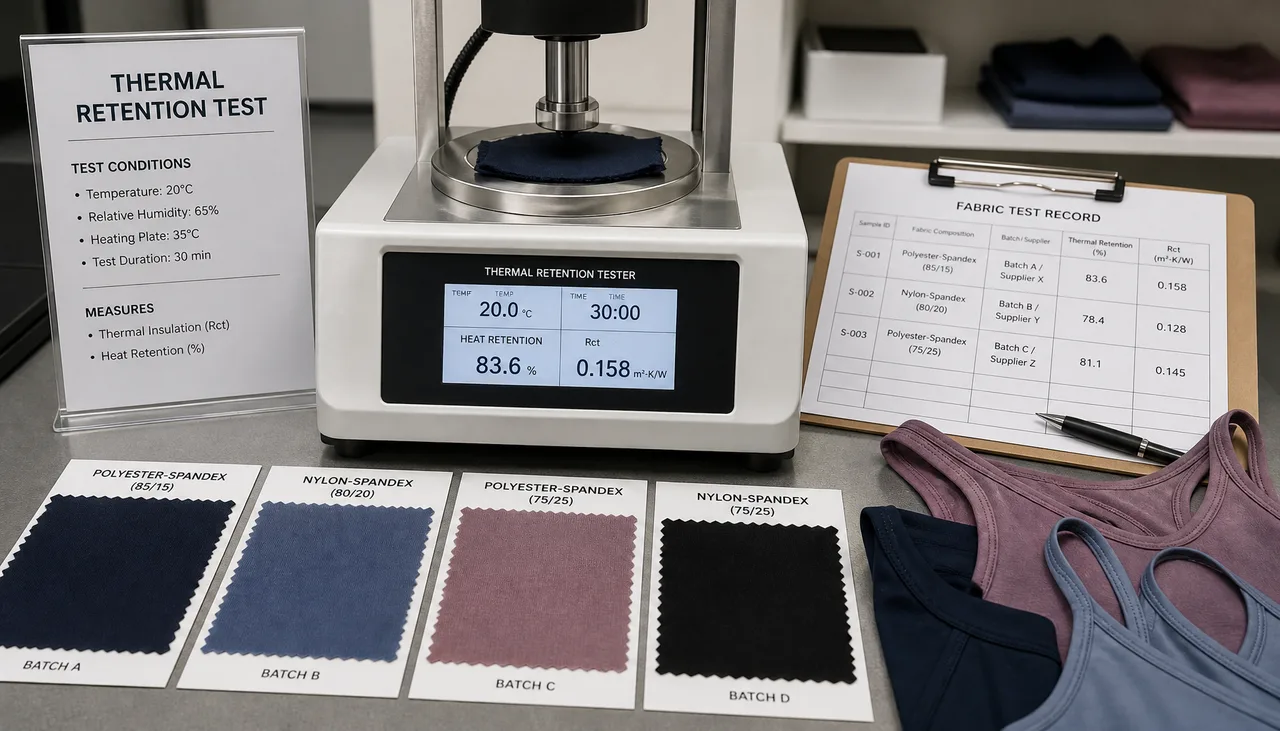
Establish the approved baseline before deciding on retesting
The first approved order should provide a comparison baseline. Keep the signed specification, tested sample, production lot reference, and test report together. The report should identify the method, specimen conditioning, fabric state, test direction where applicable, and the result used for approval.
Thermal performance should not be separated from the fabric variables that produced it. At minimum, the baseline should record:
- fiber composition;
- yarn and knit construction, where disclosed;
- finished GSM, usable width, and thickness if relevant;
- dyeing and finishing route, including brushing or other surface treatment;
- approved color or color family;
- care or preconditioning procedure used before testing;
- the buyer’s acceptance requirement and the agreed test method.
Without this baseline, a new result can be measured, but it cannot be interpreted reliably as consistent or inconsistent with the approved fabric.
Retest when a material or process variable changes
Use change control rather than the calendar alone. The following events justify retesting or, at minimum, a documented technical review.
| Change or signal | Why it matters | Recommended action |
|---|---|---|
| Fiber composition, yarn specification, or yarn supplier changes | Fiber and yarn geometry can alter thickness, air volume, moisture behavior, and heat transfer. | Retest using the approved method before bulk approval. |
| Knit construction, loop density, GSM, width, or thickness changes | A fabric with the same composition can produce a different thermal result when its physical structure changes. | Treat it as a revised fabric specification and retest. |
| Brushing, coating, calendaring, or another finish changes | Finishing can modify surface loft, porosity, thickness, and moisture movement. | Retest the finished fabric, not an unfinished substitute. |
| Production moves to a different mill, machine route, or subcontract processor | Process settings and equipment can change fabric geometry even when the item code remains the same. | Review the change and retest if equivalence has not been demonstrated. |
| Inspection shows a meaningful shift in GSM, thickness, or dimensional stability | The shift may indicate that the repeat lot no longer represents the approved construction. | Hold approval, investigate the cause, and retest if the thermal-relevant structure changed. |
| Wear trials, returns, or complaints indicate reduced warmth | A user-facing performance signal requires investigation rather than automatic acceptance of the previous report. | Compare retained samples, production records, and a new test result under matched conditions. |
An elapsed time interval can be used as a review trigger, but time by itself does not explain risk. A repeat order placed after a long gap should first be checked for raw-material, process, specification, and testing changes. If the supplier cannot confirm continuity, retesting is the safer approval route.
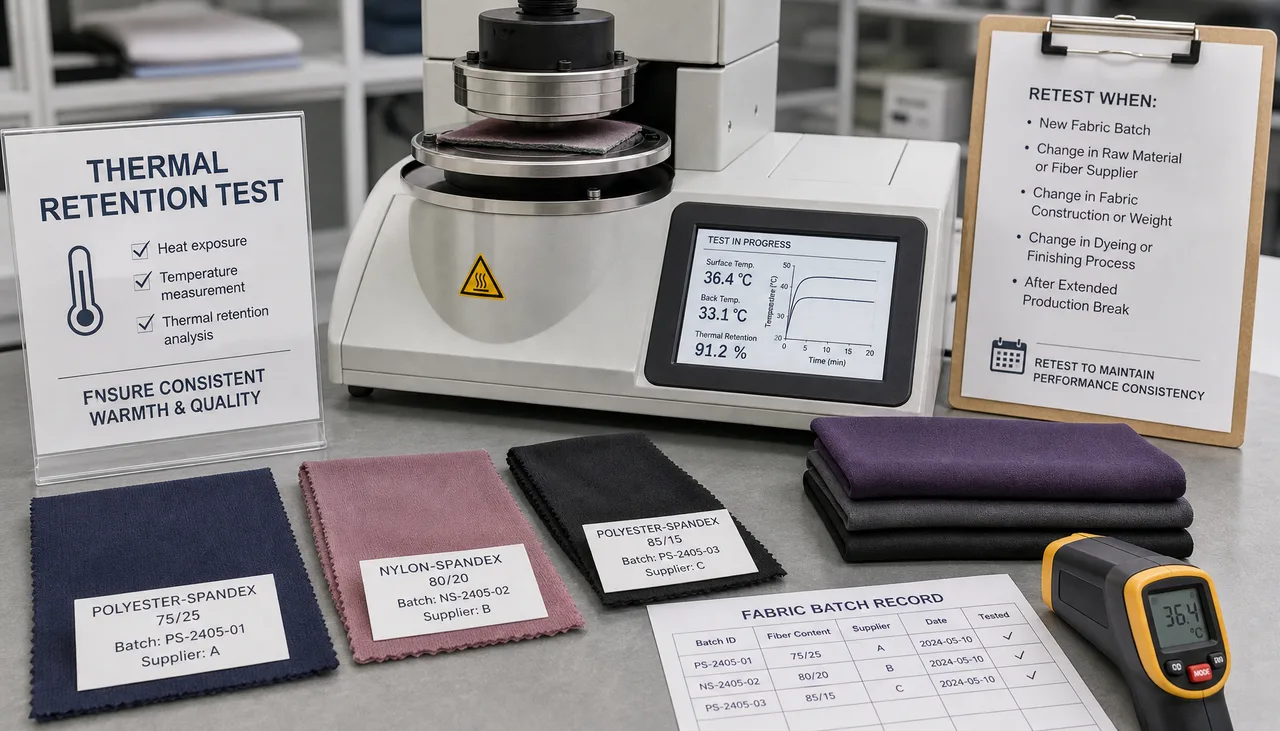
Keep repeat-test results comparable
A retest is useful only when the new result can be compared with the approved baseline. Use the same test method and align the specimen state, conditioning, fabric face, number of layers, and reporting units. If the laboratory or method changes, ask the laboratory to explain whether the two result sets are directly comparable.
Do not compare a result from greige fabric with one from dyed and finished fabric. Do not compare an unwashed specimen with a specimen tested after laundering unless the approval requirement explicitly calls for that difference. Brushed fabrics also require clear identification of the tested face because surface structure may affect the measurement.
The test report should be linked to a traceable roll or lot. A passing laboratory specimen does not automatically represent every roll in the shipment; incoming inspection still needs to confirm that production remains within the approved physical specification.
Decide between document review, targeted testing, and full retesting
Not every repeat order needs the same level of verification.
- Document review: appropriate when the supplier confirms that the material, construction, finish, production route, and specification are unchanged, and incoming inspection matches the approved baseline.
- Targeted testing: appropriate when one relevant variable has changed and the buyer needs to verify its effect. The test plan should cover the affected property and any linked risks.
- Full retesting: appropriate when several variables changed, traceability is incomplete, the production source changed, or a performance complaint cannot be explained from inspection records.
This approach keeps testing proportional to risk while protecting the validity of the original approval.
Avoid common repeat-order mistakes
- Relying on the product code. A code can remain unchanged while yarn, construction, or finishing changes.
- Retesting without the original conditions. A different method or specimen state can create an apparent performance shift that is not a production change.
- Using GSM as the only control point. Similar GSM does not prove identical thickness, porosity, surface loft, or thermal behavior.
- Accepting one color as evidence for every color. Dyeing and finishing conditions may vary; define whether approval applies to one shade, a color family, or the full order.
- Testing only after bulk production. Where thermal retention is a contractual requirement, complete the required verification before final bulk approval.
What should the repeat-order purchase file contain?
Before releasing a repeat order, the buyer should obtain the current specification, a written change declaration, the production lot reference, and any required test report. The purchase order or quality agreement should state which changes require prior notification and who can authorize a deviation.
For a ClothFactory repeat-fabric review, provide the previous item reference, approved specification, target application, relevant test report, current color, care conditions, and any observed performance issue. These records allow the new lot to be compared with the approved baseline and help determine whether document review, targeted testing, or full retesting is appropriate.