
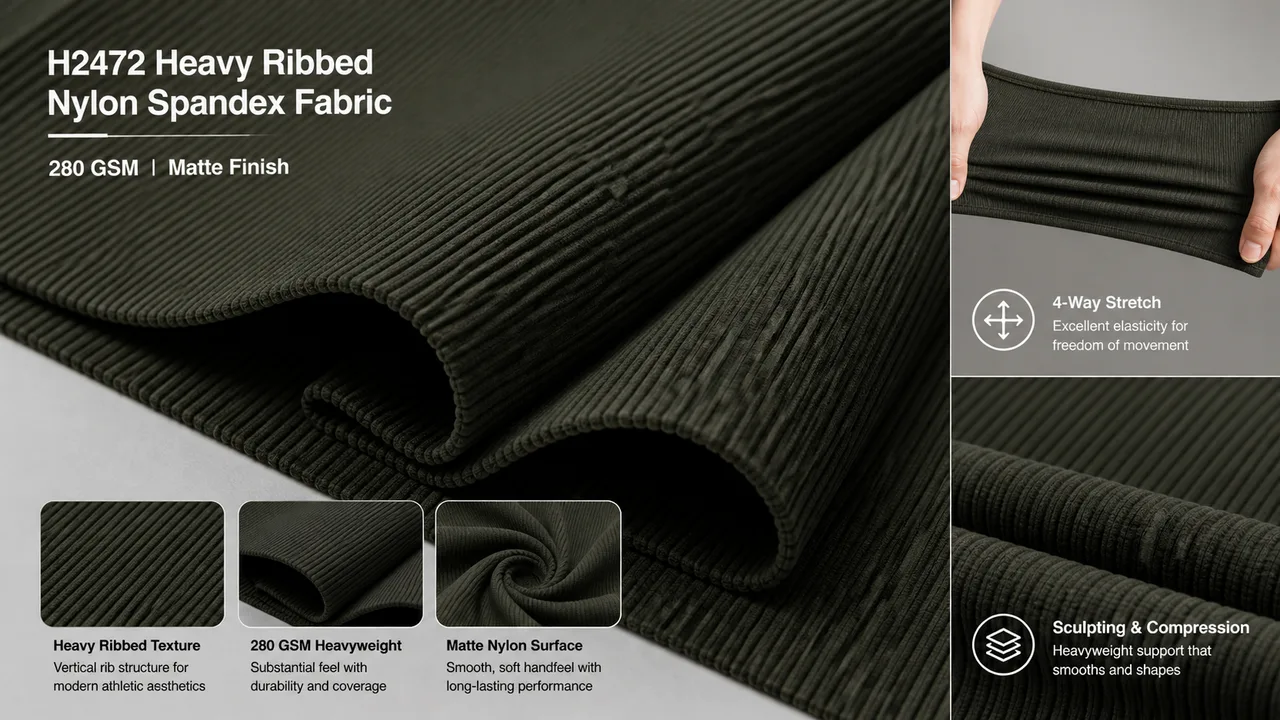
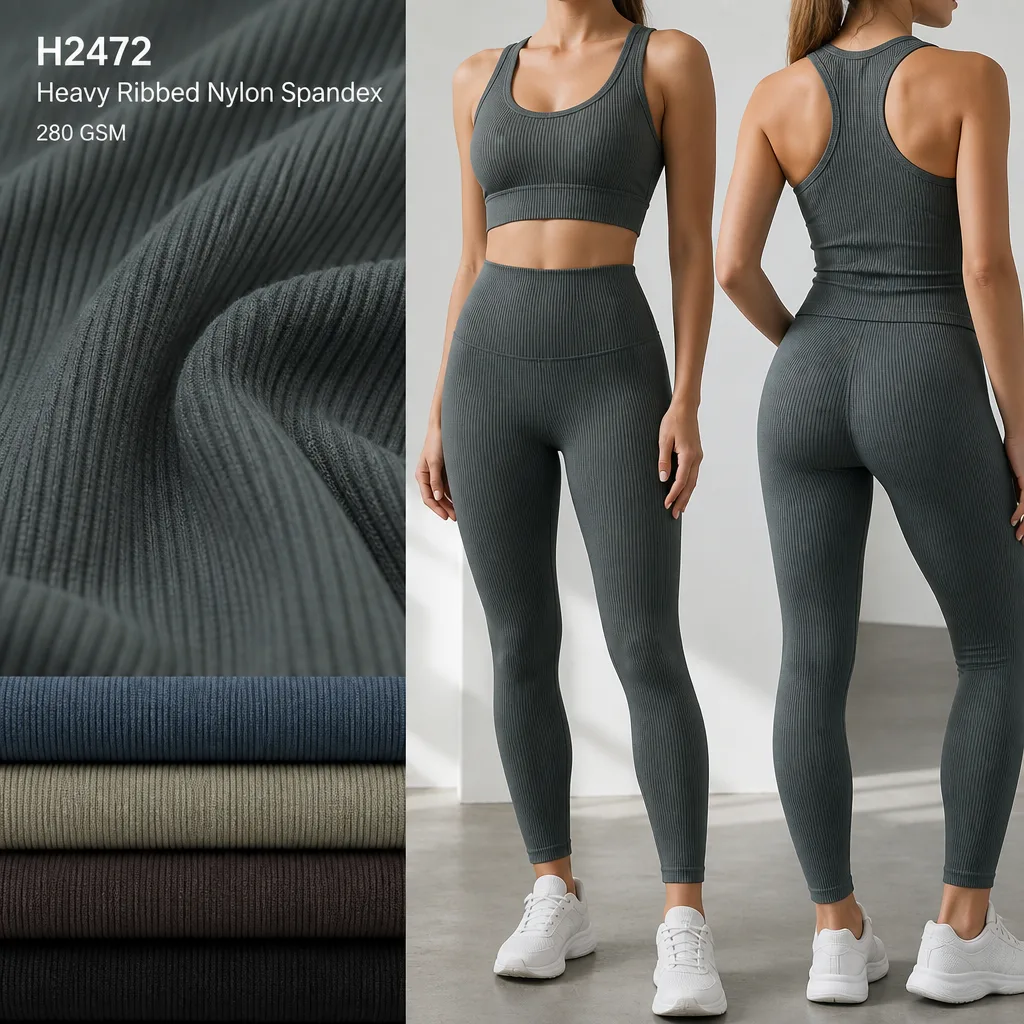
H2472 is a 280 GSM ribbed nylon-spandex fabric with 25% spandex, intended for close-fitting activewear that needs a substantial hand, visible texture, and controlled stretch. Buyers considering it for tanks, sports bras, or sculpting leggings should approve opacity, recovery, seam performance, and rib alignment on the finished garment rather than treating weight or spandex percentage as proof of performance.
Where H2472 fits in an activewear range
At 280 GSM, H2472 is positioned toward the heavier end of many activewear developments. That extra mass can help a garment feel more substantial and provide greater surface coverage than a lighter construction, but it also affects heat retention, drape, drying time, and sewing bulk.
The vertical rib gives designers a clear surface direction. It can create a visually elongated line when panels are cut consistently, while also making cutting accuracy more important: ribs that tilt, shift at seams, or run in different directions are immediately visible.
What the composition does—and does not—confirm
The stated 25% spandex content indicates that stretch is a central part of the construction. It does not, by itself, establish four-way stretch, compression level, recovery after repeated extension, or long-term shape retention. Those results also depend on yarn selection, knit geometry, dyeing and finishing, and the test conditions used.
For a comparable supplier review, request the following data on the finished fabric:
- fiber composition by mass;
- finished weight in GSM and usable width;
- stretch percentage in wale and course directions under a stated load;
- recovery after a stated extension, hold time, and relaxation period;
- dimensional change after the agreed wash and drying cycle;
- pilling, abrasion, and colorfastness results where required by the product brief.
Results from different extension loads or recovery intervals should not be compared as though they were equivalent.
Match the fabric to the garment function
Athleisure tanks
The dense ribbed surface can suit fitted tanks where the fabric itself is a visible design feature. Confirm whether the 280 GSM construction feels appropriate for the intended climate and layering system. A fabric that produces a clean fitted silhouette in an air-conditioned studio may feel too warm in an outdoor summer program.
Sports bras
Fabric stretch is only one part of support. Cup construction, lining, elastic selection, strap geometry, and seam placement determine how the finished bra controls movement. Test H2472 in the intended bra pattern and size range; do not infer support level from spandex percentage alone.
Sculpting yoga leggings
For leggings, assess coverage at the garment's maximum extension points, particularly the seat, upper thigh, and curved seams. Opacity must be checked in the intended color and size because a dark sample passing a bend or squat assessment does not prove that a pale shade or a more highly extended size will perform the same way.
Quantify the weight tradeoff
The effect of GSM on garment mass can be estimated before sampling:
estimated fabric mass = garment fabric area × GSM
Illustrative calculation, not ClothFactory production data: if one legging uses 1.15 m² of finished fabric before cutting loss, H2472 contributes approximately 1.15 × 280 = 322 g of fabric. A 230 GSM alternative using the same area would contribute about 265 g, a difference of roughly 57 g. Actual consumption changes with usable width, marker efficiency, size ratio, rib direction, and cutting loss.
The heavier option may provide the desired hand and coverage, but the weight difference must be considered alongside comfort, packing weight, and target retail positioning.
Control rib alignment and seam behavior
Treat rib direction as a controlled cutting requirement. Record the approved grain direction, identify symmetrical panels, and set a practical tolerance for rib alignment at prominent seams. Cutting trials should also check whether the fabric relaxes or distorts after spreading.
Sewing method should be selected through a garment trial. Needle type and size, thread, stitch density, seam construction, and differential feed must work together without skipped stitches, seam waviness, broken yarns, or loss of extension. A named stitch type alone does not guarantee a durable stretch seam.
Common sourcing mistakes
- Calling the fabric “squat-proof” before checking the finished garment at the required extension and in the production color.
- Treating 25% spandex as a guaranteed compression or recovery specification.
- Approving a hand feel before confirming whether the production dye and finish match the sample.
- Ignoring rib direction in marker planning and fabric consumption.
- Testing only the base size when larger sizes may place different extension on the same fabric.
What to include in the sample request
Send the supplier the intended garment, target fit, size range, color, care cycle, expected use environment, and required laboratory methods. Ask for a full-width cutting or sufficient yardage for a complete prototype, then approve the fabric and garment together for opacity, recovery, seam extension, appearance after laundering, and wearer comfort. That process gives buyers a defensible basis for deciding whether H2472 fits the collection.