
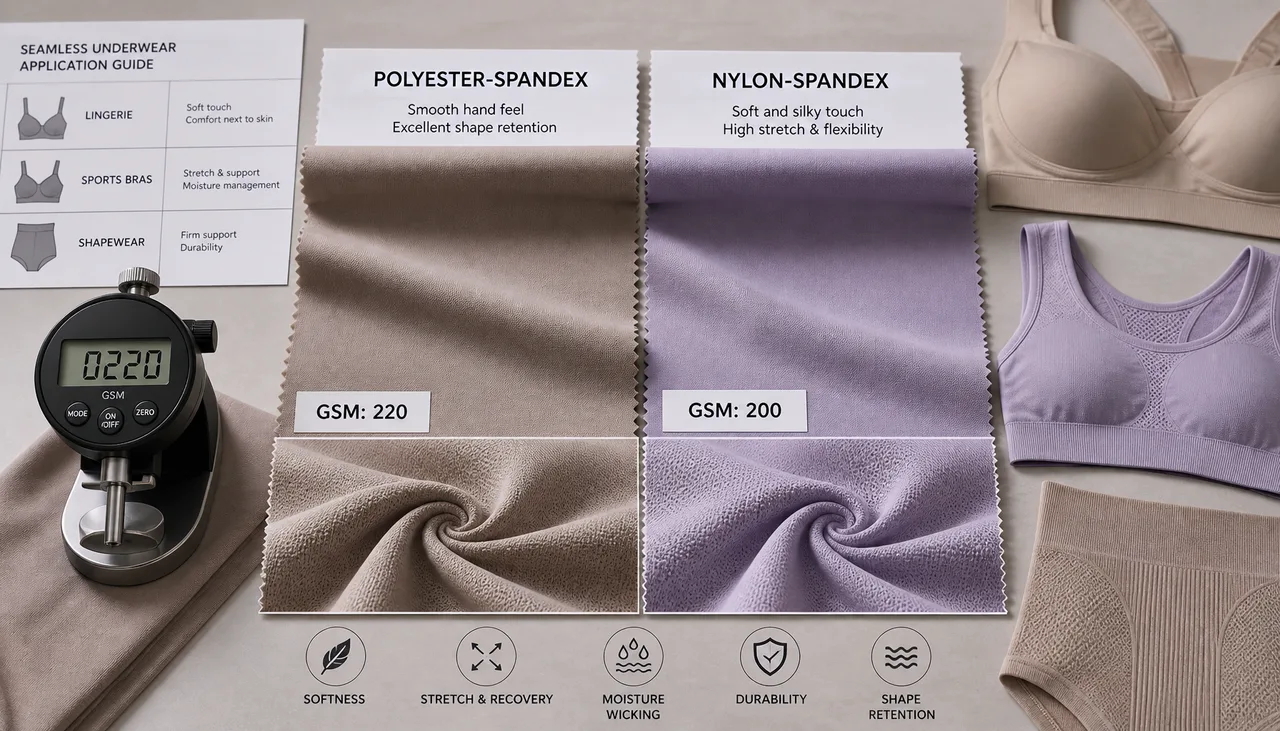
Brands should compare nylon-spandex and polyester-spandex only after defining what “seamless underwear” means in the product brief. A circular-knitted seamless garment is developed through yarn selection, knit zones, and garment programming, while bonded or free-cut underwear uses finished fabric panels; the two routes require different specifications and approval tests.
Identify the construction route first
Circular-knitted seamless underwear
In a true circular seamless program, much of the garment body is knitted as a tube with support, ventilation, and shaping zones engineered into the construction. The buyer should specify yarn composition, yarn count where available, spandex placement, knit structure by zone, garment weight, dimensions, stretch force, and finishing conditions. A single fabric GSM may not describe a garment whose density changes between the waist, body, and ventilation zones.
This route normally requires coordination with a seamless-knitting garment developer. Selecting a fabric supplier does not by itself provide a complete seamless-garment manufacturing service.
Bonded, free-cut, or minimal-seam underwear
These garments are cut from finished fabric and assembled with bonding, ultrasonic processes, limited stitching, binding, or a combination of methods. Here the sourcing specification should include composition, knit construction, finished GSM, usable width, thickness where relevant, stretch and recovery by direction, edge stability, and compatibility with the intended bonding process.
Do not use “seamless” as the only technical description on a request for quotation. State the actual construction route and garment zones.
Compare nylon-spandex and polyester-spandex by decision criteria
| Procurement question | Nylon-spandex starting point | Polyester-spandex starting point | What still requires verification |
|---|---|---|---|
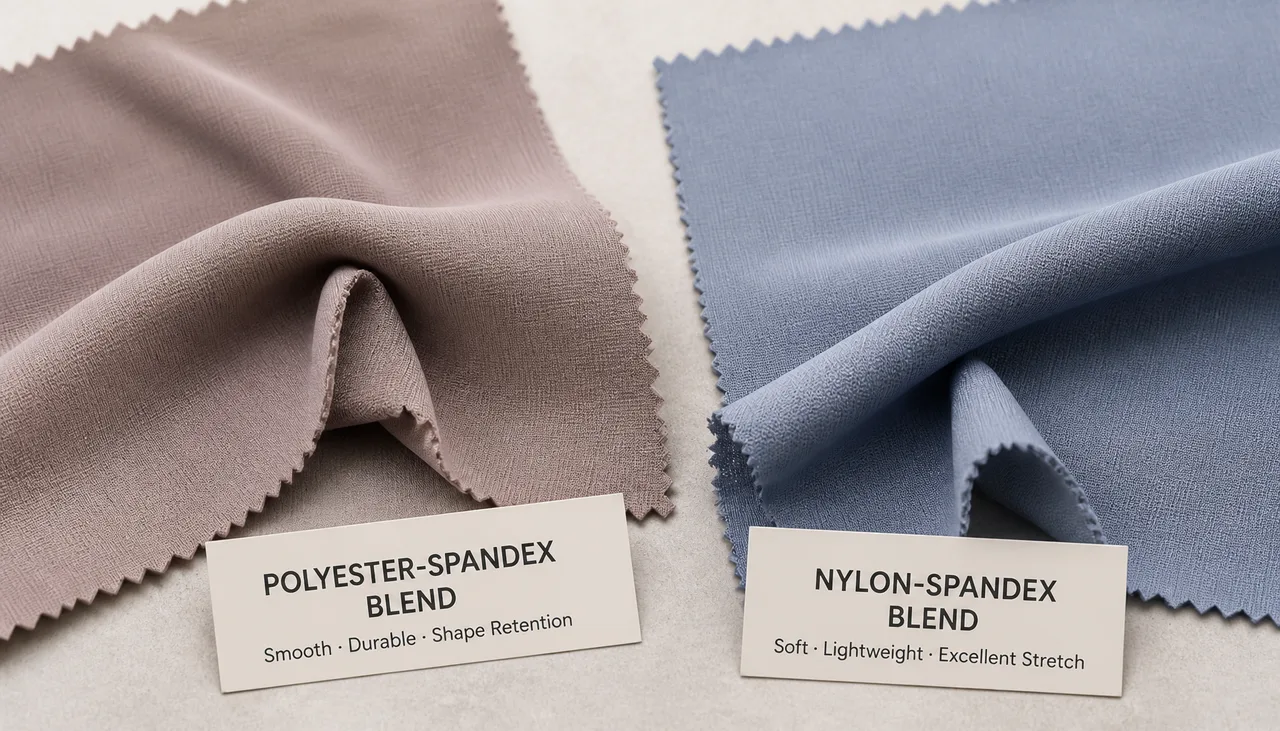
| Next-to-skin hand | Often shortlisted when a smooth, soft surface is important | Can also be engineered for a soft hand through yarn and finishing choices | Finished hand after dyeing, finishing, bonding, and laundering |
| Moisture behavior | Composition alone does not establish wicking or drying | Often considered for quick-dry constructions, but the fiber name is not proof of performance | Test the finished construction using a method tied to the intended claim |
| Color and appearance | Shade depth, luster, and surface appearance depend on yarn, dyeing, and finish | The same variables apply, with different dyeing routes and color behavior | Approve the actual color and finished sample under agreed lighting |
| Stretch and compression | Spandex content can support extension but does not define pressure | The same limitation applies | Measure force at specified extension, recovery, and residual growth by direction |
| Surface durability | Fiber choice is only one variable in pilling, abrasion, and snagging | Fiber choice is only one variable in pilling, abrasion, and snagging | Test the finished knit, color, and surface treatment |
| Bonding or free-cut use | Suitability depends on surface, thickness, finish, heat response, and edge stability | The same process-specific checks are required | Trial the actual adhesive, temperature, pressure, dwell time, and edge method |
Neither composition is universally better. The decision should follow the garment's skin-contact requirements, construction route, support level, color range, care cycle, and production process.
Do not use spandex percentage as a compression rating
A higher spandex percentage does not automatically produce stronger support. Yarn size, feeding tension, loop geometry, knit density, heat setting, finishing, specimen direction, and test extension all affect the force applied by the material.
For close-fitting underwear, request a load-extension result at the extension expected in the garment, then record recovery after the specified hold and relaxation period. Compare materials only when specimen size, direction, conditioning, extension rate, cycles, and wash history are the same.
Use GSM differently for the two construction routes
For cut-and-sew or bonded underwear, finished GSM helps estimate garment mass, coverage, seam or bond bulk, and material consumption. It does not independently prove breathability, opacity, compression, or durability.
Illustrative calculation — not a ClothFactory test result: if a bonded underwear style uses an assumed 0.45 m² of one fabric before cutting waste, a 180 gsm option contributes:
0.45 m² × 180 g/m² = 81 g
A 220 gsm option contributes approximately 99 g under the same assumption, a difference of 18 g before bonding film, elastic, lining, labels, and cutting waste. Use the calculation for weight and costing comparisons; confirm comfort and support with the finished garment.
For circular seamless underwear, garment weight and zone-specific construction may be more informative than one flat-fabric GSM value. The specification should identify where density, stretch, or support changes within the garment.
Approve the finished construction, not the fiber label
The approval plan should address the risks created by the chosen production route.
| Approval area | Circular seamless route | Bonded or free-cut route |
|---|---|---|
| Construction identity | Yarn references, knit program or zone map, dimensions, and garment weight | Fabric code, composition, knit type, finished GSM, usable width, and thickness where relevant |
| Fit response | Zone-specific extension, force, recovery, and garment dimensions | Fabric stretch, force, recovery, pattern orientation, and panel dimensions |
| Assembly | Reinforcement, gusset, strap, or other attached-component performance | Bond, weld, seam, edge, and adhesive compatibility |
| Appearance | Zonal uniformity, barre, holes, distortion, and shade | Surface uniformity, edge curl, print or shade, bond-line appearance, and show-through |
| Care durability | Garment dimensions, recovery, surface, and component attachment after laundering | Fabric dimensions, recovery, delamination, edge stability, and seam appearance after laundering |
Test the risks relevant to underwear
Depending on the design and claim, the buyer may need to define:
- composition and construction verification;
- finished weight, dimensions, width, or thickness as applicable;
- force at specified extension, stretch recovery, and residual growth;
- dimensional stability and spirality after the intended care cycle;
- bursting strength or another construction-appropriate strength check;
- pilling, abrasion, and snagging resistance;
- colorfastness to laundering, perspiration, and wet/dry rubbing;
- edge stability, bond strength, or delamination resistance for bonded and free-cut garments;
- moisture or drying performance only where a defined claim is planned;
- restricted-substance or market-compliance requirements supplied by the buyer.
Hand feel should be evaluated against an approved reference under consistent conditioning. “Soft,” “silky,” or “second skin” is not a reproducible acceptance criterion without a comparison sample or defined panel procedure.
Avoid common sourcing mistakes
- Treating every low-seam product as circular seamless. The machinery, inputs, costing, and quality controls differ.
- Choosing by composition alone. Fiber percentages do not specify knit construction, compression, finish, or durability.
- Assuming more spandex means more support. Support depends on the complete load-extension response and garment design.
- Using GSM as a comfort guarantee. Weight does not independently establish airflow, opacity, or skin comfort.
- Approving an optional finish as a standard property. Moisture management, cooling, antibacterial treatment, or brushing must be identified and verified separately.
- Skipping the assembly trial. Bonding, raw-edge, seam, elastic, and lining performance can change the result of an otherwise acceptable fabric.
Information to include in the development brief
Send the supplier or development partner:
- the exact seamless construction route;
- garment type, body zones, fit, and support requirement;
- target composition and any permitted alternatives;
- required hand-feel reference and color standard;
- target weight, dimensions, GSM, width, or thickness as applicable;
- expected extension and material orientation;
- bonding, edge, seam, lining, elastic, or gusset details;
- care cycle and required tests;
- approval tolerances and the reference retained for bulk comparison.
Procurement next step
Decide first whether the product is circular knitted, bonded, free-cut, or simply designed with fewer seams. For a finished-fabric route, ClothFactory can compare nylon-spandex and polyester-spandex constructions against the required hand, GSM, width, stretch response, finish, and assembly process. For a circular seamless garment, the buyer should also work with the knitting manufacturer to approve the yarn package, zone construction, garment dimensions, and finished-garment performance.