
Compare ski base-layer fabric suppliers against one written specification, one conditioning and test protocol, and representative production samples. A low quotation is not comparable when composition, knit structure, finished GSM, usable width, thermal behavior, moisture transport, stretch recovery, colorfastness, or tolerances differ. Supplier selection should therefore be based on the cost of fabric that passes garment-level validation, not on price per kilogram alone.
Define the base-layer use case before requesting fabric
A ski base layer worn directly against the skin must manage sweat while remaining comfortable under insulating and shell layers. The specification should state whether the garment is intended for high-output touring, resort skiing, or lower-intensity cold-weather use; the expected fit; the target climate; and the layering system. These conditions change the acceptable balance among warmth, drying behavior, air permeability, surface softness, opacity, and stretch recovery. “Thermal fabric” or “moisture-wicking fabric” is not a measurable purchasing requirement.
Compare equivalent fabric constructions
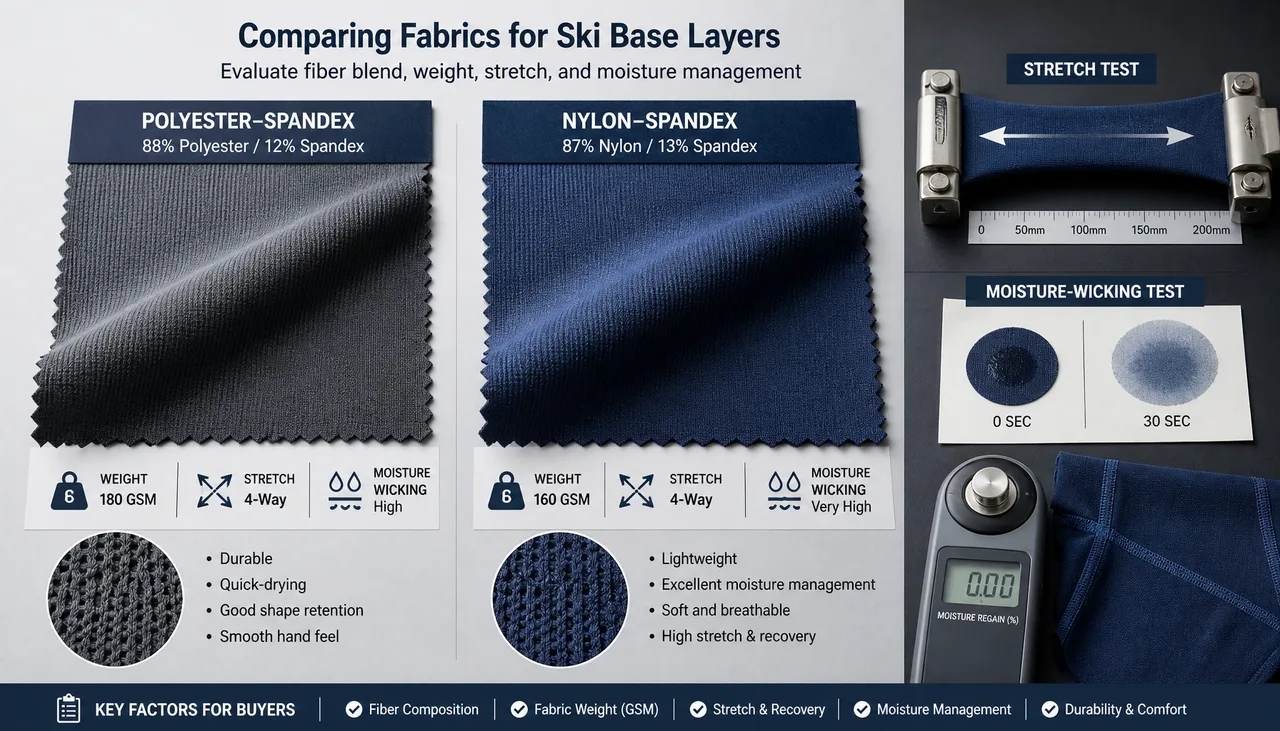
Fiber content alone does not predict base-layer performance. Polyester-spandex and nylon-spandex fabrics can be engineered with different yarn sizes, filament counts, knit structures, brushing levels, and finishes. Ask each supplier to identify the finished composition, knit construction, finished GSM, usable width, stretch direction, and relevant finishing route. If one quotation covers brushed interlock and another covers lightweight jersey, their prices and test results do not represent equivalent products even when the fiber percentages appear similar.
Issue one performance and test matrix
| Decision area | Buyer should specify | Evidence to compare |
|---|---|---|
| Fit retention | Stretch direction, extension target, recovery condition and tolerance | Laboratory report plus worn-garment trial |
| Moisture and drying | Selected methods, specimen conditioning and acceptance criteria | Reports produced using the same methods |
| Comfort | Approved hand standard, seam placement and skin-contact face | Identified swatch and prototype garment |
| Durability | Wash cycle, pilling, abrasion and dimensional-stability requirements | Pre- and post-wash results on the proposed quality |
| Bulk control | GSM, usable width, shade and roll-level tolerances | Inspection method and lot records |
The buyer should name the required test method and acceptance criterion rather than asking whether a fabric “passes.” Results obtained under different extension levels, loads, wash cycles, specimen directions, or conditioning periods cannot be compared directly. Where the brand has no established limits, test shortlisted fabrics under identical conditions, make garments from the best candidates, and convert the selected result into the approved bulk specification.
Evaluate commercial yield, not only quoted price
Illustrative calculation: Supplier A quotes USD 8.00/kg at 190 GSM and 1.50 m usable width. One linear metre weighs 0.190 × 1.50 = 0.285 kg, so its material cost is USD 2.28 per usable metre before loss. Supplier B may quote a lower price per kilogram yet deliver a narrower usable width or higher finished GSM, increasing cost per metre and per marker. Replace these hypothetical figures with measured bulk values and actual marker efficiency before awarding the order.
Audit the path from sample to bulk
Ask how the supplier identifies yarn, greige fabric, dye lot, finishing route, and finished rolls; which measurements are taken per lot; and how out-of-tolerance material is isolated. Confirm whether the approved sample is a laboratory development, a production trial, or material cut from an existing bulk lot. A supplier should also explain how shade continuity, width variation, GSM, bow or skew, and finishing changes are controlled. Certificates without sample and lot traceability provide limited protection to the buyer.
Use a controlled supplier trial
Shortlist suppliers using the same RFQ, then request identified yardage sufficient for laboratory testing, spreading, sewing, fitting, and repeated laundering. Record roll or sample identity on every report. Approve a sealed reference for color, face, hand, construction, and appearance, while keeping numerical tolerances in the purchase specification. Before bulk commitment, confirm lead time, minimum dye-lot conditions, re-order controls, claim handling, and which party pays for retesting or replacement when agreed criteria are not met.
Procurement decision
Select the supplier that can reproduce the approved construction within documented tolerances and provide traceable evidence under agreed test conditions. Send ClothFactory or any shortlisted supplier the garment use case, target composition and construction, finished GSM and usable width, stretch and recovery requirements, wash protocol, color plan, forecast quantity, and acceptance matrix. This creates quotations that purchasing, development, and quality teams can compare without relying on marketing descriptions.