
There is no defensible universal sample count for snag-resistance testing. The selected test method determines the required laboratory specimens, while the buyer's sampling plan must separately cover enough rolls, dye lots, and fabric locations to represent the production decision.
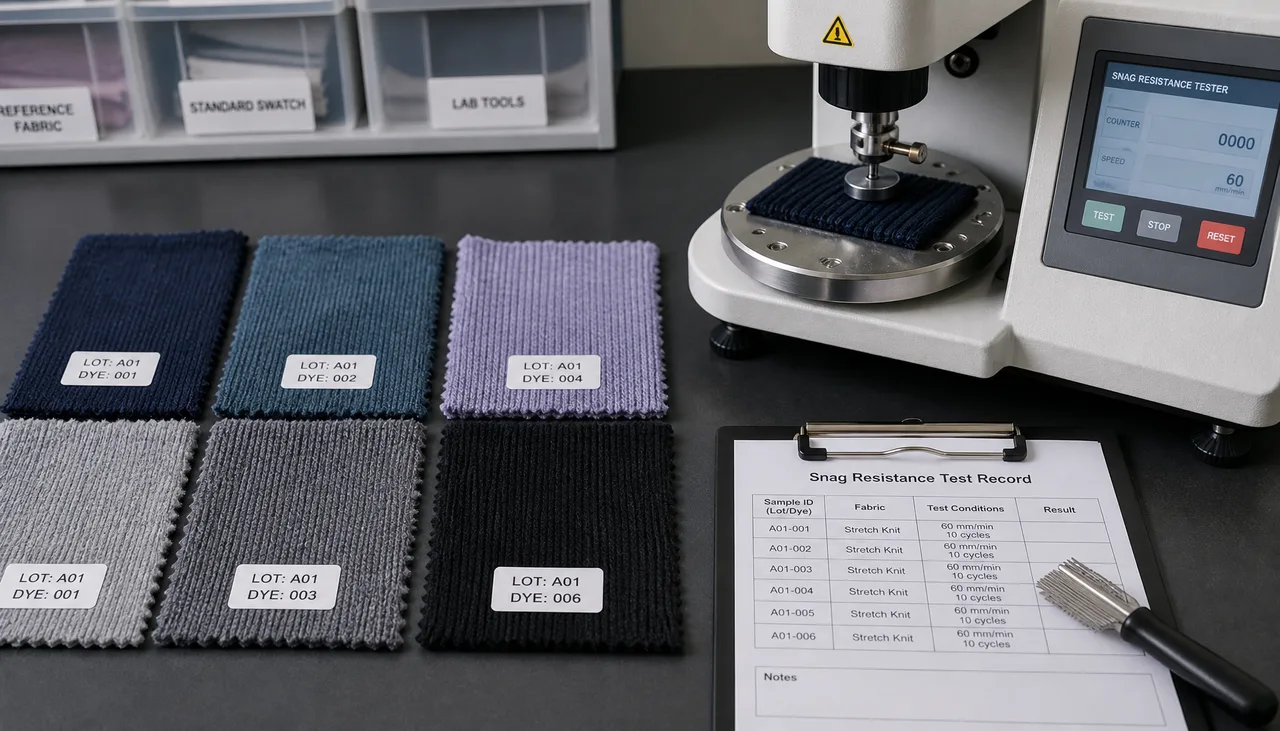
Separate test specimens from production samples
Buyers should distinguish four levels of sampling:
- Production lot: the material covered by one acceptance decision.
- Rolls or production groups: identifies variation between dye lots, machines, dates, or finishing groups.
- Locations within a roll: detects local differences across the roll length or width.
- Test specimens: the pieces prepared and exposed according to the selected snag method.
Several specimens cut from one small area provide repeat measurements, but they do not demonstrate consistency across several rolls. A test report should therefore identify both the method-required specimen count and where each specimen originated.
Ten specimens from one roll still represent one roll, not ten independent production units. Increasing laboratory repetition can improve confidence in that sampled material, but it cannot replace coverage across production sources.
Let the selected method define the specimen set
Snag methods use different equipment, exposure conditions, specimen dimensions, directions, and grading systems. Buyers should not prescribe an informal “three pieces” rule before choosing the method. Request the current method identifier, specimen count, conditioning, exposure settings, grading scale, and any deviations on the report.
If the method requires a fixed set of specimens, complete that full set for every sampling group included in the buyer's plan. Do not divide one required set across multiple rolls unless the method and acceptance agreement explicitly permit it.
Adjust sampling to the sourcing stage
| Testing stage | Decision being made | Appropriate coverage |
|---|---|---|
| Initial screening | Is the construction worth further development? | Test one complete method-required set from each candidate under identical conditions. The result is preliminary and represents only the submitted sample. |
| Finished-fabric development | Did dyeing or finishing change the snag response? | Test complete sets from matched, identified material before and after the relevant finish or wash condition. |
| Pre-production confirmation | Is the approved construction repeatable? | Take complete specimen sets from more than one production position or roll where available. |
| Bulk-lot acceptance | Can the shipment be released? | Select rolls across each defined dye lot or production group using a written risk-based or contractual sampling plan. |
The sampling agreement should state what happens when one roll or specimen group differs materially from the others. Define whether the response is adjacent resampling, wider roll coverage, roll segregation, investigation, or lot rejection. An overall average should not automatically release a roll with visibly poor snag performance.
Illustrative bulk-sampling calculation
The following is an illustrative buyer-defined plan, not an industry standard or ClothFactory test result. Suppose the buyer selects three representative rolls and takes material from two locations in each roll:
3 rolls × 2 locations = 6 sampling groups
Each group must then provide the complete specimen set required by the selected snag method. If the method requires n specimens per group, the total number of specimens is:
6 sampling groups × n method-required specimens
This calculation separates production coverage from laboratory repetition. The appropriate number of rolls still depends on lot size, dye-lot structure, color and finish groups, prior quality history, construction risk, and the purchase agreement.
Keep all comparison conditions consistent
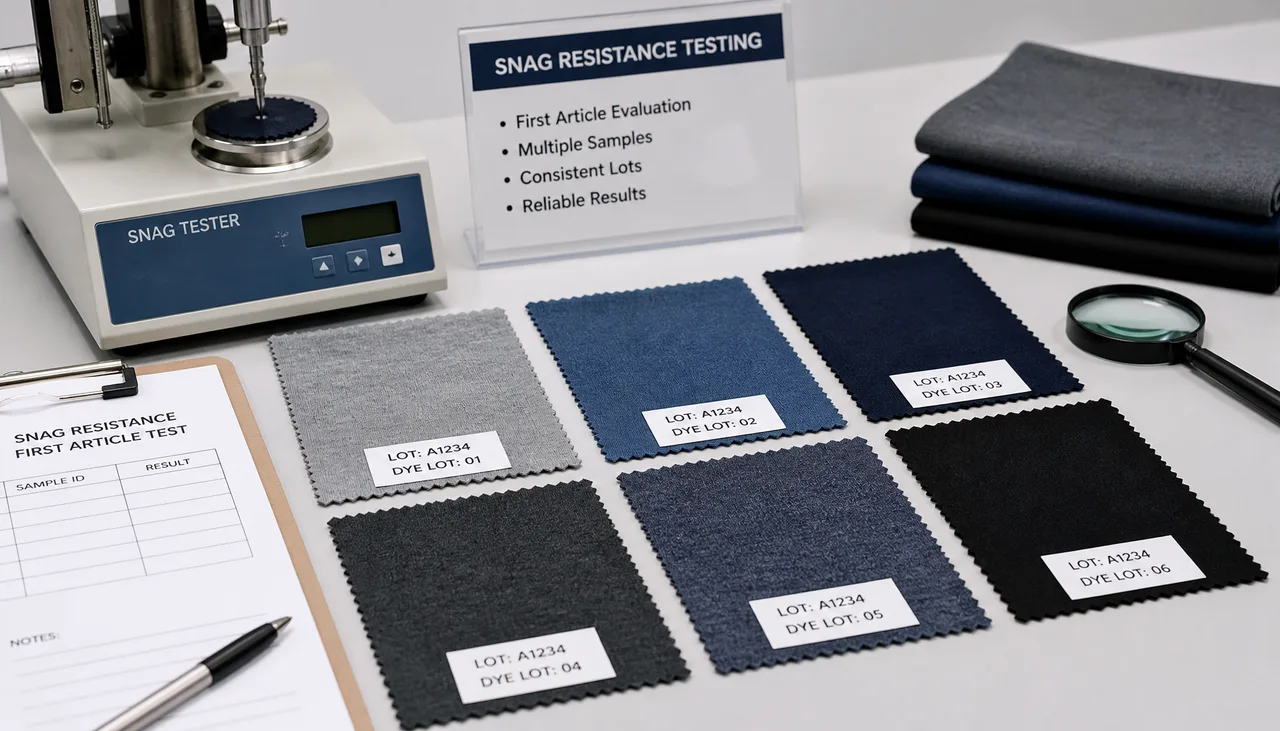
Snag results are only comparable when the test conditions match. Record:
- fabric face and specimen direction;
- conditioning and relaxation period;
- equipment and exposure settings;
- number of exposure cycles where the method uses cycles;
- grading scale, photographic standard, lighting, and viewing distance;
- whether the fabric was tested before or after laundering;
- fabric code, color, finish, roll, dye lot, and sampling location.
Do not compare results from different snag methods as if they were interchangeable. A change in apparatus or grading reference can change what the result means, even when the same fabric is tested.
Interpret the result against garment risk
Snag resistance is an appearance and durability issue, but the commercial risk depends on the garment and surface exposure.
| Application or zone | Snag risk to consider | Additional verification |
|---|---|---|
| Polo or golf-shirt outer surface | Contact with rough bags, hook-and-loop fasteners, or equipment | Inspect the exposed face and confirm appearance after laundering. |
| Leggings and fitted activewear | Surface extension may open the knit and make pulled loops more visible | Grade the fabric under an agreed extension as well as relaxed where relevant. |
| Mesh or textured panels | Open or raised structures may catch more easily | Test the exact production construction and panel orientation. |
| Lingerie and shapewear | Snags may affect both appearance and next-to-skin comfort | Check rough loops, skin contact, recovery, and seam-area interaction. |
| Inside or protected panels | Consumer exposure may be lower, but production handling can still cause damage | Review cutting, sewing, packing, and trim contact risks. |
A numerical or visual grade should not be interpreted without the agreed acceptance limit. The buyer should define the required grade by product risk, approved reference, test method, and viewing condition rather than adopting a supplier's generic “pass.”
Test the finished and stretched condition where relevant
Yarn selection, loop structure, surface texture, brushing, heat setting, dyeing, and other finishing steps can change snag behavior. Test the finished production construction, not only greige fabric or an unprocessed development swatch.
For stretch garments, a snag that looks minor in the relaxed state may become prominent when the knit opens during wear. If appearance under extension matters, state the extension condition and use it consistently during grading. Hand stretching without a recorded extension does not provide a reproducible result.
Investigate variation before averaging
Review every specimen and sampling-group result. If one group performs differently, check whether it corresponds to a particular roll, dye lot, machine position, finish, color, or fabric direction. Retesting adjacent material may help determine whether the result is local or representative, but it should not erase the original failure from the report.
Keep snag resistance separate from pilling, abrasion, bursting strength, stretch recovery, and colorfastness. These tests address different failure modes; a good snag result does not prove overall durability.
Information buyers should include in the request
Provide the supplier or laboratory with:
- fabric code, composition, knit construction, finished GSM, and usable width;
- intended garment and exposed surface or body zone;
- selected snag method and edition;
- required specimen directions and any under-extension grading condition;
- conditioning, wash, and exposure requirements;
- acceptance grade and approved visual reference;
- lot definition, roll-selection rule, and sampling locations;
- report format showing individual results and specimen traceability.
Procurement next step
Choose the snag method first, then build a sampling plan around the production lot. During development, compare complete method-required specimen sets under identical conditions. Before bulk release, expand coverage across representative rolls and dye lots and retain the individual results. ClothFactory can prepare identified nylon-spandex or polyester-spandex samples, but the buyer and supplier should agree the method, sampling coverage, grading condition, and acceptance limit before relying on the result.