
Before approving sports-bra fabric, brands should verify fabric identity, load at the intended extension, stretch recovery, dimensional stability, bursting resistance, surface durability, colorfastness, and any claimed moisture performance. The test plan must state the method, direction, conditioning, wash history, and acceptance limit; a generic result such as “good stretch” cannot support a bulk decision.
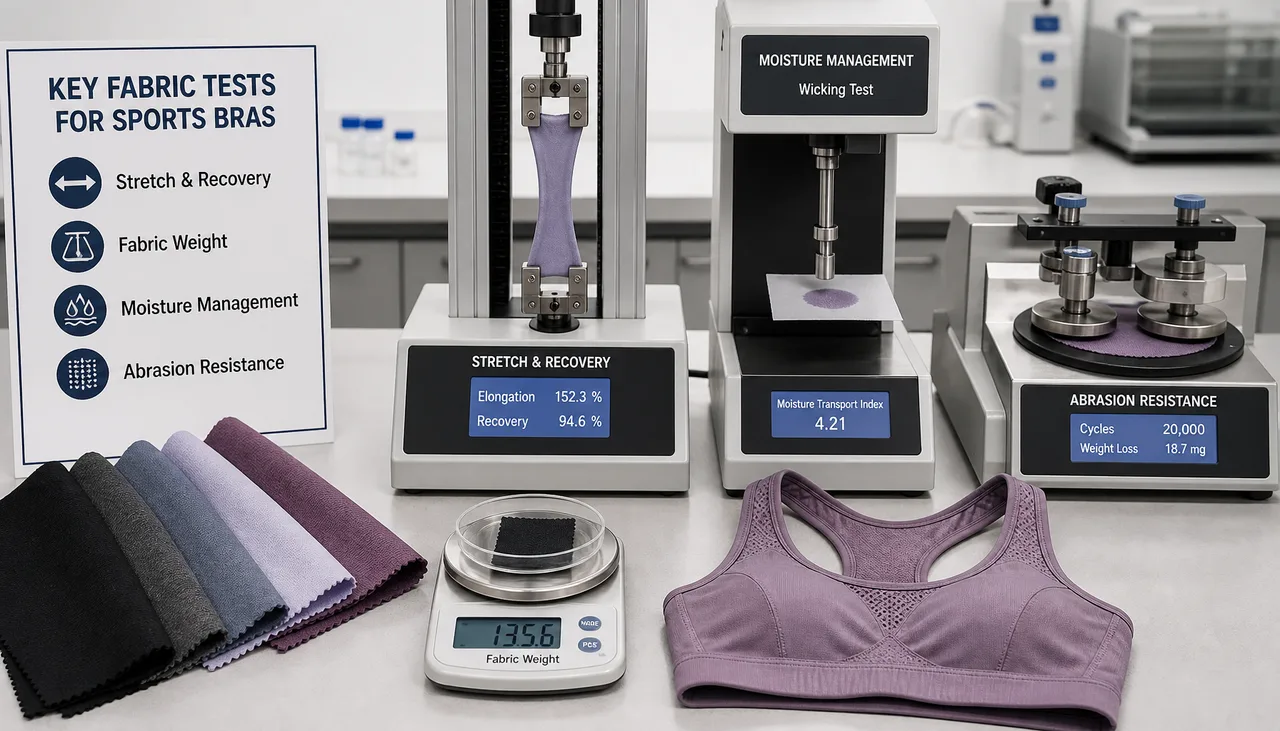
Start with the support level and garment zone
A low-impact yoga bra, a medium-support training bra, and a high-support running bra do not impose the same loads on the fabric. Before selecting tests, identify where the material will be used: main body, compression panel, back wing, lining, pocket, or trim. Record the expected garment extension, fit intent, care cycle, color range, and whether the fabric will contact skin.
Fabric testing cannot establish the support performance of the finished bra by itself. Pattern geometry, panel orientation, elastic, straps, cups, seams, and garment size all affect support. Use fabric results to approve the material specification, then verify the complete garment through fitting and wear evaluation.
Measure fabric power, not only maximum stretch
Maximum stretch shows how far a specimen can extend, but sports-bra development also needs the force required to reach a defined extension. That force is often described as fabric power or modulus. Two fabrics may both reach the same extension while applying very different pressure to the body.
The request should state:
- specimen direction and dimensions;
- gauge length and conditioning procedure;
- extension rate and target extension;
- number of loading cycles;
- force recorded at the specified extension;
- hold time, recovery time, and residual growth;
- whether testing occurs before or after laundering.
Test both principal fabric directions. The pattern must identify which direction runs around the body because the higher-power direction may not be the direction with the greatest elongation.
Illustrative recovery calculation
Assume a hypothetical marked length is 100 mm before extension and measures 103 mm after the defined recovery period:
Residual growth = (103 mm − 100 mm) ÷ 100 mm × 100 = 3%
This is a calculation example, not a ClothFactory result or a universal pass limit. The acceptable growth must be agreed for the specific garment zone, support level, and test method.
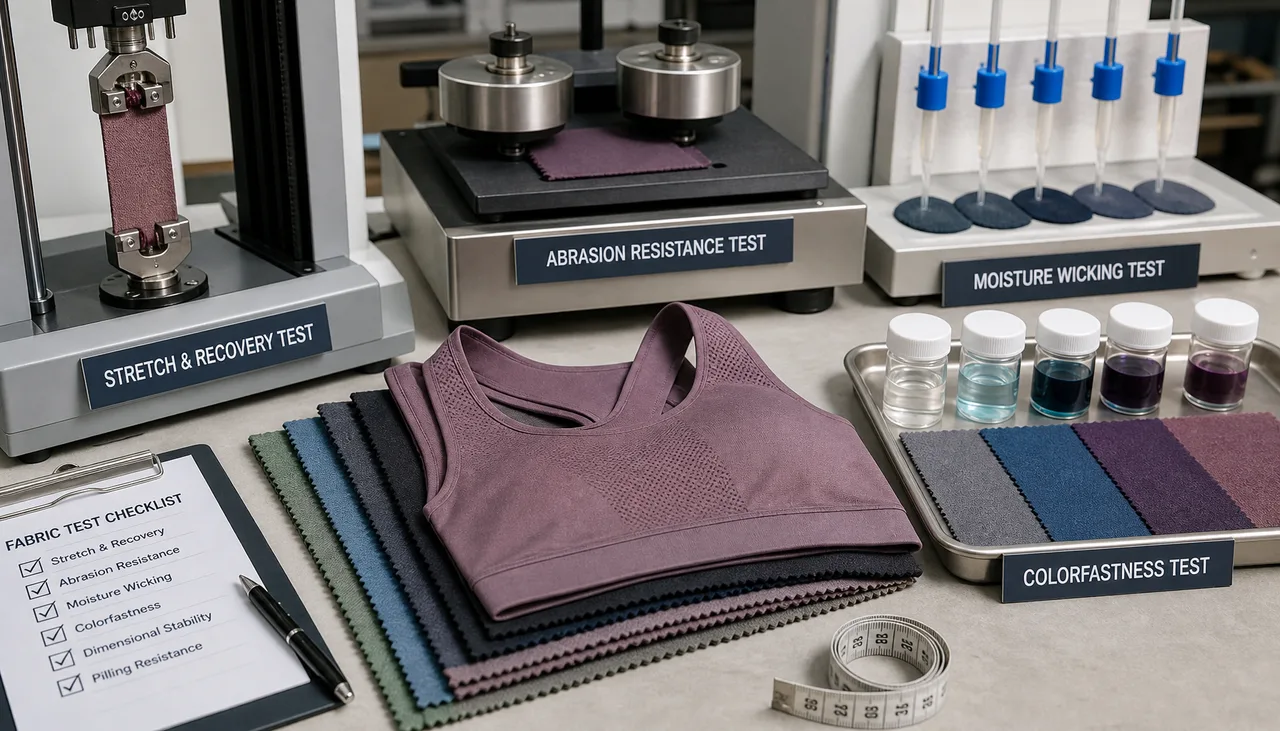
Build the approval plan around the actual risks
| Procurement risk | What to measure | Conditions buyers should define |
|---|---|---|
| Incorrect material | Fiber composition, knit construction, finished GSM, usable width, and thickness where relevant | Sampling location, conditioning, tolerance, and whether results refer to finished fabric |
| Insufficient or excessive compression | Force at specified extension in both directions | Specimen size, target extension, rate, cycles, and garment orientation |
| Bagging or fit loss | Stretch recovery and residual growth | Extension, hold time, recovery time, wash condition, and measurement interval |
| Failure near seams or cup zones | Bursting strength and relevant seam or component tests | Finished fabric condition, test method, specimen direction where applicable, and failure mode |
| Shrinkage or twisting | Dimensional stability, spirality, or skew after laundering | Wash and drying procedure, number of cycles, relaxation, and tolerance by direction |
| Surface damage | Pilling, abrasion, and snagging resistance as relevant | Abradant, cycle count or endpoint, evaluation scale, and color tested |
| Dye transfer or shade change | Colorfastness to laundering, perspiration, and rubbing | Adjacent fabric, solution, temperature, wet/dry condition, and required grade |
| Unsupported sweat-management claim | Wicking, drying, liquid-moisture management, or air permeability selected for the claim | Method, specimen side, conditioning, finish, and pass criterion |
Not every project needs every available test. Select tests from the product risk and any consumer claim, then keep the method and acceptance limit consistent across suppliers.
Verify construction, GSM, width, and thickness together
GSM is a control measurement, not a support rating. A higher-GSM fabric may provide more mass or coverage, but support also depends on yarn, knit density, spandex integration, finishing, and load-extension behavior. Usable width affects marker efficiency and consumption, while thickness can influence bulk at seams and folded edges.
The approved specification should identify whether GSM and width are measured after finishing and relaxation. Comparing one supplier's greige result with another supplier's finished result does not produce a valid sourcing comparison.
Test after the intended care cycle
Sports bras are exposed to repeated stretching, perspiration, detergent, heat, and drying. Run the agreed dimensional, recovery, appearance, and colorfastness checks after the care cycle intended for the label. If several washing or drying routes are permitted, identify which represents the approval condition.
Inspect more than the average value. Record whether laundering changes hand feel, surface appearance, edge curl, stretch force, recovery, shade, or fabric width. A fabric that passes in its original state may no longer match the fit or support brief after washing.
Treat hand feel as a controlled evaluation
“Soft” and “comfortable” are not reproducible specifications unless the buyer defines a reference and evaluation procedure. Compare coded samples under the same conditioning, use an approved hand-feel reference where possible, and record the fabric face and back separately. For next-to-skin panels, the garment sample should also be checked for seam bulk, elastic pressure, chafing points, and surface irritation.
An optional finish must be identified separately from the base fabric. Do not assume moisture management, antibacterial performance, cooling, or another treatment is standard across every color or production lot.
Confirm colorfastness for the real color range
Sports-bra fabrics may contact skin, light-colored tops, elastic, foam, or lining while wet with perspiration. Define laundering, perspiration, and wet/dry rubbing requirements for the intended product. Add light, chlorine, or seawater exposure only when the use case or product claim requires it.
Do not approve all colors from one shade. Dark, bright, fluorescent, and heavily saturated colors can create different dyeing and fastness risks. The purchase specification should state whether each color is tested or whether colors are grouped under an agreed risk-based plan.
Separate fabric approval from garment validation
After the fabric passes its specification, make a representative size set or agreed garment sample. Check:
- support and pressure at the intended activity level;
- recovery at the underband, cup, wing, and strap attachment zones;
- opacity and appearance under extension;
- seam compatibility and needle damage;
- movement, chafing, and edge comfort;
- post-wash fit, shape, and component interaction.
A fabric report cannot account for a weak elastic, unsuitable seam, incorrect pattern reduction, or panel direction. Bulk approval should therefore retain both an approved fabric reference and the garment-development record.
Information to send with the testing request
Provide the laboratory or supplier with:
- fabric code, composition, construction, color, finish, and lot identity;
- garment type, support level, and exact fabric location;
- expected extension and pattern orientation;
- test method and specimen conditioning;
- wash and drying procedure;
- acceptance limit and reporting units;
- approved reference sample where appearance or hand is evaluated;
- action required if a result falls outside tolerance.
Procurement next step
Create a test matrix before requesting quotations or samples. Link each test to a garment risk, specify its conditions and acceptance limit, and require reports to identify the exact submitted fabric. ClothFactory can use that matrix to compare nylon-spandex or polyester-spandex candidates and prepare matched development samples, while final sports-bra support remains subject to garment construction, fit, and wear validation.