
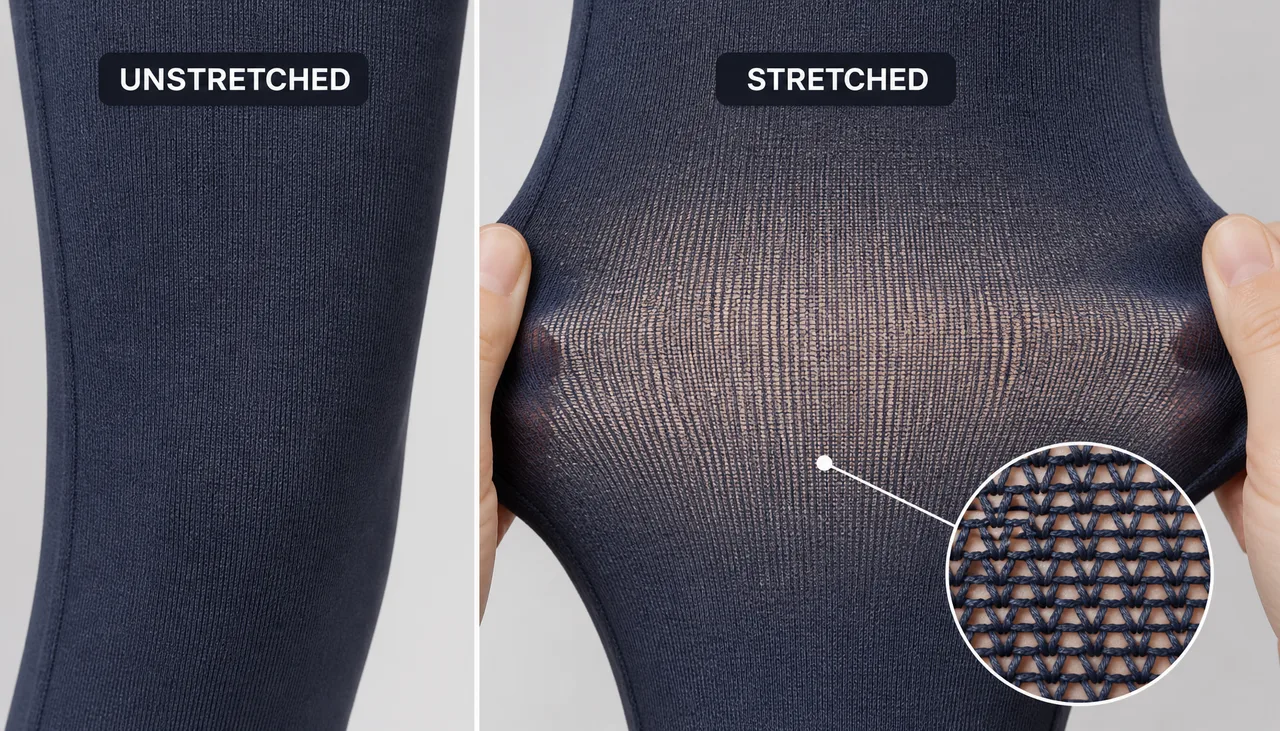
Yoga leggings become see-through during a squat when extension opens the knitted structure enough to increase light transmission through the seat and thigh. The result depends on yarn coverage, loop density, thickness, color, stretch level, and garment fit—not simply fiber composition or GSM.
What changes when the fabric stretches
As a knitted fabric extends, loops change shape and the distance between yarns can increase. The same material that appears opaque while relaxed may reveal the background at the extension created by a deep squat.
Pattern reduction matters because a smaller garment stretches the fabric further on the body. Size grading, seam placement, and body measurements can therefore change coverage even when every garment uses the same fabric lot.
Why GSM is not a squat-proof rating
GSM measures mass per square metre. It does not specify thickness, yarn diameter, loop density, stretch force, or the amount of extension in the garment. A higher-GSM fabric may provide greater coverage, but it can still become transparent if its structure opens substantially or the garment is undersized.
Compare fabrics at the same controlled extension rather than ranking them by GSM alone. Record the finished GSM and thickness because dyeing, finishing, and relaxation can alter both.
Color and lighting change the result
Pale colors, bright colors, and dark colors can transmit or reflect light differently. A coverage result from black fabric should not be applied automatically to white, pastel, or neon shades. Dye depth and finishing can also affect surface appearance under stretch.
Use consistent front and back lighting with a defined contrasting background. Avoid an uncontrolled hand test near a window, which is difficult to reproduce between suppliers or colorways.

Build a repeatable sample check
- Condition the sample and record its color, construction, GSM, thickness, and direction.
- Define the extension that represents the critical garment zone.
- Mount each candidate at the same extension over the same contrasting background.
- Inspect under fixed lighting and viewing distance.
- Repeat after the intended wash cycle.
- Confirm the result in a fitted garment across relevant sizes and body zones.
The fabric screen and garment squat test answer related but different questions. The fabric screen compares materials; the garment test captures pattern reduction, seams, size, and wearer movement.
Common sourcing errors
- Approving only a relaxed swatch. The failure occurs under extension.
- Using one color for the range. Shade can change apparent coverage.
- Specifying only spandex percentage. Blend ratio does not define loop opening or garment force.
- Using GSM as the pass limit. Weight does not describe the full optical structure.
- Ignoring washing. Dimensional change and finish loss can alter fit and coverage.
Procurement next step
Send the supplier the legging pattern intent, critical extension, color range, target construction, GSM and width, care cycle, and coverage-assessment setup. Request identified swatches in representative colors and enough material for fitted, washed garment samples. Approve the requirement in measurable terms rather than using “squat-proof” without defined conditions.