
There is no universal sample count for checking fabric stretch ratio. Buyers should define the count by testing stage, lot structure, fabric direction, and the selected method; one swatch can screen a construction, but it cannot demonstrate consistency across a production lot.
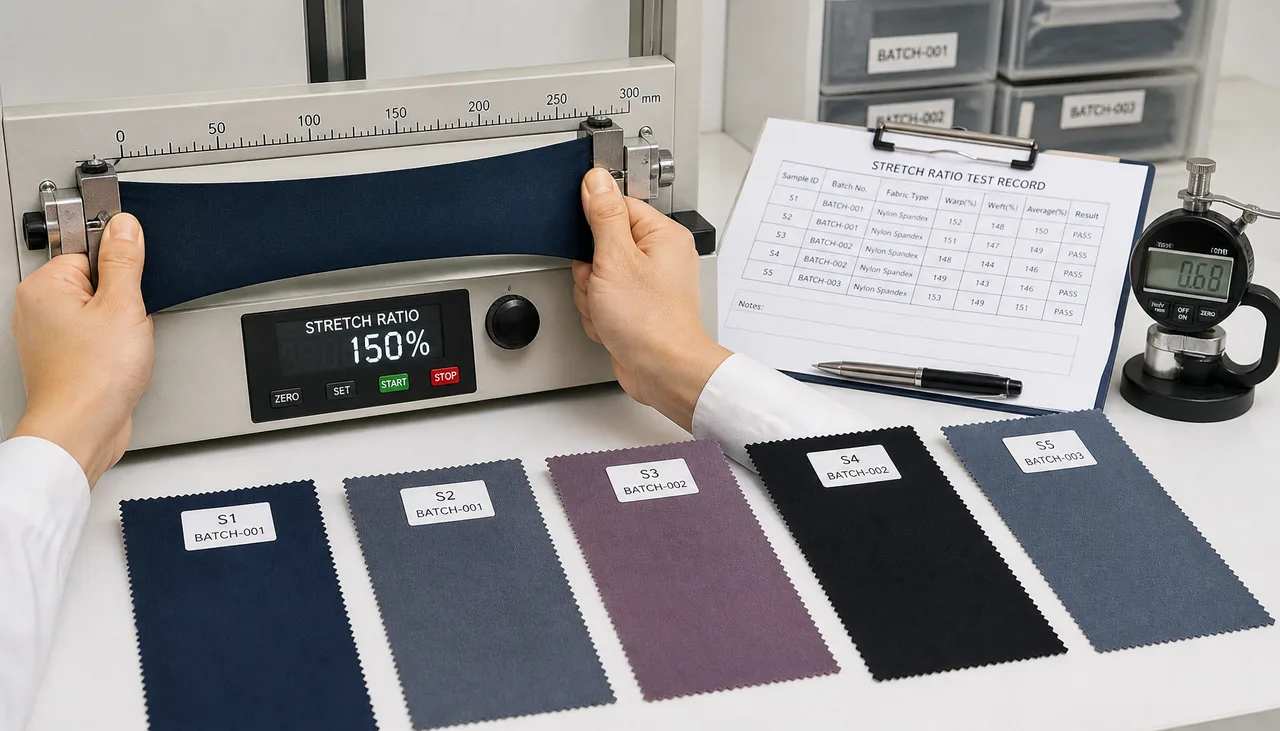
Count rolls, sampling locations, and specimens separately
A useful sampling plan distinguishes three units:
- Rolls sampled: shows whether results vary across the lot.
- Locations within a roll: detects beginning-to-middle-to-end variation or local finishing differences.
- Test specimens: provides repeat measurements under the same method.
Reporting only “nine samples tested” is incomplete. Nine specimens cut beside each other from one roll provide repetition, but they do not represent three rolls or multiple dye lots.
Use the testing stage to set the sampling plan
| Testing stage | Decision being made | Sampling approach |
|---|---|---|
| Initial fabric screening | Is this construction worth developing? | Take specimens in both principal directions from more than one location on the available sample length. Treat the result as preliminary. |
| Development or lab-dip approval | Does the finished fabric still match the target after dyeing and finishing? | Compare specimens from the approved development lot under the same conditioning, extension, hold, and recovery conditions. |
| Pre-production confirmation | Is the planned construction repeatable before bulk cutting? | Sample across available rolls or production positions rather than increasing repetitions from one small area. |
| Bulk-lot acceptance | Does the shipment meet the agreed specification? | Use a written roll-selection plan based on lot size, dye lots, machine positions, and order risk. Follow the specimen count required by the chosen test method. |
The exact count should be written into the purchase specification or quality agreement. If the governing test method specifies a minimum number of specimens, that requirement takes priority over an informal buyer checklist.
A practical screening example
The following is an illustrative buyer-defined plan, not an industry standard or ClothFactory test result:
- Select three locations across the available sample length.
- Cut three specimens in the main direction and three in the crosswise direction from each location.
- Test all specimens under identical conditioning, gauge length, extension, hold time, and recovery time.
- Report each result, the average, and the range; do not report only the best value.
This plan produces 18 measurements:
3 locations × 3 specimens × 2 directions = 18 measurements
It can reveal local and directional variation during development. It does not prove bulk-lot consistency because all specimens may still come from one roll. For bulk approval, spread the sampling across the rolls and production groups that make up the shipment.
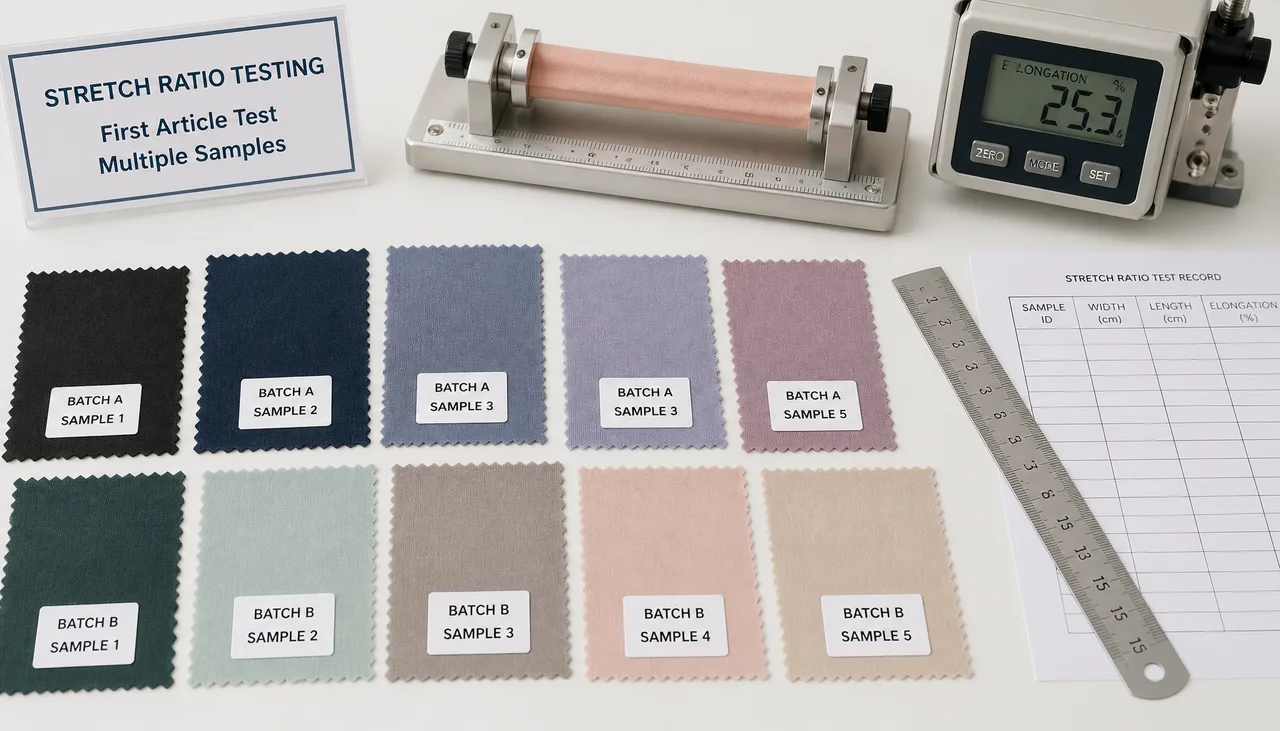
Define stretch ratio before comparing results
Stretch ratio should be calculated from a stated original gauge length and a stated extension condition. A common calculation format is:
Stretch (%) = (extended length − original length) ÷ original length × 100
Illustrative calculation: if a marked section increases from 100 mm to 150 mm under the defined load or extension procedure:
(150 mm − 100 mm) ÷ 100 mm × 100 = 50% stretch
The number is meaningful only when the direction, specimen dimensions, load or extension procedure, extension rate, hold time, conditioning, and equipment are recorded. Results produced with different conditions should not be treated as equivalent.
Measure recovery as a separate result
High stretch does not guarantee that a fabric returns to its original dimensions. Record the specimen length after the specified recovery period and calculate residual growth separately:
Growth (%) = (recovered length − original length) ÷ original length × 100
For example, if the original gauge length is 100 mm and the specimen measures 104 mm after the agreed recovery period, the illustrative residual growth is 4%. This does not establish a universal pass limit. The acceptable result depends on the garment's fit, support requirement, pattern reduction, and use zone.
Keep every comparison condition consistent
Stretch results can change when any of these variables change:
- main versus crosswise direction;
- specimen width and gauge length;
- applied load or target extension;
- extension rate and number of cycles;
- hold time and recovery time;
- temperature, humidity, and conditioning period;
- testing before or after the specified wash cycle;
- fabric location, dye lot, finish, and roll history.
The laboratory report should identify these conditions. A hand-pull comparison can help reject obviously unsuitable samples, but it is not a reproducible acceptance test.
Investigate variation instead of hiding it in an average
An average can mask one weak roll or one unstable direction. Review the individual values and the range between the highest and lowest results. If one group differs materially, check whether it corresponds to a roll, dye lot, machine position, sample location, or test setup.
Do not combine results from different fabric constructions, finishes, colors, or wash histories into one average. Dark shades, surface treatments, and heat-setting conditions may affect the finished response, so each approved production group should remain traceable.
Information buyers should include in the request
Provide the supplier or laboratory with:
- fabric code, composition, knit construction, finished GSM, and usable width;
- intended garment and the body zone where stretch matters;
- main and crosswise stretch targets;
- recovery or growth requirement and measurement time;
- selected test method and any buyer-specific conditions;
- wash or conditioning procedure;
- lot definition, number of rolls, and roll-selection rule;
- required report format, including individual results, average, and range.
For leggings, sports bras, lingerie, and shapewear, also state the expected garment extension and support level. The same stretch percentage can be acceptable for one product and unsuitable for another because pattern reduction, seam placement, and pressure requirements differ.
Procurement next step
Start with a documented development plan that covers both fabric directions and more than one sample location. Before bulk approval, expand the plan across representative rolls and production groups, then test under one agreed method. ClothFactory can prepare identified nylon-spandex or polyester-spandex samples for comparison, but the buyer and supplier should agree the specimen count, lot coverage, test conditions, and acceptance limits before relying on the results.