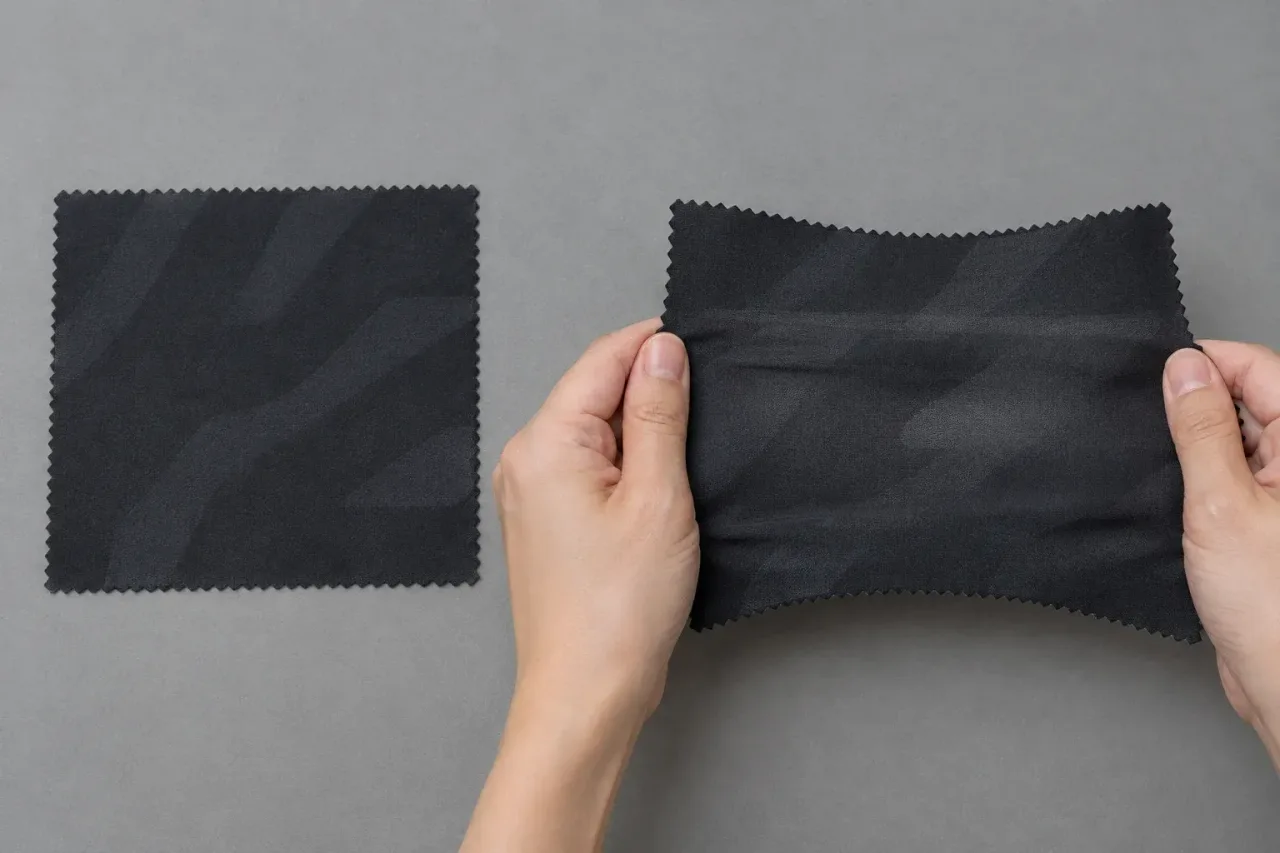
Fabric sample evaluation for sublimated sports jerseys requires a clear two-stage verification split: pre-press base knit qualification and post-press strike-off testing. Before printing, buyers must verify that the raw white polyester substrate exhibits dry heat shrinkage within supplier reference limits of ±2.0% at 190°C and meets a minimum CIE Whiteness Index of 85. After heat transfer, teams must test printed strike-offs for colorfastness, hand-feel retention, and white-core grin-through under mechanical elongation.
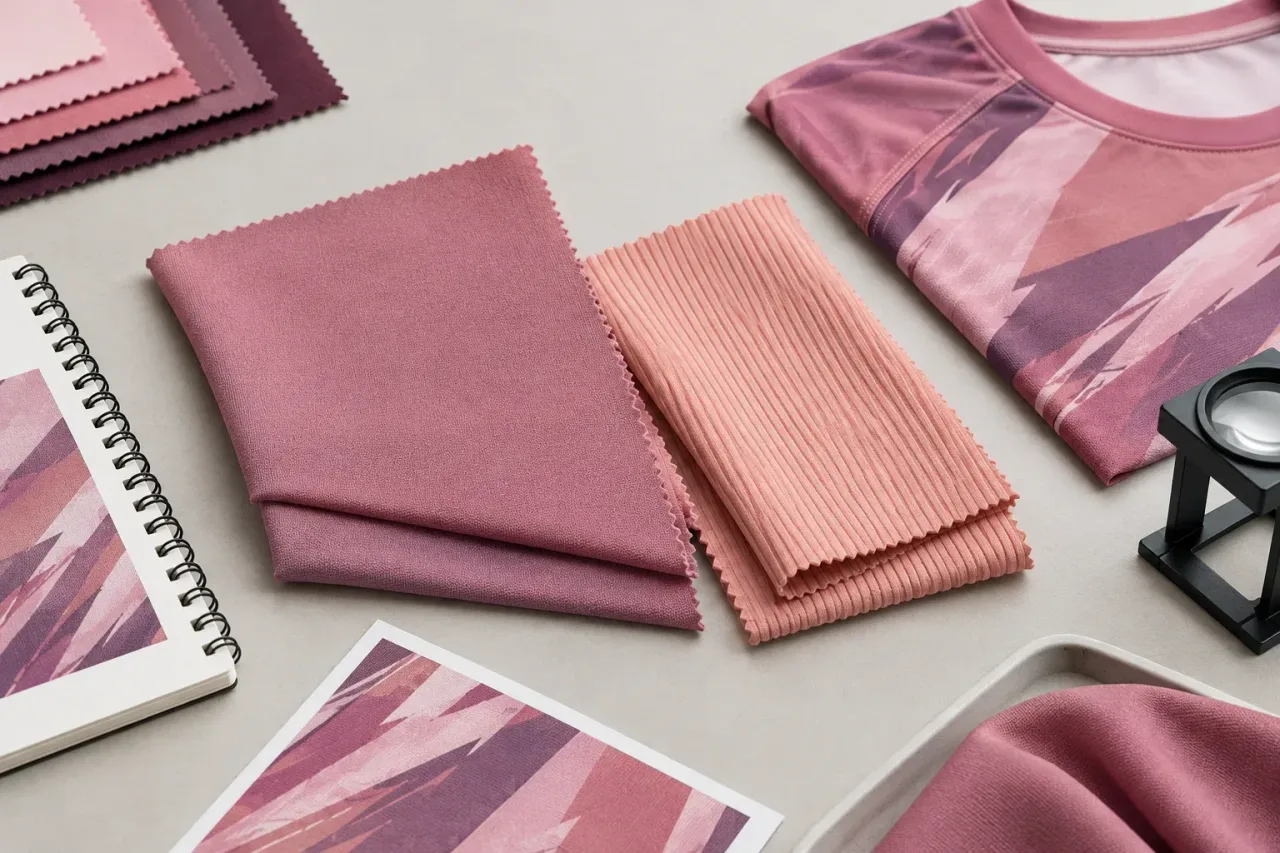
Pre-Press Base Fabric: Thermal Shrinkage and Optical Whiteness
Qualifying the raw, unprinted knit yardage prevents production defects before ink touches paper. Dye sublimation exposes the base textile to extreme heat and mechanical pressure. If the raw knit carries high residual thermal contraction, the fabric shrinks unevenly during calendar or flatbed transfer. This contraction causes the transfer paper and substrate to shift out of alignment, creating ghosting or blurred graphic outlines across team crests and player numbers.
To prevent transfer distortion, technical sourcing specifications should benchmark raw base knits against dry heat shrinkage limits of ±2.0% or less when tested at 190°C for 60 seconds. Fabric mills achieve this dimensional stability by heat-setting the knit on a stenter frame at 200°C to 210°C before delivery. Standard laundry shrinkage should also be benchmarked under ISO 5077 or ISO 6330, targeting 3% or less.
Optical brightness is equally critical. Sourcing guidelines recommend a baseline CIE Whiteness Index of 85 or greater, measured under standard CIE D65 illumination. Unbleached or yellowish greige knits act as an uncontrolled base tint, muddying pastel shades and shifting brand spot colors.
Post-Press Strike-Offs: Colorfastness, Hand Feel, and Durability
Once the base yardage passes pre-press screening, apparel developers must evaluate fully cured strike-off samples. Heat transfer presses disperse dyes deep into the polyester filaments, but excessive thermal dwell or incorrect press pressure can melt surface loops, cause plastic glazing, or stiffen the fabric hand. Compare the strike-off's drape and surface softness directly against the untreated swatch.
Production approval also depends on standardized laboratory testing for laundering, crocking, and surface abrasion. In team sports, jerseys face repetitive laundering, body friction, and perspiration. A proper lab submission confirms that the disperse dyes fully bonded to the fiber matrix rather than lingering on the surface.
|
Evaluation Stage |
Quality Checkpoint |
Standard Test Method |
Sourcing Benchmark / Passing Grade |
|---|---|---|---|
|
Pre-Press |
Dry Heat Shrinkage |
Laboratory Dry Heat (190°C, 60s) |
±2.0% maximum dimensional change |
|
Pre-Press |
Base Optical Whiteness |
CIE Whiteness (D65 Illuminant) |
$W_{CIE} \ge 85$ rating |
|
Pre-Press |
Roll Dimensional Stability |
ISO 5077 / ISO 6330 |
3.0% maximum residual shrinkage |
|
Post-Press |
Colorfastness to Laundering |
ISO 105-C06 (Accelerated Wash) |
Grade 4.0 minimum on Grey Scale |
|
Post-Press |
Crocking Resistance (Rubbing) |
ISO 105-X12 (Crockmeter) |
Grade 4.0 dry / Grade 3–4 wet |
|
Post-Press |
Pilling & Surface Wear |
ISO 12945-2 (Modified Martindale) |
Grade 4.0 after specified rubs |
Review wash test swatches for color migration into adjacent white panels, and verify that functional chemical treatments such as wicking or anti-static agents remain active after heat exposure.
Stretch Evaluation: Preventing White-Core Grin-Through on Poly-Spandex
High-movement garments and compression base layers frequently incorporate elastane, such as the 10% spandex construction found in CF-TS-0008 250 GSM Matte Polyester Spandex Double-Knit Fabric. Blended poly-spandex knits introduce two distinct manufacturing challenges: thermal sensitivity and white-core grin-through.
First, elastane fibers degrade and lose elastic recovery when subjected to standard pure-polyester transfer temperatures of 200°C to 210°C. For polyester-spandex blends, calibrate the sublimation press to an operational window of 190°C to 200°C to protect elastane elasticity while achieving full dye sublimation.
Second, disperse dyes bond with polyester filaments but do not readily penetrate synthetic elastane cores. When a finished jersey stretches across the shoulders or chest during play, the knit loops rotate and expose uncolored core yarns. On dark or saturated prints, this tension produces a faded, chalky appearance known as grin-through.
To evaluate strike-offs for grin-through:
- Apply manual biaxial tension across dark printed zones under standard D65 light to check whether unprinted white loops reveal themselves.
- Mount swatches on a mechanical stretch board at 30% to 50% elongation to verify color saturation under simulated wear.
- Check elastic recovery immediately after stretch release to ensure heat exposure has not induced permanent bagging or edge curling.