
Before approving fabric for a sun-protection jacket, brands should verify UPF under the intended color, stretch, wet, and care conditions, then test the construction for dimensional stability, strength, surface durability, colorfastness, air permeability, and moisture behavior. The test plan must follow the target market's claim requirements and the jacket design; a relaxed dry swatch result alone is not enough.
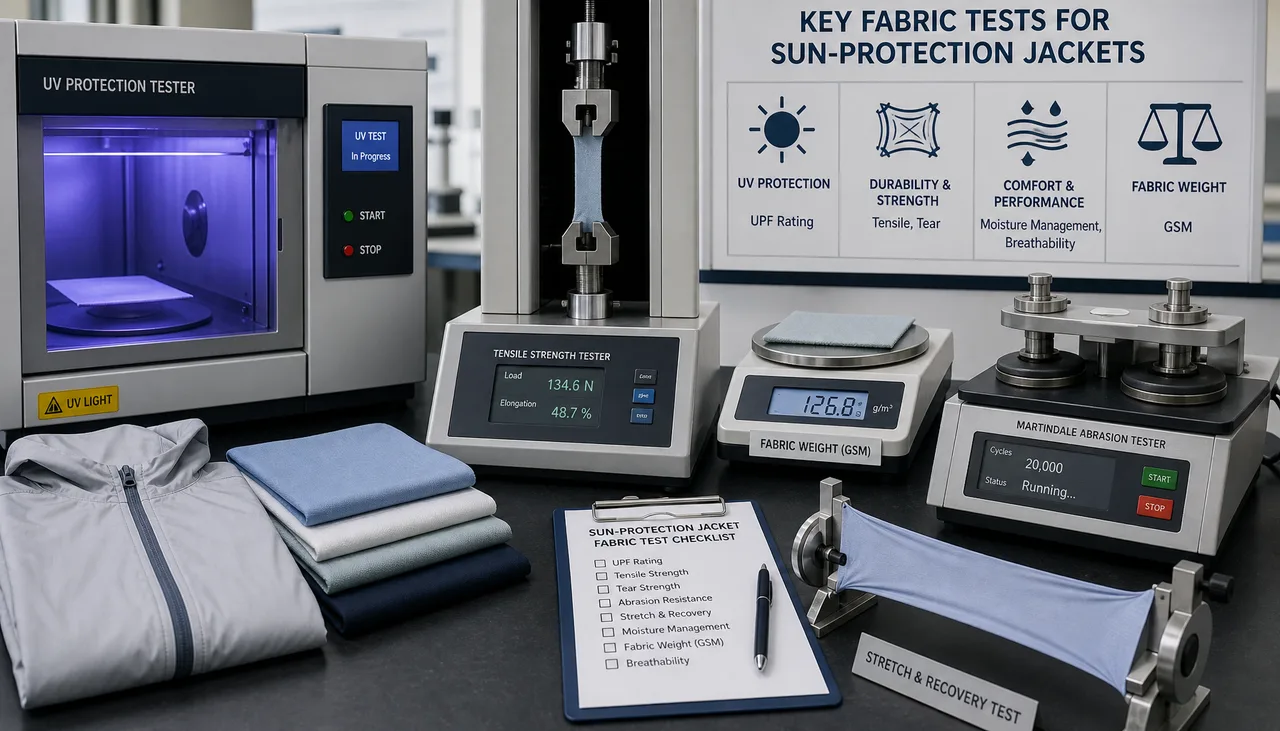
Define the product claim before selecting tests
Start with the claim that will appear on the product page, label, or packaging. “Sun-protection jacket,” a stated UPF value, water repellency, quick drying, and cooling are separate claims and require separate evidence. The applicable test method and labeling rules may differ by sales market, so the brand should confirm them with its testing laboratory or compliance team before sampling.
The supplier brief should state:
- target market and intended UV-protection claim;
- jacket coverage, fit, and panel construction;
- fabric face and stretch direction;
- color range, including pale and high-risk shades;
- expected wet exposure and climate;
- care label and claimed service condition;
- optional functions such as water repellency or moisture management.
Do not add tests for functions the product will not claim or use. Each test should answer a defined approval question.
Verify UPF under the intended conditions
UPF testing evaluates how much erythemally weighted ultraviolet radiation passes through a fabric. Conceptually, a UPF of 50 corresponds to approximately one-fiftieth, or 2%, of the relevant weighted UV passing through under the test condition. The official rating must come from the specified laboratory method; it should not be calculated from a simple consumer light-transmission reading.
Request the full report and confirm:
- test method, revision, and laboratory;
- specimen identity, color, knit construction, and finish;
- number and locations of specimens;
- relaxed or extended state and extension percentage;
- dry or wet condition;
- unwashed or post-care condition;
- individual spectral or UPF results, rating procedure, and reported classification.
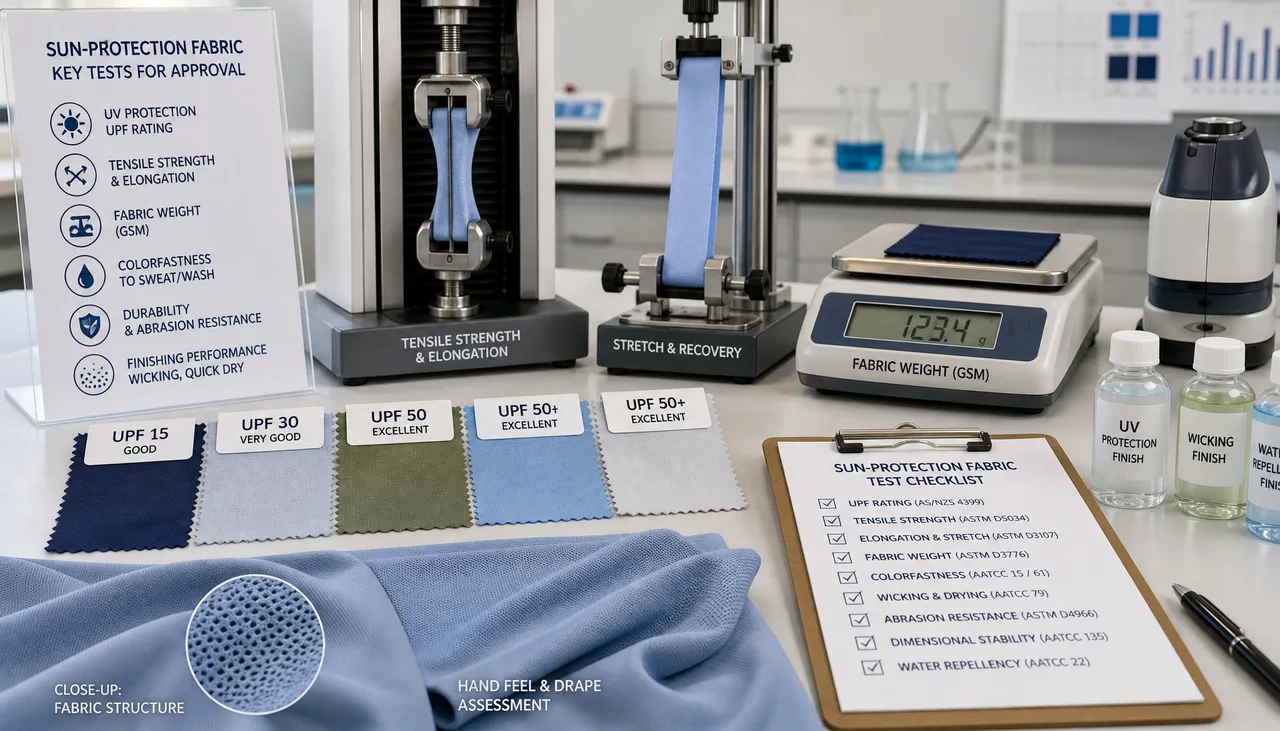
Test the conditions that can reduce UV coverage
Knitted fabrics can open between loops when stretched. Wetting, laundering, abrasion, finishing, and color can also change UV transmission. The buyer should identify the realistic risk conditions instead of testing every possible combination without purpose.
| Risk condition | Why it matters | Approval evidence |
|---|---|---|
| Working extension | Loop openings and thickness can change at elbows, shoulders, and fitted panels | UPF or UV-transmission result at the defined extension |
| Wet state | Water can alter optical behavior and garment cling | Wet-condition test when the jacket may be worn wet or heavily sweated |
| Laundering | Shrinkage, relaxation, or finish loss can change the result | Post-care result using the intended wash procedure and cycle count |
| Color range | Dye and shade depth can affect UV transmission | Results for representative high-risk colors rather than one dark shade only |
| Abrasion or wear | Surface damage may change cover or remove a topical finish | Durability conditioning followed by the relevant UV test where the claim requires it |
Testing one dark, relaxed, unwashed specimen does not automatically support every color, size, or garment zone.
Separate construction control from UV performance
GSM, thickness, knit density, fiber composition, and finish influence the fabric, but none guarantees a UPF rating. Record these properties so bulk lots can be compared with the approved construction, then retain UPF as a separate acceptance requirement.
For a knitted synthetic stretch fabric, the construction-control plan may include:
- finished GSM and tolerance;
- usable width and width tolerance;
- thickness where it is relevant to the specification;
- stretch and recovery in both principal directions;
- dimensional stability and spirality after the care procedure;
- fabric-appropriate bursting or tensile strength;
- pilling, snagging, and abrasion resistance.
The chosen strength method should match the fabric structure. A test suitable for woven fabric should not be transferred automatically to a stretch knit.
Evaluate thermal and moisture comfort separately
A fabric can achieve the required UPF and still feel unsuitable in hot conditions. Evaluate comfort-related properties against the jacket design:
- air permeability for ventilation through the material;
- liquid spreading or drying behavior where sweat management is required;
- moisture-vapor transfer when relevant to the garment system;
- hand feel, drape, cling, and noise through garment trials;
- garment weight based on pattern area and finished GSM.
These measurements are not substitutes for one another. Air permeability does not prove quick drying, and a moisture-management finish does not prove a cooling effect.
Confirm color and appearance durability
Outdoor jackets may be exposed to light, perspiration, laundering, water, and rubbing. Select colorfastness tests that reflect the intended use and care label. Review shade change, staining, crocking, and visible surface changes alongside the numerical grade.
If the fabric includes a print, coating, or topical treatment, test the production-representative version. A base fabric report cannot support a finished print or coating without verification.
Use a staged approval plan
- Screen candidate fabrics. Compare composition, construction, GSM, width, hand, stretch, and initial UPF evidence.
- Test the development sample. Use the intended color, finish, extension, wet condition, and care procedure.
- Make a jacket sample. Check fit, panel orientation, ventilation, seams, closures, coverage, and comfort during movement.
- Confirm claim durability. Repeat the required performance tests after the agreed conditioning or care cycles.
- Approve the specification. Record methods, tolerances, sample identities, colors, and failure actions.
- Control bulk production. Test production lots using the agreed risk-based plan and retain roll and dye-lot traceability.
Interpret changes with the claim requirement
Illustrative example — not ClothFactory test data: suppose a development fabric is reported as UPF 50 before laundering and UPF 35 after the agreed care cycle. The post-care result is 30% lower numerically:
(50 − 35) ÷ 50 × 100 = 30%
That calculation does not decide whether the fabric passes. The decision depends on the approved method, rating rules, product claim, and required condition at the end of the stated care sequence. Buyers should use the laboratory's reported classification rather than treating percentage change as the official UPF rating.
Avoid common approval mistakes
- Approving from GSM alone. Higher mass does not guarantee a UPF result.
- Testing only a relaxed swatch. Fitted panels may transmit more UV under extension.
- Using one color for all shades. Pale or bright colors may behave differently from the tested dark shade.
- Ignoring wet and post-wash conditions. The claim may need to remain valid after realistic use and care.
- Treating UPF as a comfort test. UV protection does not establish airflow, drying, or cooling.
- Transferring a base-fabric report to a finished product. Printing, coating, dyeing, and finishing can change performance.
- Accepting a summary certificate without sample identity. The report must trace to the approved construction, color, and finish.
Information to send with the test request
Provide the laboratory and supplier with the intended claim, target market, fabric code, composition, construction, GSM, usable width, colors, finish, garment fit, working extension, wet-use condition, and care procedure. State which results apply to development approval and which must be repeated for bulk production.
ClothFactory can use that brief to compare nylon-spandex or polyester-spandex candidates and prepare matched development samples. Final approval should remain tied to the applicable test methods, production-representative fabric, garment verification, and target-market compliance review.